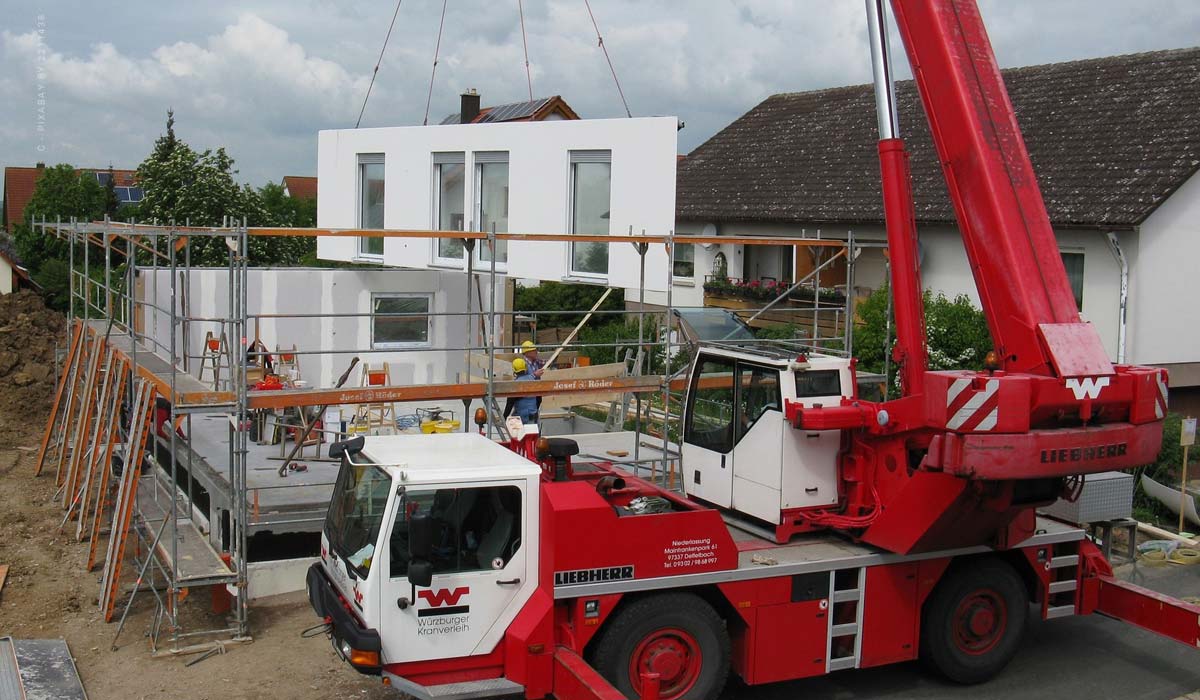
The single-family home – is by far the most popular house type in Germany. Alongside other house types such as the Bungalow,Villa or Massivhaus the single-family home is one of the most popular types. The single-family home has been for a long time not traditional and just an ordinary row house. It includes a wide range of house types and is an ideal investment. Real Estate is the best capital investment and why not invest in a future with your family? Are you interested in buying or building a single-family home? Perhaps even including a studio apartment? Here you will find everything about the advantages and disadvantages, prices, various sizes and get exclusive tips and ideas for your first home. Here you can go back to our overview of house types.
Single-family home: What is meant by it? Definition & Characteristics
What is a single-family home? When thinking of this term, one first imagines a row house or a semi-detached house, which is correct, but does not sufficiently explain the term. A single-family home simply means that it is designed for one family, while the size, shape, or location can be freely chosen. Choose a luxurious townhouse or a more modest bungalow. Build or buy and bring everything up to the latest and most modern standards. In this article, you will learn everything you need to know about this type of building.
Features: a house for the whole family with more living space
In most cases, a single-family home will be the first house for a small family. It doesn’t matter whether the property is large or smaller. Often, people move from an apartment into their first own house, where they have the opportunity to live freely. Accordingly, you should carefully plan the house and think about what is important to you in a house. A wide range of single-family homes is available to you, and now you should set out to find the perfect home.
Advantages & disadvantages of a single-family home: garden, living space & co.
Before every major investment, one should think carefully and decide for oneself whether one can afford it. This also applies to building or buying a house. In order to support you ideally in your decision, we have summarized the most important advantages and disadvantages of a single-family home for you. Think it through and find your dream home.
Advantages: Freedom and individual design
A single-family house is one of the most common and versatile types of houses available. In many cases, it is purchased by young families who are living in their own four walls for the first time. The resulting freedom is probably the biggest advantage of living in a single-family house. You have the space to live individually and to be creative. Especially when you build your dream house, you can design everything according to your wishes and ideas.
Decide how your house should look, how big it should be, and what the ideal room layout should be. Another advantage is the garden. Usually, people move from an apartment into a house and now have their own green area. Particularly with children, this is a major plus point.
Disadvantages: large investment and a lot of responsibility
Building a house or buying a home is always associated with a major investment. As soon as you plan to live in your own four walls, you should clarify in advance whether you can financially handle this. Although the construction or purchase will cost the most money, you should not neglect the additional costs that arise during the time of living. You will have to pay more heating costs and even if repairs are needed, you are solely responsible for carrying them out and financing them. Therefore, think carefully before making such a big decision.
When building: Choosing and purchasing the right plot of land
You have decided to build your own house and are now looking for the perfect plot? We want to support you in this decision and have compiled a checklist with the most important aspects. Think about where you want your property to be built and pay attention to the type of your plot. To find the perfect spot for your future house, you will find the most important aspects here.
If you would like to learn more about choosing the right plot, you will find many more useful information and tips here!
Location choice: City or rather rural?
First and foremost, focus on choosing your location. Would you rather live centrally or outside the city? In town or in the countryside? Once you have decided on this question, you need to find the right spot.
Check the infrastructure of your potential plot. How far is the nearest school and your workplace? And how is the public transportation connected? These are all important aspects that you need to clarify for yourself. If you have a car available, you will be less reliant on trains or buses. Lastly, you should decide whether you want to live in an established residential area or a new development. Both have their advantages and disadvantages.
Central or Outside
Infrastructure (Work, School)
Public transportation
Residential area or new development
Checklist for choosing the right plot
Alongside location selection, choosing the right plot is almost just as important. The condition of the land must be right, which is why we recommend that you familiarize yourself with its history and quality before purchasing.
First, look at the zoning plan to determine whether the plot is already developed. Afterwards, you should check the land register to rule out any right of way and to secure the mortgage between you and your financial institution. We also recommend having a soil investigation carried out, as this is particularly important when building a basement. Lastly, you should be able to rule out any old liabilities such as chemicals, oil, or metal scrap.
Zoning plan
Land register
Soil investigation
Old liabilities
Building a single-family home: Financing, loans & more
Once you have found the right plot, nothing can stand in the way of the start of construction of your dream property. However, you should pay attention to some aspects when building each house type. In addition to the financial costs associated with such an investment, you should also keep your eyes open on the construction site to prevent any mistakes. We have created a checklist with the most important points for you, so that nothing can go wrong.
Additional costs, loans & Co.
To build a house, you must always take out a construction loan, as you cannot pay for the entire investment from your own equity. Have your trusted financial institution advise you in advance and consider whether you will be able to repay the mortgage in the long term. Furthermore, there are certain requirements to obtain a loan, which you will learn about at your bank. In addition to this investment, you should not neglect the additional costs that arise during construction. A real estate agent, notary fees or land transfer tax are usually paid from your own equity, and you must factor in these additional costs.
Tip! If you would like to learn more about new construction projects, you will find a suitable article here with information about the process and costs for developers & construction projects
Construction partners, construction experts & Co.
Also the construction partner and building expert are two important people you should personally choose. Do you want to design everything yourself, consult an architect or rather rely on a prefabricated house? How much energy and time investment do you want to put into the construction? You should also decide this in advance. Once the construction starts, you must make sure that everything runs without errors. For this reason, we recommend you involve a building expert who can take over the site supervision and relieve you of the burden.
Decisions such as garage, carport or a basement should also be made in advance. Do you need the additional storage space of a basement and a parking space for your car? Think ahead here as well and keep an eye on the resulting costs.
House building vs. house purchase: advantages and disadvantages compared
When it comes to house construction and house purchase, a major investment is involved. Before making such a decision, you should thoroughly examine the associated costs and consider whether they fit into your budget. Here, we will present the respective advantages and disadvantages of these investments so you can make an important choice.
House Construction: Design Freedom Only for Higher Costs
Among the advantages of building a house is the design freedom in terms of house and room design. You have the opportunity to furnish everything according to your ideas and can incorporate the latest technology from the beginning. Additionally, you have free choice when searching for a plot of land and can decide where the best environment and location for you is.
Design freedom
Plot selection
When considering the disadvantages, you should always include the higher costs. Since you want to combine all your wishes, your budget can quickly become overwhelmed, and the financial investment may be higher than expected. You should also consider the time required for building a house. Something unexpected can always come up and lead to unforeseen costs.
Higher costs
More time required
Unforeseen costs
Home purchase: faster and cheaper with less individuality
A home purchase is usually more cost-effective, and in particular, the absence of unexpected costs that can arise during construction is a major advantage. You will have much less work and won’t need to spend time and energy on planning.
Cheaper and faster
Little personal time required
However, one should be aware that it often happens that houses require renovation and you may have to invest additional money. Moreover, you do not have the possibility to carry out individual room design and cannot always choose the ideal location for your property. You will be forced to make compromises and possibly lower your requirements slightly.
Possibly in need of renovation
No individual house/room design
Possibly worse location
Buying a house: Process, steps & tips
More on the topic of buying a house and all alternatives: