Student dorm or nursing home: Investment Alternative – Interview
Real Estate as an Investment – You Must Read This Interview! Exotic Investing: Mr. X (a good friend of mine) provides some insights into nursing homes, student housing, and tips on Leverage Effect, Equity & Co. Whether it’s a single-family home, apartment, warehouse, student housing, or nursing home: The offers for Investment in the real estate market are diverse. Those who want to invest money in real estate should find the right property for their investment goals. Classic or exotic: Which real estate is suitable as an investment? Learn about student housing and nursing homes as investment alternatives to the typical real estate property!
Investing Classically or Exotically?
There are a few facts that real estate investors cannot ignore when looking at
- Germany is getting older
- More and more Germans are living alone
- Small units (apartments) bring more than large ones
Care homes, nursing homes, student housing or even entire student dormitories. Let’s take a look at this more exotic form of investment!
Tip: After each answer, I’ll summarize the most important points in quick 5 facts!
PS: Do you want to speak with Mr. X and build yourself? I’d be happy to forward you: Contact us.
5 Learnings in this Interview
Let’s start with this: What can you learn in this interview:
- Diverse offers in the real estate market for investment
- Nursing homes as managed real estate with special risks
- Success factors for developers: good networking and knowledge of real estate prices
- Student dormitories as an exotic form of investment
- Differences between existing properties and new construction properties, leverage effect of equity
Let’s start with our first question to Mr. X:

Pflegeapartments as an investment with a future?
Question: The topic of nursing care is increasingly affecting people. It’s about the lack of personnel, but also about nursing homes that are supposed to be built. On the market, there are increasingly offers that present the construction of such houses as individual participation or even as real estate funds for several nursing homes. How will this development proceed and how do you assess this type of investment?
Anyone who knows well about nursing homes and the entire topic of nursing care can seriously consider such investments. But for this, it really takes a lot of specialized knowledge, because nursing homes have a particular risk: with these so-called management real estate it depends on the qualification of the operator. If he does not manage carefully, there will be no returns – neither for the home nor for the investor. In the worst case, insolvency threatens and the money is gone.
And this has nothing to do with the fact that nursing homes are usually very well occupied. That is, in fact, how builders of nursing homes advertise. It’s more about the high costs of proper nursing care. And these are only partially paid by state institutions. The rest has to be covered by the resident or their relatives. If that is not possible, many things are cut back in the home. This negatively affects the reputation of the house, which in turn brings in fewer residents. This increases the deficit due to the loss of rent additionally.
Sure: There are also funds that consist exclusively of nursing home shares. In this case, the risk, as with most fund structures, is already somewhat lower. However, the return is also significantly lower. Anyone who really wants to invest in real estate should not buy management real estate.
5 Facts about Nursing Apartments
Take note of the following:
- Senior living facilities as an investment require a lot of expertise and involve risks.
- The qualifications of the operator are of great importance.
- High care costs and partly state funding can pose risks.
- Funds with shares in senior living facilities offer less risk, but lower return.
- Recommendation: Exercise caution when investing in senior living facilities, consider other properties.

Building senior living facilities: Tips and developers
Question: What general requirements does a developer need to be successful? And what is particularly important when planning and building senior care properties?
Planning and building senior care properties
First of all, I’d like to briefly explain what a developer actually is. From the buyer’s perspective, the developer is kind of the “all-inclusive worry-free package” for everyone who wants to buy a property. After all, the developer takes care of everything related to land purchase, planning, and building the property. Even the later purchase agreement usually goes through a notary, organized by the developer. The buyer receives the key to their completed property, moves in their furniture, and can enjoy their new home.


Find the right developer / construction company
So that all of this works as smoothly as I just said, the developer needs many good connections to authorities, construction companies, etc. Moreover, he must have a “good nose” for where free plots of land or existing houses are for sale. This means, lastly, that a good developer must be excellently networked regionally.
Anyone who wants to buy a property from a developer can therefore well and easily rely on smaller, local or regional companies.
And there is still something else a developer must know and be able to do: He needs excellent knowledge of land and property prices. This helps him when purchasing the areas and buildings and forms the basis for negotiations with construction companies. After all, the developer wants and must also make money with his projects himself. Only then can a developer borrow money from banks under good conditions. Money with which he mostly pre-finances the purchase and construction of his projects. You already suspect that a developer usually deals with enormous sums of money.
Building a nursing home: demographics and location
What is especially important when planning and building nursing homes, in my experience, is looking at the demand for such a house in the area where it is being built! That sounds quite banal, but not everywhere where homes are built are they actually needed. Anyone investing in such a house will not enjoy their investment. Therefore, the planner of a home, just like the investor, should closely coordinate with the local community to determine whether there is an exact demand plan for nursing homes and what the outcome is.
Everything else related to planning and construction is covered in the state building code and many other standards. A builder of nursing homes must naturally take these into account, otherwise they will not get residents.
5 Facts about Building a Nursing Home
So take into account:
- Successful builders need good connections and regional networking.
- Knowledge of land and real estate prices is crucial.
- Builders often finance projects in advance with bank loans.
- Planning and building nursing homes require an accurate demand analysis in the region.
- Compliance with state building codes and standards is mandatory for nursing home construction.
Example visualization (new construction):

Detour: The Student Dorm as an Investment
Question: So far, it has been rather exotic to invest in specialized real estate such as elderly and nursing homes. In contrast, student dormitories are already more in the focus of investors. What opportunities are there with this form of investment?
Student Apartments: Small Unit, Higher Price per Square Meter
Clearly: again, the devil is in the details. I’ll stick to the general principle for now: when building student housing, there are “thick” and “slim” solutions. This does not refer to the size of the rooms or apartments, but to the share of common property in the house. A house that includes common areas, a fitness center, a barbecue terrace, or similar – the thick solution –
brings higher rental income (because you are not bound by the rent cap), but in return, the maintenance costs to be paid by the owner are also significantly higher.
If the house is not fully rented out, these costs will gladly eat up the rental income.
Tip: Read my guide here as well to:
As always: location, location, location!
As with all Real Estate, the location is particularly important when it comes to the student house. The mere presence of a university does not necessarily mean that the Apartment must be constantly rented out. If the study offerings are not attractive enough, or if there are many affordable “normal” Apartments in the surrounding area, there will be nothing to gain from the Investment.
I therefore rather recommend investments in properties that are not restricted to a single target group of tenants. So that, in the Apartment, students as well as normal tenants can live. If, in addition, the entire living environment is considered particularly attractive – for example due to proximity to shopping opportunities, recreational areas, etc. – the issue of “rent default” plays almost no role.
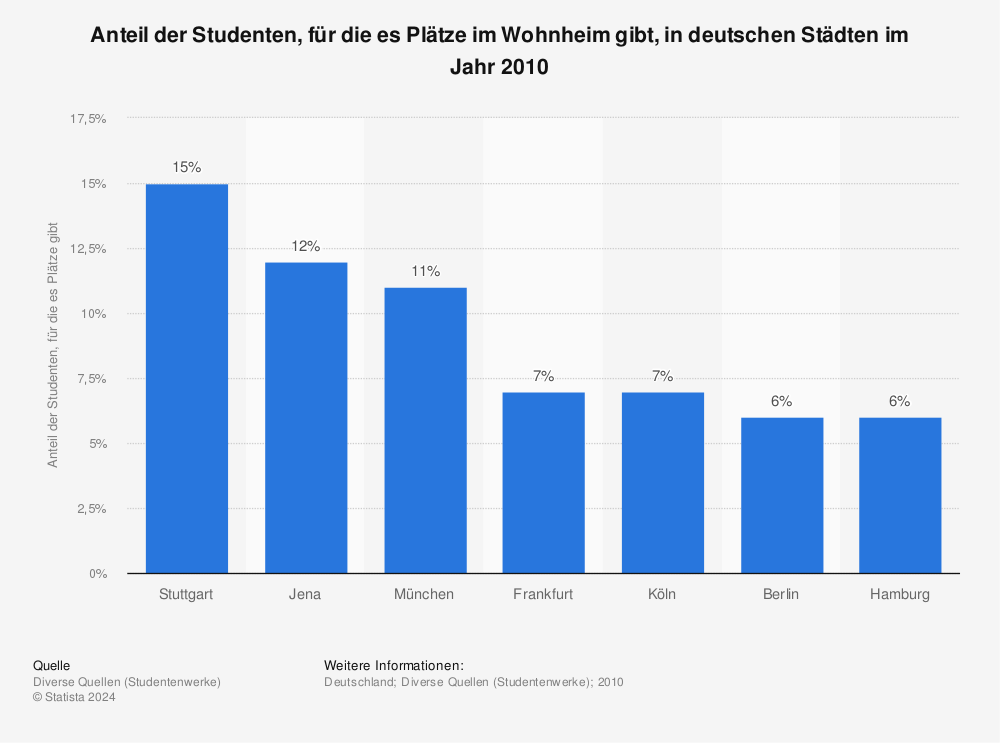
More statistics can be found at Statista.
5 Facts about Investment in Student Dormitories
So take a look at:
- Student dormitories are increasingly popular with investors.
- Differences between “thick” and “slim” solutions in housing construction.
- The location is crucial for the success of the investment.
- Diversified tenant base minimizes the risk of rental defaults.
- Cities like Stuttgart, Jena, and Munich offer high return opportunities in this area.

Condominium as an Investment
Question: Lastly for those who are less risk-tolerant. The classic approach is investing through purchasing a condominium. What should be considered and how best to finance such an investment?
Funding an Apartment: Tips
We are always talking about apartments that the investor does not live in themselves, but rents out. Because then, in addition to the proceeds from a later sale, I have regular rental income as a return.
In order for this income to flow as smoothly and uninterrupted as possible, the apartment must be located in an attractive environment. This starts with the house itself. Is there a garden? Is there an elevator? How is the availability of parking spaces? Natural light, outdoor seating, and much more play a decisive role in the good rentability. That the building condition of the house should be in excellent condition needs no mention. In the apartment itself, the tenant is responsible for the maintenance of the property, but in the common areas, it is always the owners. Especially when buying an apartment in older houses, the condition of the basement, roof, hallway, windows, etc., shows whether the owners are investing or not.
With regard to financing, everyone naturally asks their bank and the tax advisor. When it comes to an investment, it can be about using existing capital for the purchase, or borrowing money to buy. With the currently low interest rates, everyone can also create their investment with little existing equity. But be careful: many offers on the market are considered overpriced because the seller has factored in the low interest rate into the selling price.
Don’t worry! Even medium-sized apartments can be rented out well.
Buy condominiums in metropolitan areas?
The demand for housing is rising. Especially in the big cities Frankfurt, Berlin, Munich etc. What does this development mean for the market? Should one rather buy a small or better a large apartment? Is a condominium even suitable as an investment?
To the second question, I explicitly say “yes”! Not everyone wants or can live in a single-family house. That is why condominiums are in high demand today and also in the distant future. Whoever then pays attention to the right conditions regarding location and equipment is doing everything right!
Whether to choose a large or small apartment also depends on the consideration of whether you will eventually live in your own apartment. Small and very large units are currently in demand on the housing market. Those who want to live in their investment property later and do not want “ballrooms” should rather go for the medium size, say 70 sqm. And don’t worry! You can also rent those out well.
Existing property or new construction?
Question: The construction of multi-family homes with owner-occupied or rental apartments is politically desired. What are the differences in demand for existing properties and new construction projects in this sector?
Actually no difference! There are enough builders and investors interested in multi-family homes and housing developments. I can speak for myself here as well. Our company buys both existing properties and land for the construction of residential developments. The supply is limited for both forms, especially when you are interested in attractive locations. That is why we are constantly looking for multi-family homes or plots of land that we can further develop and resell.
5 Facts About Buying an Apartment
So take the following into consideration:
- When buying an apartment as an investment, location and furnishings are crucial.
- Funding can be done with equity or debt capital, be careful of inflated prices.
- Owner-occupied apartments are still a good investment in metropolitan areas.
- The size of the apartment depends on individual preferences and plans.
- There is no significant difference in demand between existing real estate and new construction properties in this sector.
Existing real estate:

New construction (Visualization)

Leverage effect of equity: From 1 to x apartments
From the small apartment to a real estate empire – with the leverage effect it’s possible!
Renting apartments on a large scale
Question: Whoever wants to make money with Real Estate can trade houses, build new ones or simply rent out apartments on a large scale. What are the biggest differences here compared to managing a simple condominium or a single-family house?
This question is already quite extensive to answer here. Wanting to make big money as a Real Estate dealer usually means: acquiring a lot of knowledge about the Real Estate market and investing even more work. Because most of the necessary tasks happen at the same time. Example new construction: whoever starts building a property must immediately start the next project to secure cash flow, manage credit lines, etc. He must, alongside many conversations with authorities and banks, simultaneously find and manage buyers or tenants for his properties. The management of the finished properties usually comes along with it if you remain the owner of the property.
On the other hand, the management and maintenance of your own apartment or small house is absolutely manageable. Owner meetings, additional costs calculations, checking investments for multi-family homes and occasionally a tenant conversation: that’s it.
Leverage effect explained: Equity x 10
And yet, the small rented condominium can be the entry point into a larger real estate empire. That’s where the so-called leverage effect comes in (also known from the stock exchange “leverage effect”). In short, it is the effect I achieve when I take out a loan on the apartment I originally bought from the bank after a few years, in order to buy a new apartment. The value increase of the original apartment helps me to increase my equity calculation and thus take out a higher loan for a larger and more expensive apartment. This game can be repeated as often as you like, if done correctly.
Digitalization of the Housing World
Experts advise that the digital living world of tomorrow must already be planned today. What changes has digitalization brought to the real estate industry? How does this affect investors?
I’ll start with a very simple example: Anyone who today wants to sell or also buy real estate no longer looks in the newspaper. Real estate portals with great photos or videos would not be conceivable without digitalization. This means, however, that both sides also need competencies in digitalization in order to separate the wheat from the chaff among the offers as a buyer. The seller should know which portal is suitable for their target group of buyers.
In the management of real estate, so-called facility management, digitalization is still in its infancy. Creating consumption values to generate accurate additional costs settlements is a very simple example there. It becomes interesting when, for example, it comes to regulating access to real estate electronically. As people’s need for security increases, a lot can be regulated from a distance through digitalization here. An electronic concierge, so to speak. Or in property maintenance: how can robots be used there to save labor costs.
Anyone who today plans apartments and houses must clearly have the topic “smart home” on their radar! If it is to be the case that in the future living, working, and consuming will increasingly take place in one’s own apartment, then the infrastructure for the digitalization of the apartment must be planned in advance. And I’m not just talking about the laying of cables or the invisible installation of entertainment electronics. Rather, apartment floor plans must be flexibly adjustable, the use of rooms must be changeable, and the use of electronics must ultimately be possible everywhere. There are also interesting perspectives for planners and investors alike.
And this means for the investor in the real estate world: check whether the investment is future-proof in terms of these developments. Anyone who wants to have financially capable buyers and long-term tenants in the future must invest in the digitalization of their real estate. Especially since we cannot yet imagine the possibilities of this development in their entirety today.
Thank you a thousand times for the interview!
Conclusion: 5 Learnings from this Interview
Let’s start with that: What do you learn from this interview:
- Diverse offers in the real estate market for investment
- Nursing homes as management real estate with special risks
- Success factors for developers: good networking and knowledge of real estate prices
- Student dormitories as an exotic form of investment
- Differences between existing real estate and new construction properties, leverage effect of equity

Investing 1 Million Euros: Real Estate, ETFs & the Best Strategy

Sell villa in Meerbusch: Sought-after villa location near Düsseldorf
Student Housing: Buy, rent, make money in university & college locations

Buying profile: Cologne, Düsseldorf (NRW), Berlin & Munich - Apartment & Apartment building

Heritage Self-Help Groups: Inherited Money, What to Do? Step-by-Step Guide

Lukinski Rating Germany: Investment Property - City List










AI and GDPR in Germany: Why Data Protection Matters for Real Estate and Tax Questions

Investment Real Estate: What You Need to Pay Attention to When Buying Your First Property

Real Estate Software to Create Yourself: ChatGPT Example Link Structure Investment
Selling an apartment building in Berlin: steps, estate agents, taxes - what to look out for?