Berlin | Pankow | Apartment building | 1,410,000 € with approx. 3.48% yield
An apartment building in Berlin-Pankow for 1,410,000 € with a gross yield of 3.48% — at first glance a classic mid-tier Berlin income property. But anyone investing in Pankow should know the district: with over 400,000 residents, Pankow is Berlin’s most populous district and stretches from Prenzlauer Berg to Buch. Before you calculate the purchase price factor and calculate the net yield, it’s worth taking a close look at the micro-location, tenant structure and realistic operating costs — because whether this object holds up as real estate as a capital investment is decided not in the brochure, but in due diligence.
Pankow at a glance: district, localities and micro-locations
The district of Pankow is as heterogeneous as almost no other in Berlin. Investors often make the mistake of equating “Pankow” with the eponymous locality around Breite Straße — in fact the district comprises thirteen localities with substantially different price levels and buyer profiles.
The most important localities for investors
- Alt-Pankow: late-19th-century housing stock along Florastraße and Wollankstraße, S-Bahn ring, mixed tenant structure, upgrading potential
- Prenzlauer Berg: part of Pankow district, but priced 25–35% above Alt-Pankow, renovated period buildings, academic clientele
- Weißensee: quiet, lakeside, many 1950s buildings, stable family target group
- Französisch Buchholz & Niederschönhausen: single-family-home character, lower rental yields, owner-occupier market
- Buch: characterised by prefabricated housing, lowest entry prices in the district, higher gross yields but higher vacancy risk
Buyer profile and tenant structure
Alt-Pankow is dominated by young families and working professionals aged 30–45 who were priced out of Prenzlauer Berg and value the combination of period charm, proximity to Mauerpark and deep connection to the ring railway. Fluctuation is moderate, and in renovated buildings rental default typically runs below 1.5% of annual cold rent.
Transport and infrastructure as value drivers
The S-Bahn ring connection via Schönhauser Allee and Wollankstraße, as well as tram lines M1 and M2, cut the journey into the centre to 15–20 minutes. In Buch, the S-Bahn station on line S2 provides a connection, but travel time to Friedrichstraße is significantly longer there — a direct price driver for micro-locations along the ring.

Price ranges Pankow: where does this object stand in the market?
For an honest classification of the purchase price of 1,410,000 €, a comparison with the respective micro-location is needed. The following table shows the typical ranges within the district of Pankow.
| Locality | Purchase price €/m² (apartment building) | Cold rent €/m² | Factor (gross) |
|---|---|---|---|
| Prenzlauer Berg | 5,500–7,500 | 13–17 | 30–35 |
| Alt-Pankow | 4,200–5,800 | 10–13 | 27–32 |
| Weißensee | 3,800–5,200 | 9–12 | 26–30 |
| Französisch Buchholz | 3,500–4,800 | 9–11 | 25–28 |
| Buch | 2,200–3,200 | 7–9 | 22–26 |
Classification of the factor of 28.7
At a gross yield of 3.48%, the purchase price factor stands at around 28.7 — this is market-appropriate for a Pankow apartment building, in the mid-range. Higher factors (32+) are typically seen only in premium locations in Prenzlauer Berg or with new builds carrying ESG certification.
Rule of thumb Berlin: factor below 25 = bargain with risk, 25–30 = solid existing location, 30+ = top location with value-appreciation speculation. 28.7 in Alt-Pankow means: fairly priced, value growth must be the driver, not the cash flow.
Negotiating room on this object
- Existing rents below the rent index: justify a price discount, as rent increases are capped
- Renovation backlog: every identifiable defect = negotiating leverage of 3–7% of the purchase price
- Heating system over 20 years old: GEG obligation to replace — budget 30,000–60,000 €
- Energy class F or worse: demand a renovation plan, price room of 5–10%
Yield analysis: from 3.48% gross to the actual net yield
The advertised gross yield is a simple fraction (annual cold rent ÷ purchase price). It ignores all costs that actually burden the owner’s cash flow. At a purchase price of 1,410,000 € and 3.48% gross, the annual cold rent stands at around 49,068 €.
Realistic cost items
- Management: 25–30 €/residential unit/month — for 6 units around 2,000 € annually
- Maintenance: 8–12 €/m²/year according to the Peters formula, in Berlin period buildings rather at the upper end
- Rental default risk: 2% of the target rent — applied as a flat rate
- Non-recoverable additional costs: approx. 0.3–0.5 €/m²/month
- Reserve formation: separate maintenance reserve for roof, façade, heating
Sample cash flow calculation
| Item | Amount p.a. |
|---|---|
| Annual cold rent (gross) | 49,068 € |
| − Management | −2,000 € |
| − Maintenance (10 €/m², 350 m²) | −3,500 € |
| − Rental default risk 2% | −981 € |
| − Non-recoverable additional costs | −1,500 € |
| Net rental income | ≈ 41,087 € |
| Net yield before financing | ≈ 2.91% |
As described in the guide income property, the actual yield typically falls 0.5–0.8 percentage points below the gross yield — for this object we land at around 2.9% before financing costs and taxes.
Return on equity after financing
If the object is financed with an 80% bank loan at an example interest rate of 4%, the leverage effect produces a return on equity between 4 and 6% — depending on repayment, special repayment options and the tax deductibility of debt interest. For capital investors with a high marginal tax rate, depreciation (AfA) also acts as an additional return booster.
- Leverage effect: debt capital boosts returns as long as the rental yield exceeds the interest rate
- Repayment effect: at 2% initial repayment, wealth accumulation grows additionally
- Tax savings: AfA of 2% p.a. (period buildings before 1925: 2.5%) reduces taxable profit
- Interest rate sensitivity: 1 percentage point more interest = approx. 14,000 € less cash flow p.a.
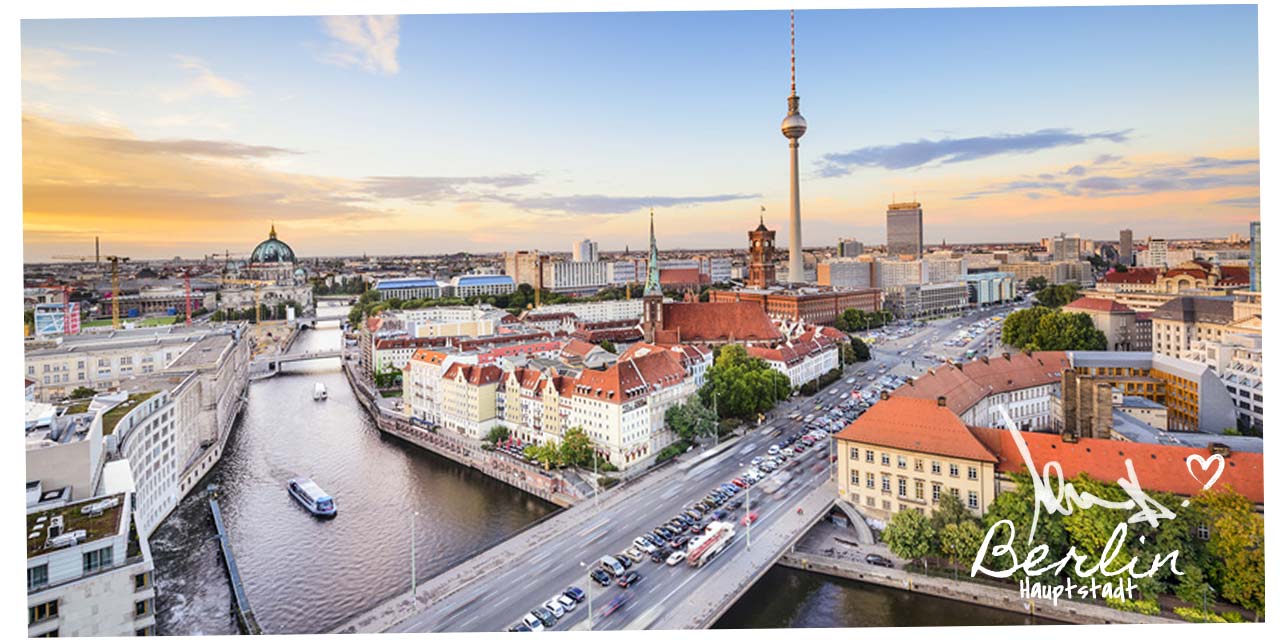


Berlin is among the federal states with the highest real estate transfer tax rate. Anyone investing 1,410,000 € must budget for significant purchase-related costs — which are often left out of yield calculations.
Additional costs in concrete terms
- Real estate transfer tax Berlin: 6.0% = 84,600 €
- Notary and land registry: approx. 1.5% = 21,150 € (see calculating notary fees)
- Broker commission: in Berlin usually split evenly, 3.57% buyer share possible
- Total: realistically 8–11% on top of the purchase price
Structuring the equity
With a typical bank financing at 80% loan-to-value, you would need around 280,000 € of capital here plus the additional costs — a total of approx. 400,000 € equity. The Berlin advantage: real estate transfer tax optimisation via share deals only becomes relevant at volumes this object doesn’t reach.
Don’t forget the liquidity reserve
- Immediate repairs: after purchase, unexpected initial costs of 5,000–15,000 € are common
- Rental default buffer: 6 months of target rent as a reserve, so around 25,000 €
- Modernisation budget: depending on strategy, 50,000–150,000 € on top
- Additional-cost back payments: factor these in when taking over ongoing tenancies

Pankow-specific risks and market particularities
Pankow is regulatorily in focus — several districts are subject to social preservation statutes (Milieuschutz). This has immediate consequences for the investment calculation.
Social preservation areas in Pankow
- Modernisation levy capped: max. 8% of costs can be passed on to annual rent, often less
- Approval requirement: lift installation, floor plan changes, luxury renovation require official approval
- District’s right of first refusal: legally restricted, but a practical delay risk
- Conversion ban WEG: division into condominiums usually requires approval
What this means for value appreciation
Classic division strategies (buy an apartment building, convert to condominiums, sell individually) are no longer feasible in many Pankow locations. The value lever shifts to rent increases within the framework of the rent index and to pure market value development — a longer investment horizon is mandatory.
Rent cap and Berlin rent index
Upon re-letting, the rent may be no more than 10% above the local comparative rent. Anyone relying on an aggressive rent-raising model will be disappointed in Berlin — the lever lies in closing gaps in existing stock (long-unchanged rents) and in modernisation with correctly apportioned costs.
Checklist: due diligence before purchase
Before making an offer, these points should definitely be ticked off. This list summarises the critical checkpoints specifically for Berlin existing properties.
Legal and economic review
- ☐ Rent index conformity of all current tenancy agreements checked
- ☐ Is the object located in a social preservation area? District office enquiry
- ☐ Energy certificate available, GEG conformity (heating replacement deadlines) assessed
- ☐ Last 3 years’ operating cost statements analysed
- ☐ Reserve status and recent building-fee development reviewed
- ☐ Roof condition, façade, riser pipes assessed by an expert
- ☐ Cash flow calculator run through with realistic values
- ☐ Exit strategy and tax holding period defined
- ☐ Financing offers obtained from at least 3 banks
- ☐ Market value cross-checked via income approach
Technical and structural checkpoints
- ☐ Land register extract checked for encumbrances, rights of way and contaminated sites
- ☐ Register of building encumbrances queried (often overlooked)
- ☐ Asbestos, PCB, mineral wool in pre-1995 buildings excluded
- ☐ Riser pipe renewal for water/sewage documented
- ☐ Insurance claims of the last 10 years enquired about
Exit strategy: selling after 10 years in Pankow
The real estate speculation tax ceases to apply to let properties after the ten-year speculation period (§23 EStG) has elapsed. Anyone counting on long-term value appreciation in Pankow should firmly plan for this horizon.
Realistic value development
Pankow apartment buildings have achieved double-digit annual returns from value appreciation over the past ten years — that phase is over. Realistically, 1.5–3% value appreciation p.a. is expected in the coming years in stable locations, and quite possibly more in upgrading districts such as Alt-Pankow. You can access the market via our overview buying an apartment building.
Sales formats compared
- Asset deal to a private investor: classic route, wide buyer pool, full real estate transfer tax incidence falls on the buyer
- Share deal: only sensible from seven-figure volumes, complex structuring via GmbH/KG
- Division & individual sale: usually not possible in social preservation areas, otherwise a high additional proceeds
- Sale to an institutional investor: lower price, but fast and uncomplicated
Tax optimisation on exit
Alongside the speculation period, private individuals also benefit from the privilege of receiving capital gains completely tax-free after 10 years. Anyone holding the object as business assets or classified as a commercial property dealer (three-object limit) loses this privilege — legal structuring before purchase is therefore part of any serious investment planning.
FAQ: investing in Pankow
Is 3.48% gross yield good or bad in Pankow?
3.48% gross corresponds to a purchase price
Berlin | Kreuzberg | Apartment building | 3,700,000 € with approx. 2.7% return
Berlin | Lichterfelde | Apartment building | 4,450,000 € with approx. 1.88% return
Berlin | Kreuzberg | Apartment building | 5,000,000 € with approx. 3.81% return
Berlin | Reinickendorf | Apartment building | 4,650,000 € with approx. 4.5% return
Berlin | Prenzlauer Berg | Apartment building | 5,000,000 € with approx. 2.9% return
Crime statistics: Location downgrade Germany +5.5% Crimes & burglaries






Sell a villa in Berlin: List, Rating, Prices, Real Estate Agent, Mistakes, Experiences
Townhouse Berlin: Modern townhouses to buy & rent
![Buy a townhouse in Berlin-Mitte: Luxury on 5 floors [also suitable for embassy / company headquarters]](https://lukinski.com/wp-content/uploads/2025/08/townhouse-berlin-mitte-stadt-kaufen-5-etagen-luxus-regierungsviertel-art-kunst-marmor-interior.jpg)
Buy a townhouse in Berlin-Mitte: Luxury on 5 floors [also suitable for embassy / company headquarters]
Plot of land by the water in Berlin: KP 90 Mio. - Luxury residential development in Germany's capital city