Berlin | Reinickendorf | Apartment building | 4,650,000 € with approx. 4.5% return
An Apartment building in Berlin-Reinickendorf for 4,650,000 € with approximately 4.5 % gross return — at first glance a solid investment, yet the truth lies in the price factor, the local rental index, and the micro-location. Anyone evaluating this district as an investor should carefully separate the numbers: gross return is not net return, and the purchase price alone says little about the actual potential for value appreciation. In this guide, we systematically break down the investment — from
Reinickendorf: Micro-location and Investor Profile
Reinickendorf is not a scene district — and that is exactly its advantage. While Mitte, Kreuzberg, and Prenzlauer Berg have long been overpriced, the northwest of Berlin offers a rare combination: stable tenant structure, low vacancy rate, and a price level that is significantly below the Berlin average. For institutional buyers and family offices, this is a textbook setup: a defensive investment with built-in location leverage through the Tegel conversion.
What makes Reinickendorf special for investors
- Price level: Purchase prices for multi-family homes typically range from 3,800–5,200 €/m² — the Berlin average for comparable properties is around 5,500–6,500 €/m².
- Rental structure: High proportion of long-term existing tenants, families, and commuters — low turnover, predictable cash flows.
- Vacancy rate: Market standard under 2 %, in residential neighborhoods around Frohnau, Hermsdorf, and Tegel-See partly under 1 %.
- Infrastructure: U6, S25, S26, A111 — connection to City West (20 min.) and Center (25 min.) is excellent.
- Tegel conversion: The former airport area is being developed into the research and industrial district “Berlin TXL” — a mid-term price driver for the entire district.
- Buyer profile: Predominantly existing property holders, family offices, and investors with an investment horizon of 10+ years — not a speculative market.
Micro-location insider: Where the music really plays
Reinickendorf is not the same everywhere. Anyone who knows the district only from statistics overlooks the fine differences between neighborhoods, which can differ in price by a factor of 1.5. The following micro-locations should be known by name to every investor:
- Frohnau (Villa colony): Berlin’s northernmost garden city based on an English model — Zeltinger Platz, Edelhofdamm. Highest price level in the district, hardly any MFH stock, but exclusive location.
- Hermsdorf: Bourgeois-quiet, Olafstraße and Bismarckstraße as top addresses. Solid MFH stock from the 1920s and 1950s.
- Konradshöhe / Tegelort: Peninsula at Tegeler See — Hidden gem with water location. Limited offer, high value stability.
- Lübars: Last rural village in Berlin with protected village core — emotionally charged location, MFH rare.
- Tegel-South / Borsigwalde: Direct profit quarter of the TXL conversion. This is the biggest lever of the next decade.
- Wittenau / Waidmannslust: Solid middle-class stock, ideal for cash flow strategies.
- Märkisches Viertel: Large housing complex with over 17,000 residential units — of interest exclusively to institutional property holders with economies of scale.
- Reinickendorf-Ost (Wedding-Grenze): Gründerzeit-Altbau, höchstes Aufwertungspotenzial, aber auch höchstes Milieuschutz-Risiko.
Typical Property Types in the District
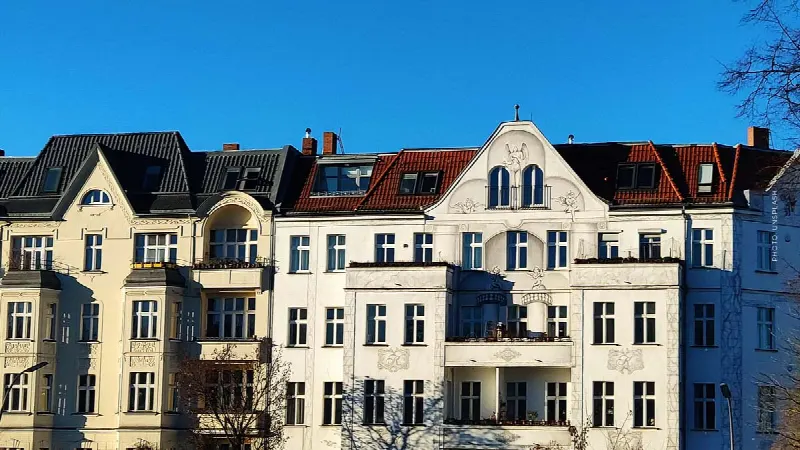
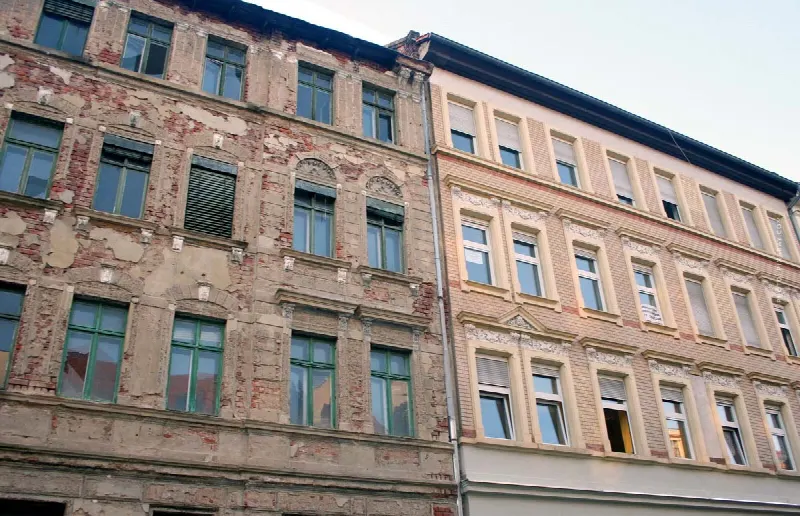
Reinickendorf is architecturally diverse. In the south (Wedding border, Borsigwalde), Imperial-era buildings and tenement blocks from the turn of the century dominate. In the north (Frohnau, Hermsdorf, Heiligensee), you’ll find classic townhouses, row houses, and smaller multi-family homes in the Reform style. Classic properties from the 1950s and 1960s form the backbone of the multi-family housing market — typically 6–18 residential units, often with modernization potential.
Buyer Profile and Investment Horizon
Those who buy in Reinickendorf rarely think in years — they think in decades. This changes the negotiation dynamics: property owners accept no ambitious price factors without a verifiable value appreciation scenario, but rather assess objectively based on cash flow and substance.
- Family Offices: Seek existing properties with 8–20 units as a generational investment.
- Property Owners (Private): Expand portfolios with a focus on tax optimization through depreciation and holding period.
- Project developers: Active mainly around Tegel-South, with division and renovation strategies.
- Cooperatives: Classic existing property buyers in the Märkisches Viertel and Wittenau.


The Investment in Detail: 4.650.000 € at 4.5 % return
A gross return of 4.5 % means specifically: The annual net cold rent is around 209,250 €. This corresponds to a purchase price factor of approximately 22.2 — a fair value for Berlin conditions, in central locations factors of 25–30 are more common.
Rule of thumb: A purchase price factor below 20 is favorable, 20–25 is market standard, above 28 becomes risky without a clear value increase scenario. In Reinickendorf, the fair range is currently 20–24.
Hypothetical Object Profile
To make the numbers tangible, here is a typical investment profile for this price class:
- Location: Reinickendorf-East, well connected to U6 / S25
- Year of construction: 1958, partial renovation in the 2000s
- Residential units: 14 residential units plus 2 commercial units on the ground floor
- Living area: approx. 1,180 m² living + 140 m² commercial
- Plot: 820 m² with 8 parking spaces in the courtyard
- Rent level: Average 13.20 €/m² net cold — thus slightly above the rent index, indicating indexed rents and new lettings
- Maintenance backlog: moderate, heating renewed in 2018, roof due in the next 10 years
Step-by-Step Return Calculation
The following breakdown shows how a seemingly attractive gross return of 4.5 % results in a significantly more sober net return — once purchase ancillary costs and management are accurately accounted for.
| Position | Amount / Value |
|---|---|
| Purchase price | 4,650,000 € |
| Annual net cold rent (4.5 % gross) | 209,250 € |
| Purchase price factor | 22.2 |
| Land transfer tax Berlin (6.0 %) | 279,000 € |
| Notary & land register (approx. 1.5 %) | 69,750 € |
| Real estate agent commission (up to 3.57 %) | up to 165,905 € |
| Total investment including purchase ancillary costs | approx. 5,165,000 € |
| Management costs (approx. 20 % of rent) | −41,850 € |
| Annual net profit | 167,400 € |
| Net yield on total investment | approx. 3.24 % |
The most common mistake made by beginners: a gross return of 4.5% is assumed to be the actual income. Realistically, after
Return on equity with and without leverage
The true difference in return between beginner and professional becomes apparent only after taxes. The following table shows three equity ratios and the respective leverage — each based on 4.0% debt interest and 2.0% linear depreciation:
| Scenario | Equity 25 % | Equity 35 % | Equity 50 % |
|---|---|---|---|
| Equity including additional costs | approx. 1.67 Mio. € | approx. 1.82 Mio. € | approx. 2.84 Mio. € |
| Debt | 3.49 Mio. € | 3.02 Mio. € | 2.33 Mio. € |
| Interest service p. a. (4.0 %) | 139,600 € | 120,800 € | 93,200 € |
| Cash flow before taxes | 27,800 € | 46,600 € | 74,200 € |
| Return on equity before taxes | 1.7 % | 2.6 % | 2.6 % |
| Tax savings (depreciation + interest) | approx. 55,000 € | approx. 48,000 € | approx. 38,000 € |
| Return on equity after taxes | 4.9 % | 5.2 % | 3.9 % |
The table makes clear: The optimal range is 30–40 % equity. Those who finance too highly with equity are giving up the tax leverage; those who finance too low are under pressure when interest rates jump.
Stress test: What happens in the worst case?
With a volume of 4.65 million €, a purely best-case scenario is negligent. Three scenarios should precede every investment decision:
| Scenario | Assumption | Effect on Cashflow | Rating |
|---|---|---|---|
| Rent default 5 % | 0.7 units on average vacant | −10,500 € p. a. | manageable |
| Rent default 10 % | structural problem | −21,000 € p. a. | critical with high debt financing |
| Interest rate increase to 5.5 % | after interest rate binding | +45,000 € interest burden p. a. | Cashflow turns negative without rent increase |
| Major damage (roof) | one-time 180,000 € | Substance from reserve | only manageable with reserve |
| Rent cap reform | Capping during indexing | −15,000 to −30,000 € p. a. | political risk |
The consequence: When making this investment, a

Rent level and potential for capital appreciation
Der Mietindex in Reinickendorf zeigt einen weiten Bereich — entscheidend ist, in welchem Bezirk sich die Immobilie befindet. Bereits zwischen Frohnau und dem Märkischen Viertel gibt es einen Unterschied von mehr als 4 € pro Quadratmeter.
Typical net cold rents per district
| District | Net cold rent €/m² | Character |
|---|---|---|
| Frohnau / Hermsdorf | 10.50–13.00 | Villa colonies, quiet, upscale |
| Tegel / Heiligensee | 9.00–11.50 | Near water, middle class |
| Wittenau / Waidmannslust | 8.50–10.50 | Existing stock, solid residential area |
| Reinickendorf-Ost / Borsigwalde | 7.80–9.80 | Old buildings, potential for appreciation |
| Markisches Viertel | 7.20–9.00 | Large housing estate, high demand |
The Tegel Effect: Schumacher Quarter in Detail
The insider point that many reviews overlook: On the former Tegel airport site, two megaprojects are being developed in parallel. The Schumacher Quarter will provide over 5,000 residential units for around 10,000 people — predominantly built using wood and with a high proportion of rent-controlled housing. In parallel, the Research and Industrial Park Berlin TXL “The Urban Tech Republic” is being developed with F

Investment Real Estate: What You Need to Pay Attention to When Buying Your First Property
Berlin | Kreuzberg | Apartment building | 3,700,000 € with approx. 2.7% return
Berlin | Friedrichshain | Apartment building | 3,100,000 € with approx. 5.00% return
Berlin | Lichterfelde | Apartment building | 4,450,000 € with approx. 1.88% return
Berlin | Mitte | Apartment building | 15,000,000 € with approx. 2.9% return
Berlin | Friedrichshain | Apartment building | 2,680,000 € with approx. 3.75% return