
Real Estate Statistics: House, Apartment, Investment & Real Estate Prices in Germany
Statistics and studies are important tools for Real Estate Investors & investors, not only for assessing square meter prices and property prices, but also the demographic development (Tip: Investment Microapartment) of districts, new construction, building permits, all of which ultimately influence your investment decisions. For property buyers, but also for property sellers, the “right” time for the transaction is important in order to achieve the highest possible profit or the highest possible return! A look at the numbers and facts in Germany. An overall overview is provided by our page on the German Real Estate Market.
: Statistics on real estate, housing and investment
How is the general economic situation of people developing? When is buying or selling worthwhile? What current studies are available? We have made it our mission to collect the most important results from the Federal Statistical Office for you.
Tip! Classic or exotic: Which property is suitable as an investment? The interview: Real estate as an investment (Part 1) + my Investment Atlas for Germany
House Price Index in Germany
!function(){“use strict”;window.addEventListener(“message”,(function(a){if(void 0!==a.data["datawrapper-height"]){var e=document.querySelectorAll(“iframe”);for(var t in a.data["datawrapper-height"])for(var r=0;r<e.length;r++)if(e[r].contentWindow===a.source){var i=a.data["datawrapper-height"][t]+"px";e[r].style.height=i}}}))}();
Current Inflation in Germany
!function(){“use strict”;window.addEventListener(“message”,(function(a){if(void 0!==a.data["datawrapper-height"]){var e=document.querySelectorAll(“iframe”);for(var t in a.data["datawrapper-height"])for(var r=0;r<e.length;r++)if(e[r].contentWindow===a.source){var i=a.data["datawrapper-height"][t]+"px";e[r].style.height=i}}}))}();
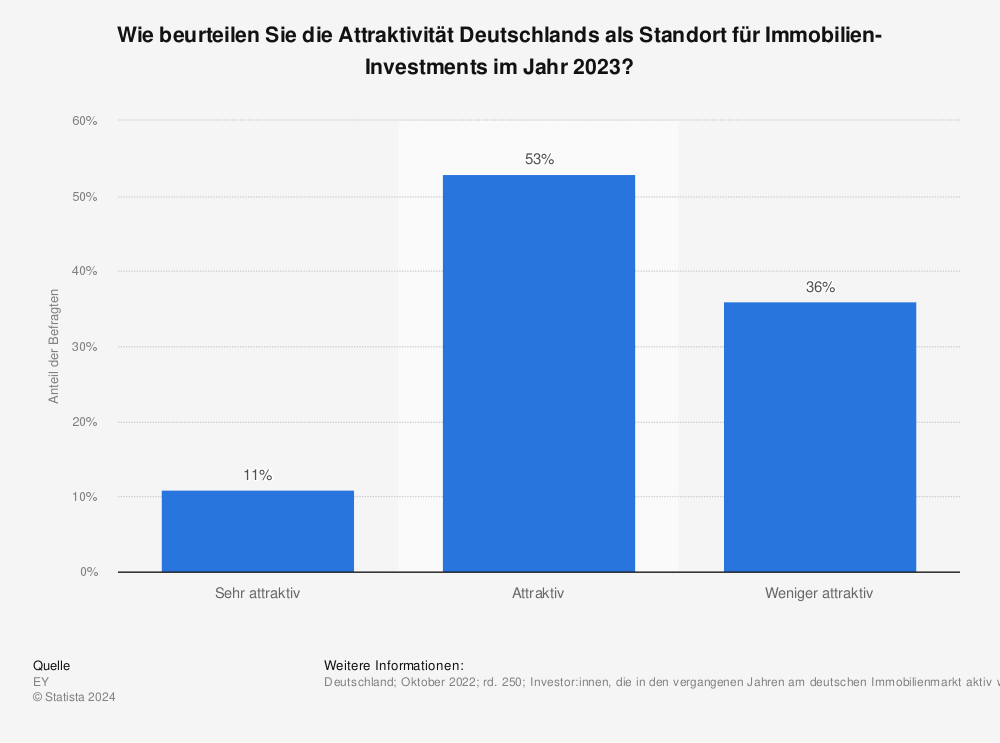
Attractiveness for Real Estate Investments
The
How do you assess Germany’s attractiveness as a location for real estate investments in the year?
More statistics can be found at Statista
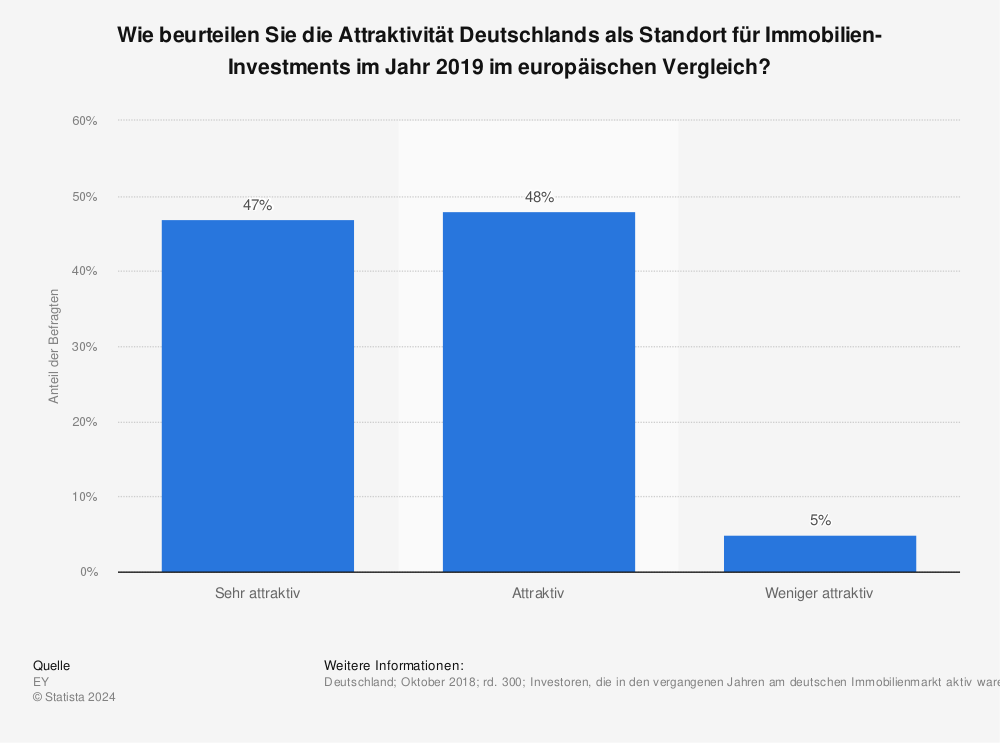
Germany’s Position in the European Comparison
How would you assess Germany’s attractiveness as a location for real estate investments in 2019 in comparison to other European countries?


2023: The Real Estate Price Drop -6.8%
The latest figures from the Federal Statistical Office:
“The average price of residential real estate fell by 6.8% in the first quarter of 2023 compared to the same quarter of the previous year. According to the Federal Statistical Office (Destatis), this was the largest decline in residential property prices compared to a previous quarter since the start of the time series in 2000.”
This applies not only to existing properties, but the sentiment is also reflected in new construction.
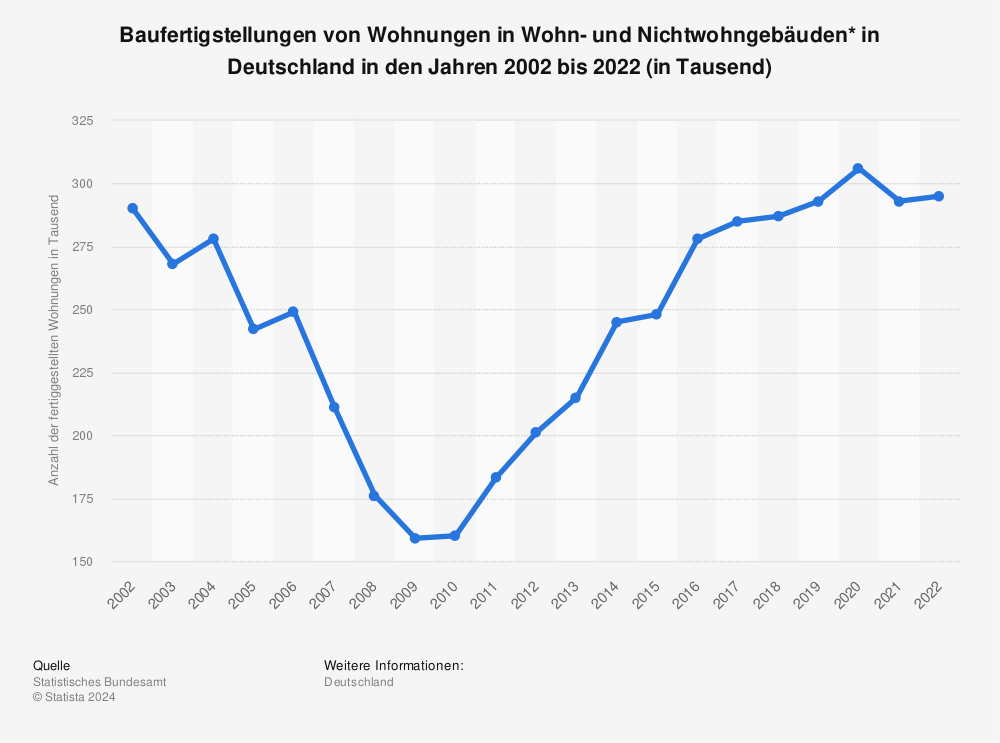
Completion of residential units in residential and non-residential buildings
Here you can see the official evaluation of: “Completion of residential units in residential and non-residential buildings* in Germany (in thousands)”. The latest figures are still from 2022. In the first half of 2023, construction permits were granted for 135,200 residential units in Germany, whereas 200,000 would have been needed to achieve the planned target of 400,000 new buildings for the year.
- Target 2022: 400,000 newly built residential units
- Achieved: 292,000
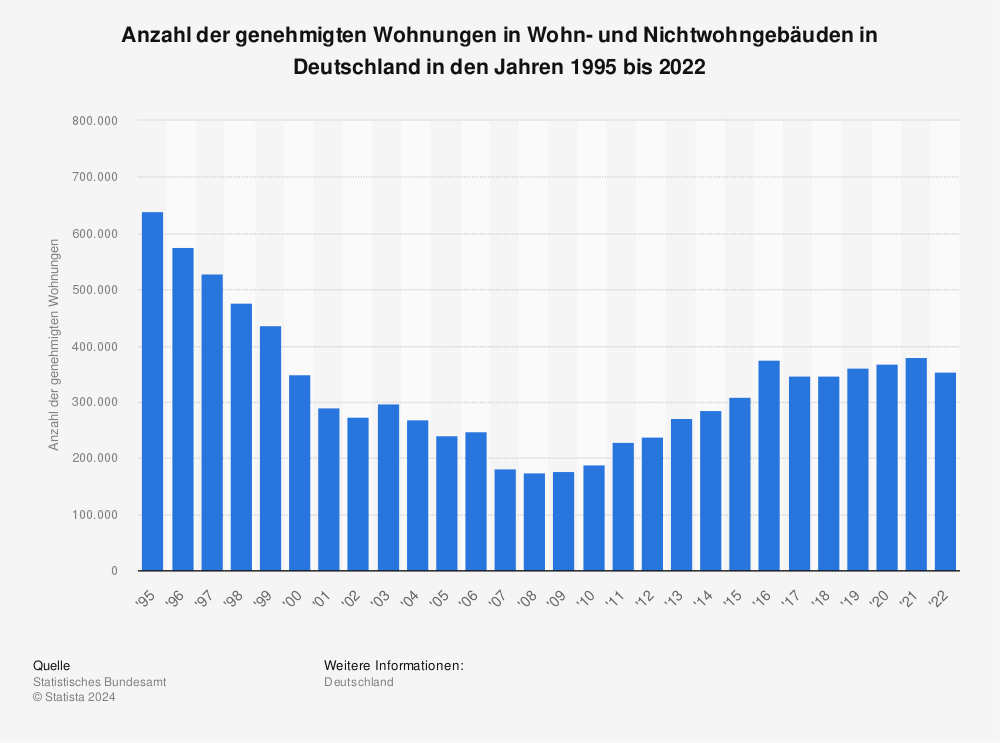
Residential construction stagnates: Number of approved housing units
How has the number of approved housing units in residential and non-residential buildings in Germany developed? The number of new approvals is decreasing, as well as the actual newly built units.
- 27.1 % in 20 years
Number of approved housing units in residential and non-residential buildings in Germany from 1995 to 2017.
- 2022: 331,300
- 2018: 346,810
- 2013: 270,34
- 2008: 174,691
- 2003: 296,823
- 1998: 475,711
Tip! Interesting statistics
Further studies and statistics can be found on the websites of the Federal Statistical Office. Read more about:
- Heirs and inheritance statistics
- Money investment statistics
- For new construction: Weather statistics
2019: Stable growth
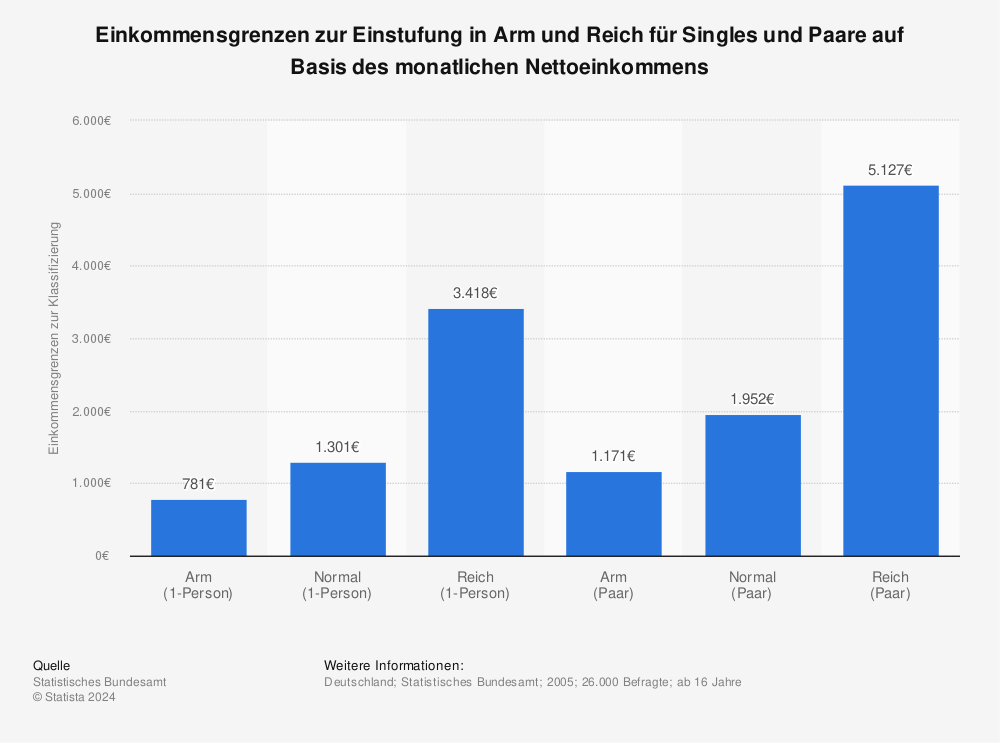
Income thresholds for classifying individuals and couples as poor or rich
Here you can see the official analysis of: “Income thresholds for classifying individuals and couples as poor or rich based on monthly net income”.
- Poor (1 person): 781 euro
- Normal (1 person): 1.301 euro
- Wealthy (1 person): 3.418 euro
- Poor (couple): 1.171 euro
- Normal (couple): 1.952 euro
- Wealthy (couple): 5.127 euro
More statistics can be found at Statista
Disposable income per employee
Disposable income per employee in Germany from 1960 to 2018. Here you can see the average disposable income per employee in the last 5 years in Germany:
- 2018: 22,792 Euro
- 2017: 22,124 Euro
- 2016: 21,636 Euro
- 2015: 21,098 Euro
- 2014: 20,577 Euro
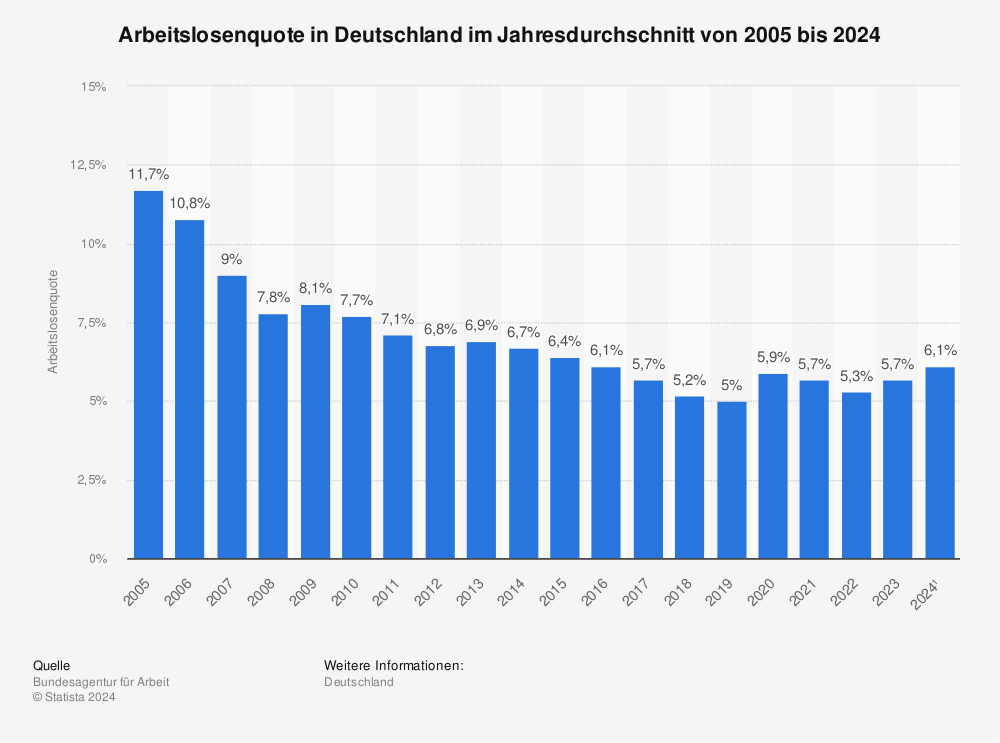
Unemployment rate on an annual average
Unemployment rate in Germany on an annual average from 2004 to 2019. Here you can see the official evaluation of the unemployment rate in the last 5 years in Germany:
- 2019: 5.3 percent
- 2018: 5.2 percent
- 2017: 5.7 percent
- 2016: 6.1 percent
- 2015: 6.4 percent
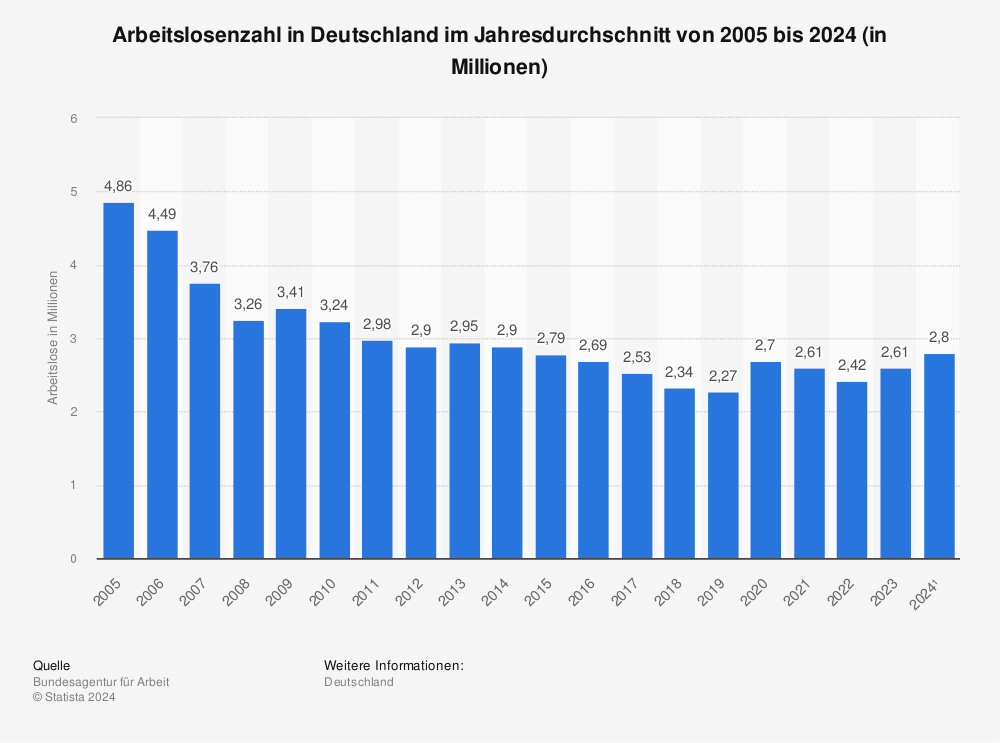
Average unemployment number
Average unemployment number in Germany from 2004 to 2019. Here you can see the average unemployment number in Germany over the last 5 years:
- 2019: 2.39 million
- 2018: 2.34 million
- 2017: 2.53 million
- 2016: 2.69 million
- 2015: 2.79 million


2018: Rent Boom
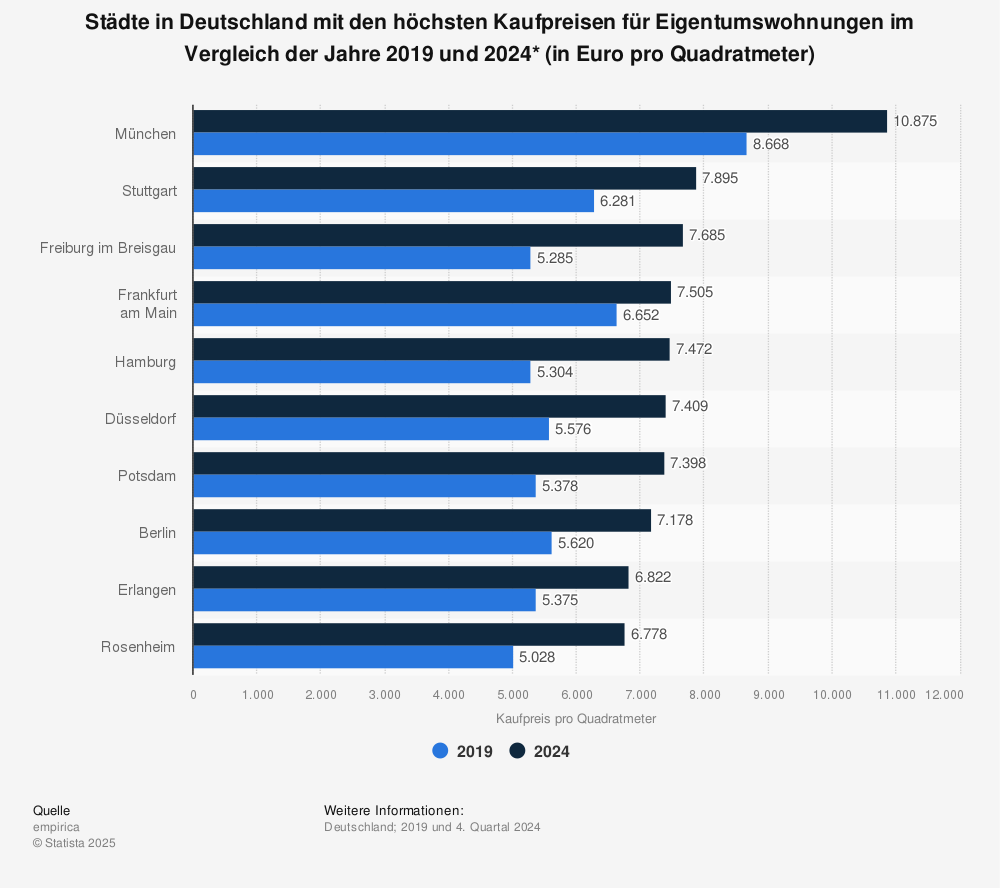
Square meter price for condominium – Top 10
Here you see the cities with the highest square meter prices for condominiums in comparison of the years 2010 and 2018* (in euros per square meter).
- Munich (Bavaria) with 8,342 euros per square meter; from 6,737 euros per sqm in 2014; increase of 1,695 euros per sqm in 4 years
- Stuttgart (Baden-Württemberg) with 5.925 Euro per square meter; from 4.744 Euro per sqm² in 2014; increase of 1.181 Euro per sqm²
- Frankfurt am Main (Hessen) with 6.060 Euro per square meter; from 4.373 Euro per sqm² in 2014; increase of 1.687 Euro per sqm²
- Freiburg im Breisgau (Bayern) with 4.943 Euro per square meter; from 4.740 Euro per sqm² in 2014; increase of 203 Euro per sqm²
- Ingolstadt (Bayern) with 4.969 Euro per square meter; from 4.287 Euro per sqm² in 2014; increase of 682 Euro per sqm²
More statistics can be found at Statista
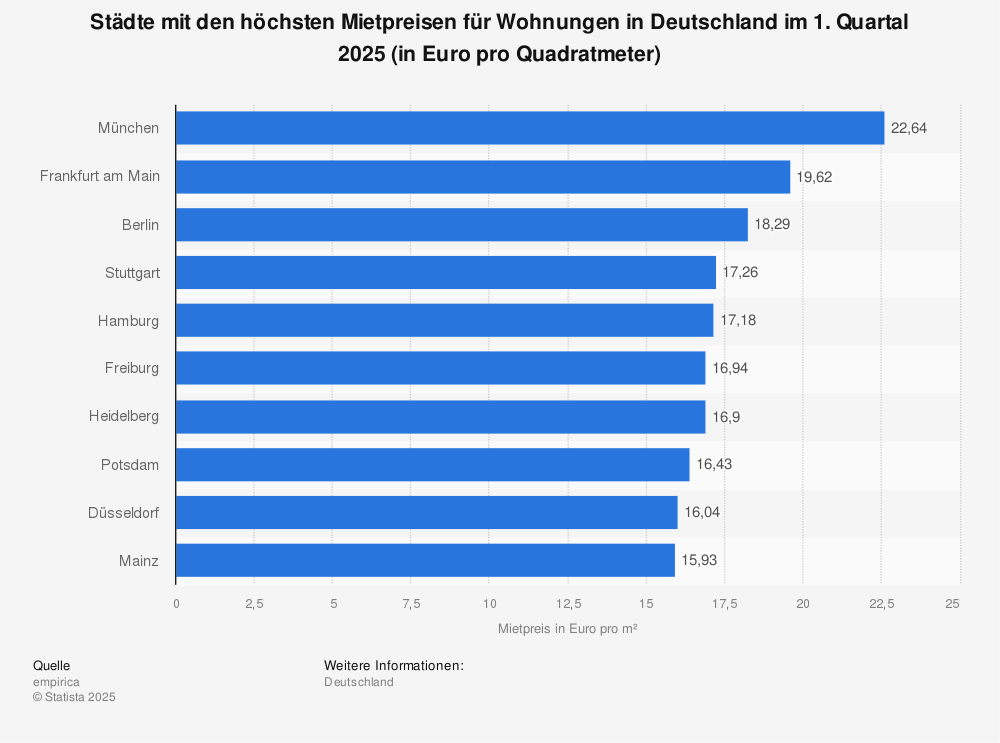
Cities with the highest rental prices for apartments
Here you can see the 10 cities with the highest rental prices in the 4th quarter of the house valuation and the common methods can be found here. Year 2018:
- Munich: 17.56 Euro/m²
- Frankfurt am Main: 13.96 Euro/m²
- Stuttgart: 13.64 Euro/m²
- Berlin: 12, 29 Euro/m²
- Darmstadt: 12.23 Euro/m²
- Mainz: 12.17 Euro/m²
- Freiburg: 12.13 Euro/m²
- Wiesbaden: 12.03 Euro/m²
- Hamburg: 11.94 Euro/m²
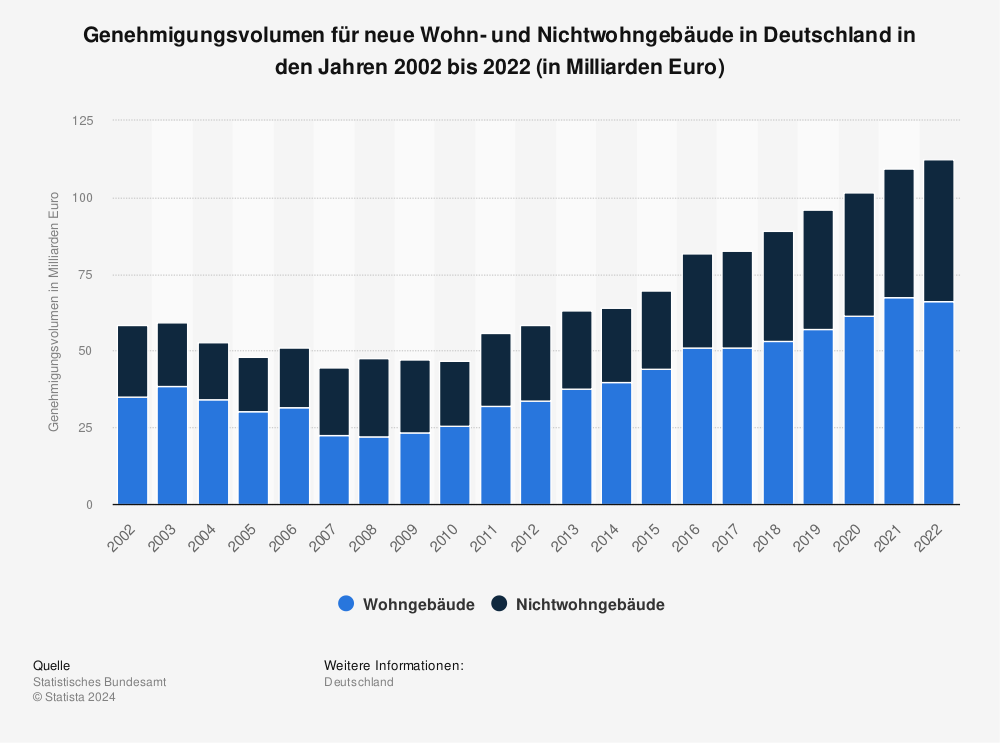
2017: New Construction Volume
More on the topic:
- New Construction: Single-family home, building land, financing and costs
- Developer: Realizing new construction
Approval volume for new residential and non-residential buildings
2016: Comparison of Federal States
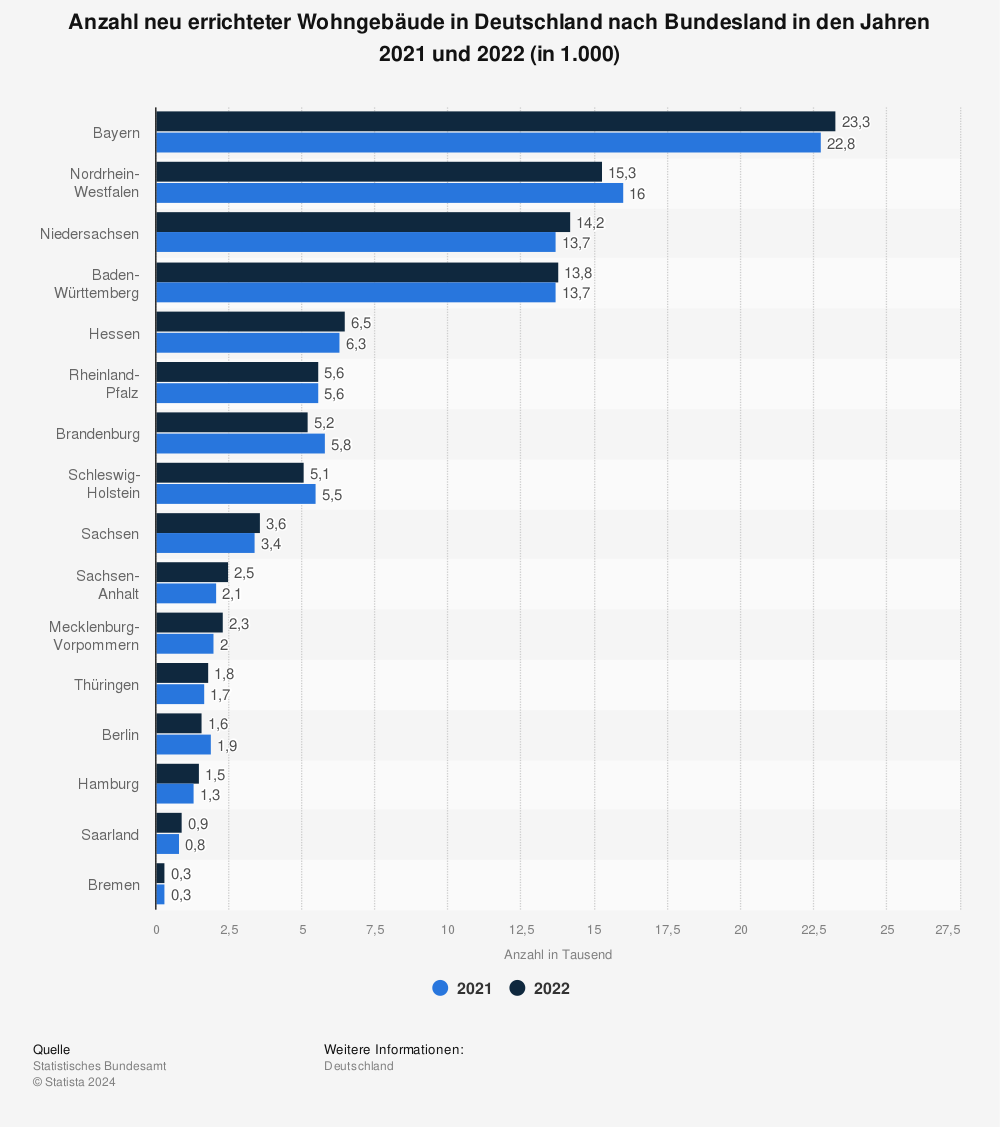
Number of newly built residential buildings by federal state
Here you can see the number of newly built residential buildings by federal state:
- Bavaria: 21,600
- North Rhine-Westphalia: 17,400
- Lower Saxony: 15,400
- Baden-Württemberg: 14,500
- Schleswig-Holstein: 6,800
- Hesse: 6,400
- Brandenburg: 6,200
- Rhine-Palatinate: 5,900
- Saxony: 4,300
- Mecklenburg-West Pomerania: 2,400
- Berlin: 2,200
- Saxony-Anhalt: 2,100
- Thuringia: 2,000
- Hamburg: 1,400
- Saarland: 900
- Bremen: 500
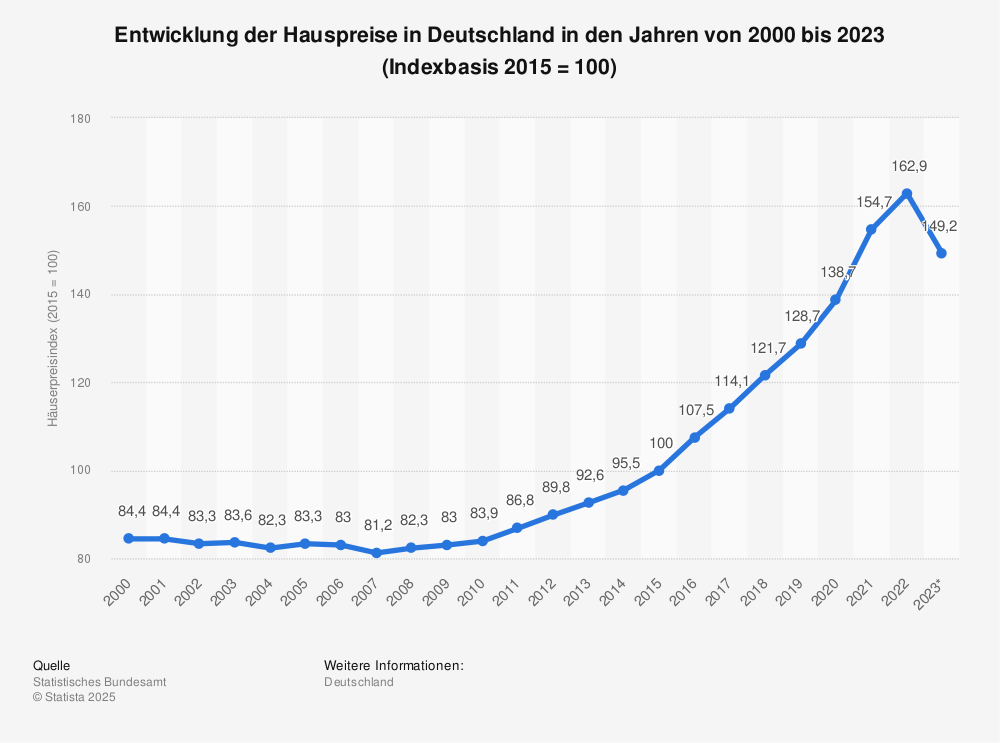
Development of house prices
Development of house prices in Germany from 2000 to 2017 (2015 = index 100).
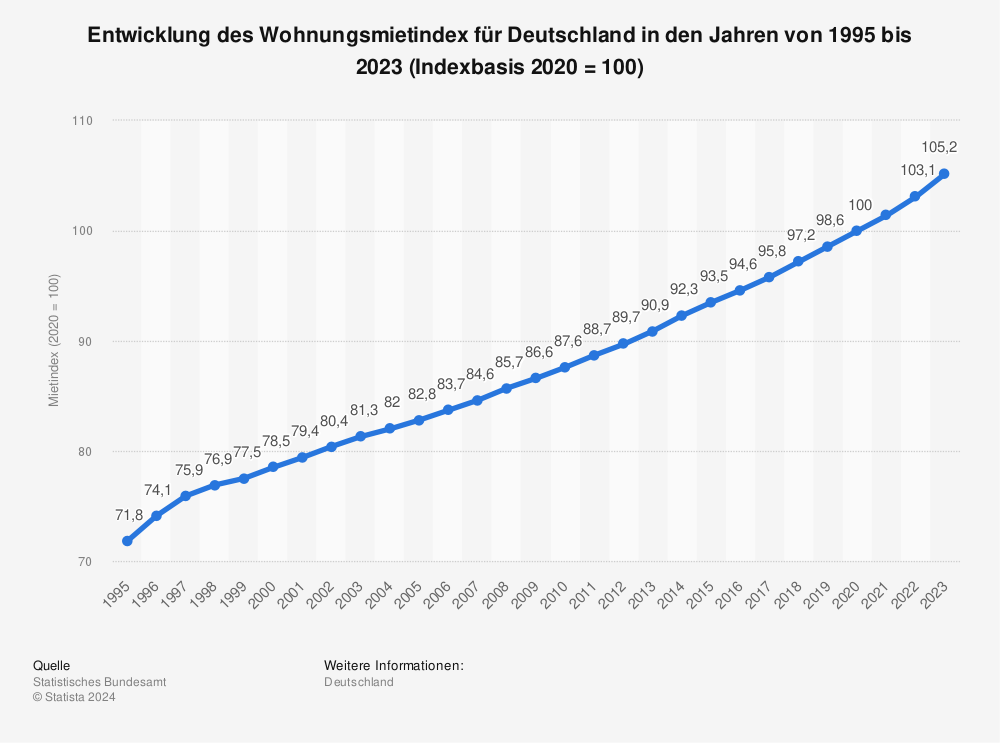
Development of the rental price index
Development of the rental price index for Germany from 1995 to 2017 (2010 = index 100)
Other
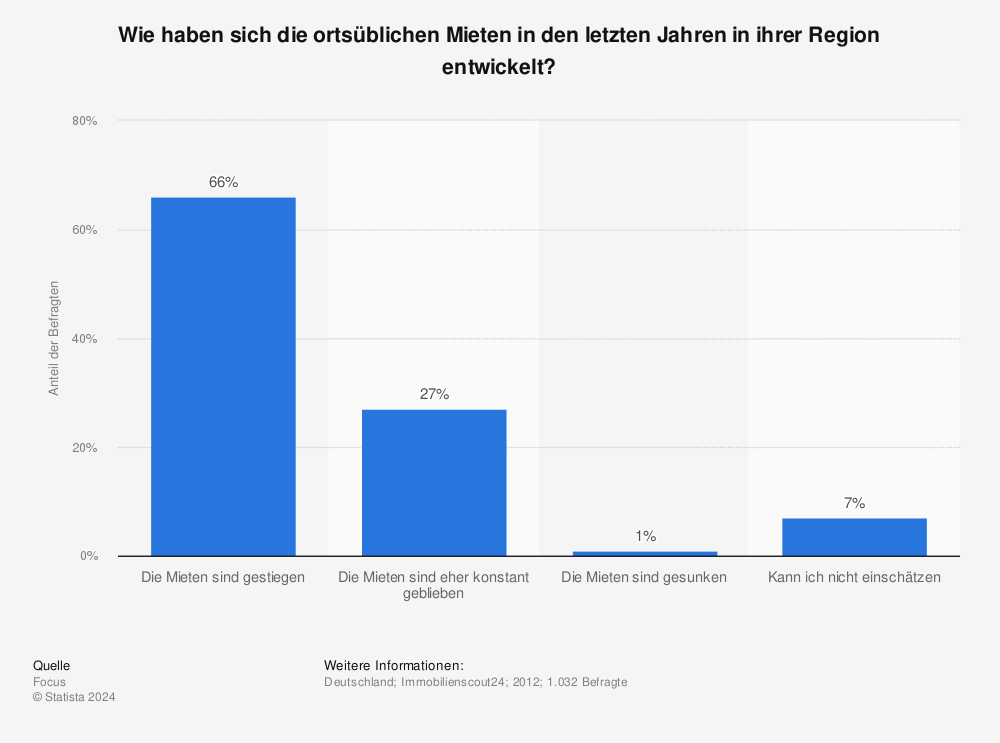
Development of local rental prices
How have local rental prices developed in your region in recent years?
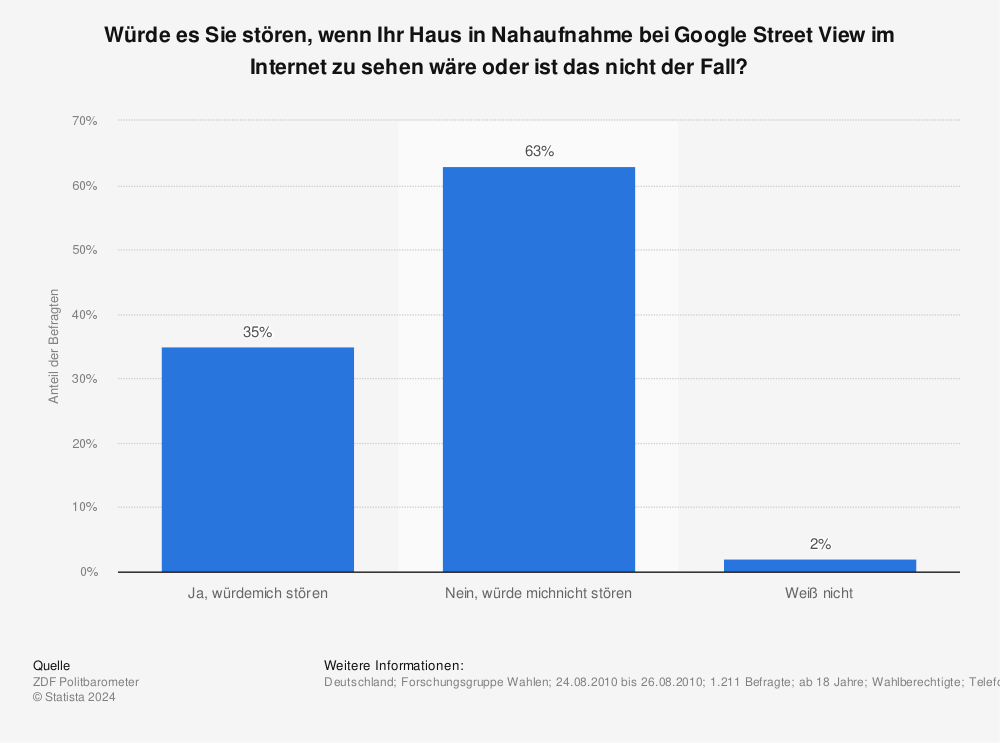
Controversy: Google Street View
Would it bother you if your house were visible up close in Google Street View on the internet or is that not the case?
Condominium Ownership
How high is the homeownership rate in the individual federal states? Here are the “most recent” figures from the federal statistical office. Since 2014, there has been no new survey. As soon as new data becomes available, we will include it here! Here you can see the homeownership rate in Germany between 1998 and 2014 by federal state.
© Statista 2019 – Source: Federal Statistical Office
| 1998 | 2002 | 2006 | 2010 | 2014 | |
|---|---|---|---|---|---|
| Saarland | 58.1% | 56.9% | 54.9% | 63.7% | 62.6% |
| Rhine-Westphalia | 55% | 55.7% | 54.3% | 58% | 57.6% |
| Lower Saxony | 48.9% | 51% | 49% | 54.5% | 54.7% |
| Schleswig-Holstein | 46.8% | 49.4% | 47.1% | 49.7% | 51.5% |
| Baden-Württemberg | 48.3% | 49.3% | 49.1% | 52.8% | 51.3% |
| Bavaria | 47.6% | 48.9% | 46.4% | 51% | 50.6% |
| Hesse | 43.3% | 44.7% | 44.3% | 47.3% | 46.7% |
| Brandenburg | 35.5% | 39.8% | 39.6% | 46.2% | 46.4% |
| Germany overall | 40.9% | 42.6% | 41.6% | 45.7% | 45.5% |
| Thuringia | 39.2% | 41.8% | 40.6% | 45.5% | 43.8% |
| North Rhine-Westphalia | 37.4% | 39% | 38.7% | 43% | 42.8% |
| Saxony-Anhalt | 36.5% | 39.6% | 37.9% | 42.7% | 42.4% |
| Mecklenburg-West Pomerania | 32.2% | 35.9% | 33.2% | 37% | 38.9% |
| Bremen | 37.5% | 35.1% | 35.4% | 37.2% | 38.8% |
| Saxony | 28.7% | 31% | 29.5% | 33.7% | 34.1% |
| Hamburg | 20.3% | 21.9% | 20.2% | 22.6% | 22.6% |
| Berlin | 11% | 12.7% | 14.1% | 14.9% | 14.2% |
Sell hotel – Tourism and guest numbers
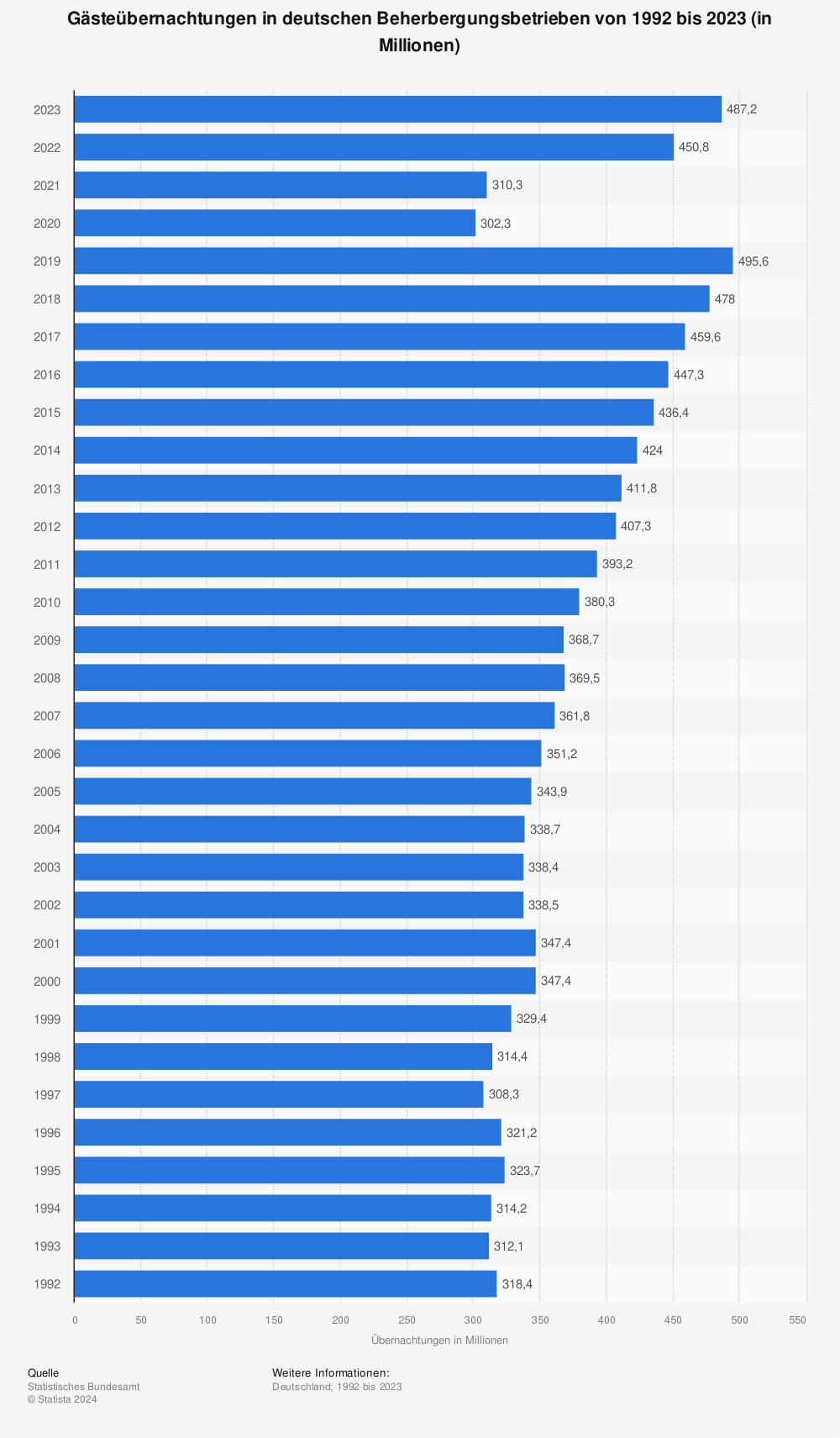
Munich, Berlin, Frankfurt and nationwide: Tourism in Germany is booming and has been shining with new record numbers for over 10 years. Accordingly, the number of overnight guests is naturally increasing, as is the demand for hotels in the real estate market. From the stylish, luxurious boutique hotel in the city center to hotels with attached gastronomy and event areas. In Germany, people are not only taking more vacations, but also spending more money on them. As a result, prices for overnight stays are rising, and the hotel industry is becoming a lucrative business for more and more companies and entrepreneurs.
Therefore: The real estate market and the tourism market are both currently on the rise. If you sell now, you will achieve a good selling price – why wait for the next real estate bubble?
Overnight stays in German accommodation establishments from 1992 to 2018 (in millions).
Help and Definition
The most important forms of representation and terms at a glance:
Why are the studies so selective?
The Federal Statistical Office only offers a part of the information for free use. A large portion of the statistics that have been prepared for use are only available with a Premium account. This Premium account at the Federal Statistical Office costs 49 € per month.
What is a bar chart?
Bar charts are the most common form of statistical results used by the Federal Statistical Office. In a bar chart, different values are displayed on a scale. The scale extends along one axis and contains a value, such as the number of inhabitants or the average income. The other axis then carries the different types or classes, for example, different age groups or the subdivision into different districts.
What is a pie chart?
The pie chart format is used relatively rarely by the Federal Statistical Office. A pie chart displays statistical values in a 100% distribution. A pie, meaning a circle, represents 100%. When entering individual values, a straight line is drawn from the edge to the center, creating small triangles, one side slightly rounded. This creates the optical effect of a pie slice. That is why this form of presenting statistical values is also called a pie chart.
What does the Federal Statistical Office do?
As an authority, the Federal Statistical Office is responsible for collecting general, relevant data. This data is used, among other things, by various ministries, as well as by associations, private individuals, and naturally also by students and students. The Federal Statistical Office is based in Berlin, but is also represented by various offices throughout the country.
Are the statistical data representative?
Yes, the surveys conducted by the Federal Statistical Office are mostly representative surveys or results from extrapolations. The data are therefore interesting for many population groups, from the real estate agent who wants to observe the demographic development of a particular area to students preparing for a presentation or a major research paper. Thus, the Federal Statistical Office fulfills a major and important task in Germany.
Further studies and statistics can be found on the internet pages of the Federal Statistical Office. Read more about:

Lukinski Rating Germany: Investment Property – City List

“Hollywood” sign: Real Estate Investor Story from “Hollywood Land” – you never would have guessed!

Typical mistake! Buying your first property: What can go wrong?

Construction financing: interest rates, conditions in comparison, tips & calculators

Buy a villa in Spain: Mallorca, Ibiza or Marbella? Comparison + Buyer Tips
Sales talk & purchase price negotiation: preparation, strategy & tips





AI and GDPR in Germany: Why Data Protection Matters for Real Estate and Tax Questions
Plot of land by the water in Berlin: KP 90 Mio. – Luxury residential development in Germany’s capital city

Real Estate Software to Create Yourself: ChatGPT Example Link Structure Investment
A-Lage Real Estate: Advantages, Disadvantages, Profit in Sale – new video