
Success with Real Estate Investments in Dubai: Factors, Visa & Location Choice
Dubai has evolved from a desert city into one of the most liquid real estate markets in the world – with gross rental returns of 6 to 8 percent, no income tax on rental income, and a Golden Visa for investments of at least 2 million AED. This makes the emirate structurally more attractive for German investors than Munich, Vienna or Zurich. However, the market is also volatile: those who bought at the wrong time in 2008 saw value losses of over 50 percent. This guide shows what investors really need to pay attention to when it comes to location, financing, legal structure and taxes – with concrete figures, comparison tables and insider perspectives on return calculation and profitable investment properties.
The Real Estate Market in Dubai: Opportunities, Figures and Challenges
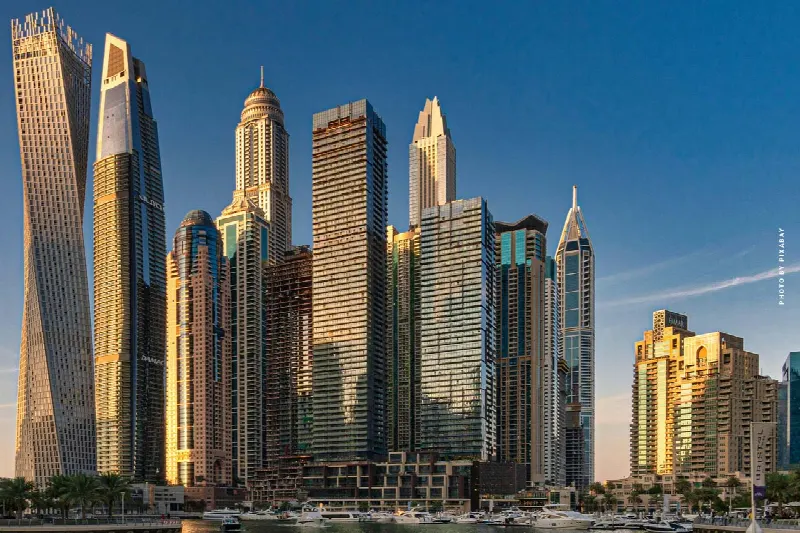
 Dubai offers investors a range that no European market can match: studio apartments starting at 80,000 EUR in JVC, mid-market apartments in Business Bay between 250,000 and 500,000 EUR, luxury penthouses on Palm Jumeirah above 5 million EUR. I have already reported on Dubai’s largest mega-construction projects – they are the engine of value growth.
Rent Yields in the Reality Check
The gross rental yield varies between 5 and 9 percent depending on location and property type – significantly higher than in Germany’s top locations (2–3.5 percent). Important: gross is not net. Service charges (15–25 AED/sqft/year), DEWA connection costs, management (5–8 percent of rent), and vacancies typically reduce the net yield by 1.5 to 2.5 percentage points.
- JVC, Dubai South, Town Square: Gross 7–9 % (mass market, higher fluctuation)
- Business Bay, Marina, JLT: Gross 6–7.5 % (established, stable demand)
- Downtown, Palm Jumeirah, Emirates Hills: Gross 4.5–6 % (capital preservation, prestige)
Challenges and Real Risks
Those investing in Dubai must understand market cycles. The crash of 2008/09 brought value losses of 40–55 percent, and the correction from 2014–2020 caused further 25–35 percent losses in some areas. Specific risks:
- Oversupply risk: 30,000–40,000 new units enter the market annually
- Developer creditworthiness: Off-plan purchases only with Tier-1 developers (Emaar, Damac, Nakheel, Sobha, Meraas)
- Service charges: In some luxury towers up to 35 AED/sqft/year – can halve the yield
- Currency peg: AED is pegged to the USD – EUR/USD fluctuations directly affect German investors
- Exit liquidity: In crises, selling times can increase from 3 to 12+ months

Understanding Legal Frameworks and Property Rights
Anyone wanting to enter the Dubai real estate market must first understand property ownership rights. In Dubai, there are three forms of ownership: Freehold (full ownership, also for foreigners), Leasehold (leasehold rights for 30–99 years), and Commonhold (condominiums with common areas). For foreign investors, only the “Freehold” areas are relevant – these include Dubai Marina, Downtown Dubai, Palm Jumeirah, Business Bay, JVC, Dubai Hills, and JLT.
The Purchase Process Step by Step
Unlike in Germany, the purchase does not take place at a notary but at the Dubai Land Department (DLD). Typical process:
- MoU (Form F): Reservation contract, 10% deposit to the escrow agent
- NOC (No Objection Certificate): Issued by the developer, confirms the unit is free of debt
- DLD Transfer: Registration with the Dubai Land Department, title deed is issued
- Oqood Registration: Mandatory for off-plan properties, protects the buyer’s rights
The processing time typically takes 30–45 days. A local lawyer (fee 5,000–15,000 AED) is not legally required, but strongly recommended.
Visa Requirements: Specific Thresholds
Visa through real estate investment are a central argument for wealthy investors:
| Visa Type | Minimum Investment | Duration | Special Feature |
|---|---|---|---|
| Investor Visa | 750,000 AED (~190,000 EUR) | 2 years, renewable | Property must be fully paid for |
| Golden Visa | 2,000,000 AED (~510,000 EUR) | 10 years, renewable | Possible with mortgage, family included |
| Retirement Visa | 1,000,000 AED property + income | 5 years | From age 55, alternatively savings |
However, the visa does not automatically establish tax residency – 90+ days of physical presence and proof of UAE residence are required for that.

Location choice: Neighborhoods in direct comparison
The choice of the right location decides on yield and value development. An investment in Downtown is not “better” than one in JVC – it is a different investment case.
Comparison table of top locations
| Neighborhood | Price per sqft | Gross Yield | Target Group |
|---|---|---|---|
| Downtown Dubai | 2,200–3,500 AED | 4.5–6 % | Capital preservation, prestige, tourists |
| Dubai Marina | 1,600–2,400 AED | 6–7 % | Expats, young professionals |
| Palm Jumeirah | 2,800–6,000 AED | 4.5–6 % | HNWI, holiday rental |
| Business Bay | 1,500–2,200 AED | 6–7.5 % | Working professionals, mid-market |
| JVC / Dubai Hills | 900–1,500 AED | 7–9 % | Beginners, cash flow focus |
| Dubai South / MBR City | 800–1,400 AED | 7–8.5 % | Speculative, value appreciation |
Emerging neighborhoods with growth potential
While established areas offer stability, the greatest potential for value appreciation lies in the newer master communities:
- Dubai Hills Estate: Emaar master community with golf course, schools, mall
- Dubai South: Close to Expo site and Al Maktoum Airport, long-term trigger
- MBR City: Directly behind Downtown, with Meydan and Crystal Lagoon
- JVC (Jumeirah Village Circle): Highest rental yields in the mid-market segment

Off-Plan vs. Ready Property: The strategic fundamental decision
This decision is made by every Dubai investor first – and it shapes the entire investment structure. Off-Plan means purchasing before completion with a payment plan, Ready Property means purchasing an existing unit.
Off-Plan: Advantages and pitfalls
- Advantage: Entry with 10–20 % down payment, remaining amount staged (e.g. 60/40 or 50/50 post-handover)
- Advantage: Price increase upon completion typical of 15–30 % with serious developers
- Risk: Construction delay of 6–24 months is market standard
- Risk: Market correction can lead to negative equity at handover
- Mandatory: Oqood registration with DLD and escrow account check
Ready Property: Advantages and disadvantages
- Advantage: Immediate rental income and real viewing
- Advantage: Visa can be applied for immediately after DLD registration
- Disadvantage: Higher capital requirement upfront (minimum 25 % + additional costs)
- Disadvantage: Lower potential for value appreciation compared to Off-Plan
Financing and tax aspects of investment properties in Dubai
The financing of real estate abroad differs structurally from German procedures. For foreign investors: Maximum 50 % loan-to-value for properties under 5 million AED, 40 % for higher amounts (Central Bank Regulation). Those financing as UAE residents can go up to 75 %.
Actual additional costs upon purchase
In addition to the purchase price, acquisition costs of 6–8 percent apply:
- DLD Transfer Fee: 4 % of the purchase price (often 50/50 buyer/seller)
- Title Deed Issuance: 580 AED
- Trustee Fee: 4,000 AED (+ 5 % VAT)
- Commission: 2 % + 5 % VAT
- Mortgage Registration: 0.25 % of the loan amount
- NOC Fee: 500–5,000 AED (developer-dependent)
Tax advantages and German tax reality
Dubai does not levy income tax on rental income, capital gains tax, inheritance tax, or annual land tax – this is the structural USP. However: For German investors with a residence in Germany, this does not apply without restrictions.
- DBA Germany-UAE: Rental income is taxed in the state of source (Dubai) – so in practice not – but is subject to the progression reservation in Germany
- Sale profits: Tax-free in Germany after the speculation period (10 years), before that taxed at personal tax rate
- Exit taxation: Carefully examine when relocating residence to Dubai
- Attribution taxation: Relevant when using UAE company structures
Comparison of financing options
| Financing option | Maximum loan for foreigners | Advantages / Disadvantages |
|---|---|---|
| Real estate loan from UAE banks (Non-Resident) | 50 % (under 5 million AED) | Transparent interest rates (4.5–6 %), but strict income proofs required |
| UAE bank as Resident | Up to 75 % | Best conditions, but requires UAE residence and salary proofs |
| Developer Payment Plan (Off-Plan) | Effectively 80–90 % | Interest-free, but market risk and developer creditworthiness |
| International banks (Private Banking) | 50–70 %, often Lombard solution | Flexible, but minimum volume usually from 1 million EUR of assets |
| Own capital from Germany | 100 % | No bank hurdles, but high capital investment and lump risk |
Overview of market trends and future developments

Heritage Self-Help Groups: Inherited Money, What to Do? Step-by-Step Guide

Lukinski Rating Germany: Investment Property – City List
Apartment Buy USA – Explanation, How-to, Prices + Co
What Real Estate Type Should I Invest in? Explained, Full Guide + Checklist

Mortgage Explained Easily – House Financing, How-to, Guide

All Taxes you have to Pay when Buying a House – Transfer Tax, Mortgage Tax + Co






Berlin | Moabit | Apartment Building | €5,300,000 with approx. 4.0% Yield
Federal Election and Real Estate Market: What Survey Data Reveals About the Future
US Elections and Real Estate: What Polling Data Tells Property Investors

Investment Real Estate: What You Need to Pay Attention to When Buying Your First Property