Create & sell NFTs: App / Marketplace, become a Creator, earn money – guide
Create & sell NFTs – do you want to make money with NFTs? Those who really make money with NFTs are usually artists who already have recognition, reach, and buyers in the “real world.” As a complete beginner, it’s not enough to upload a few artworks on an NFT marketplace and hope for a buyer. Reality: Over 95% of all listed NFTs on OpenSea are never sold. This guide helps you get started as an NFT creator – with numbers, cost overview, marketplace comparison, and insider tips. You’ll learn about wallets, marketplaces, the minting process, fees, promotion strategies, and tax basics. Additionally, we show you the decisive advantage of NFTs for artists: the royalty on every resale.
Earning money with NFTs: Basics
Before we start publishing and selling NFTs, here’s an overview of the basics – including numbers that other guides often omit.
- How does an NFT work?
- NFT art: Advantages (Smart Contract / Royalty)
- Reality Check: What do you really earn?
How does an NFT work? Explained quickly
NFT = Non-fungible Token = “non-replaceable value tokens”. More beautifully phrased:
NFTs are digital, unique, protected objects with a verifiable ownership history
NFTs are digital one-of-a-kind items, traceable thanks to a visible sales history. Everything is documented in a Blockchain, most commonly Ethereum. Each NFT is a token that contains additional content – for example, smart contracts with transaction history, a link to the original file, and royalty rules.
Was that too fast for you? Learn everything about it here:

Advantages for Artists: Smart Contract & Royalty
NFTs use Smart Contracts – programmed contracts that are permanently stored on the blockchain. They can include: transaction history, link to the original file, unlockable content – and the killer advantage: royalty.
The creator can set a percentage in the Smart Contract that they automatically receive with every future transaction. Common rates are 5–10%, with most marketplaces having a maximum of 10%.
Profit on every sale (Royalty)
A major advantage over the physical art market, where the creator only benefits once at the initial sale. With NFTs, the creator receives a share from every transaction.
For artists, this means: Regular, passive cash flow over years
Calculation Example Royalty (10%):
- Initial sale: 1 ETH → 1 ETH to you (minus fee)
- Resale: 5 ETH → 0.5 ETH royalty to you
- Resale: 20 ETH → 2 ETH royalty to you
- Total royalty: 2.5 ETH extra, without further action
Important (Industry Status): Royalties are technically not enforceable on all marketplaces. Platforms like Blur or LooksRare have made royalties optional in the meantime. On OpenSea, royalties can be enforced through the “Operator Filter Registry” – inform yourself before minting whether your chosen marketplace enforces royalties.
Reality Check: What do you really earn?
Before you start, an honest look at the market:
- 95%+ of NFTs on OpenSea never sell. Just uploading is not enough.
- Floor Price of most collections: below 0.01 ETH – often a loss after gas costs.
- Top 10% of creators generate 90% of the volume (classic Pareto distribution).
- Promotion is 80% of the work – Twitter, Discord, community building.
- Realistic entry point: 100–500 EUR profit in the first year is already a success.

Cost Overview: What does creating an NFT really cost?
The most secretive question. Here are the real costs – evergreen formulated, as gas prices fluctuate strongly.
| Cost Item | Amount | When due? |
|---|---|---|
| Create wallet | 0 EUR | one-time |
| OpenSea account setup | 0 EUR (Lazy Mint) | one-time |
| Mint gas fee (Ethereum) | 20–150 EUR | per NFT (or batch mint) |
| Mint gas fee (Polygon) | almost 0 EUR | per NFT |
| Listing fee | 0 EUR | one-time per listing |
| Sales commission OpenSea | 2.5% | per sale |
| Sales commission SuperRare | 15% | per sale (first sale) |
| Sales commission Foundation | 15% | per sale |
| ETH ↔ EUR withdrawal | 1–2% | per withdrawal |
Insider Tip: Anyone minting on Ethereum quickly pays more gas than the NFT ever brings in. For beginners, Polygon (selectable via OpenSea) is a better start – gas costs are almost zero.

Blockchain Choice: Ethereum vs. Polygon vs. Solana
The blockchain determines costs, reach, and target buyer audience.
| Critierion | Ethereum | Polygon | Solana |
|---|---|---|---|
| Minting Gas Fee | high | almost 0 | very low |
| Buyer Volume | highest | medium | medium-high |
| Prestige | highest | low | medium |
| Wallet | MetaMask | MetaMask | Phantom |
| Marketplace | OpenSea, Blur | OpenSea | Magic Eden |
| Recommended for | Experts, high-end | Beginners | Gaming, volume |
Create an Account: Marketplace and Wallet
To sell NFTs, you need two things: a Wallet (digital wallet) and an account on an NFT marketplace.
- Set up a wallet (10 minutes)
- Connect your marketplace account (5 minutes)
- Complete your profile, set social links (15 minutes)
Learn everything about registration, wallets, and marketplaces here:
Step 1 – Wallet: Your digital wallet
The Wallet is your digital wallet. This is where your cryptocurrency – and also your purchased and minted NFTs – are stored. You connect the wallet to the marketplace, after which you can upload and sell artworks.
Short explanation:
- Cryptocurrency – digital currency (e.g. ETH, MATIC, SOL)
- Ethereum – most widely used blockchain in the NFT space
- Wallet – wallet and storage for NFTs, accessed via seed phrase
- Seed Phrase – 12–24 words that restore your wallet (NEVER share, NEVER store digitally)
The most important wallet providers:
- MetaMask – standard for Ethereum & Polygon, browser extension
- Coinbase Wallet – beginner-friendly, app-based
- WalletConnect – bridge protocol for mobile wallets
- Phantom – standard for Solana
- Ledger / Trezor – hardware wallets for higher security (from 79 EUR)
Security Insider: Anyone holding NFTs worth more than 1,000 EUR should definitely use a hardware wallet (Ledger). Phishing attacks on MetaMask are the most common cause of loss.
Step 2 – Marketplace: Platform for buying and selling
An NFT marketplace is the platform where artists offer their work and collectors buy and sell digital art.
Marketplace Comparison for Creators:
| Marketplace | Fee | Blockchain | Curated? | For whom? |
|---|---|---|---|---|
| OpenSea | 2.5% | ETH, Polygon | No | Beginners, all |
| Blur | 0% | ETH | No | Traders, volume |
| SuperRare | 15% | ETH | Yes, application required | 1/1 artists |
| Foundation | 15% | ETH | Invite-only | High-end art |
| Rarible | 2.5% | ETH, Polygon, Tezos | No | Multi-chain |
| Magic Eden | 2% | Solana, ETH | Partially | Solana, Gaming |
| Binance NFT | 1% | BNB, ETH | Partially | Binance users |
Here you will find a comprehensive list of marketplaces for NFTs:
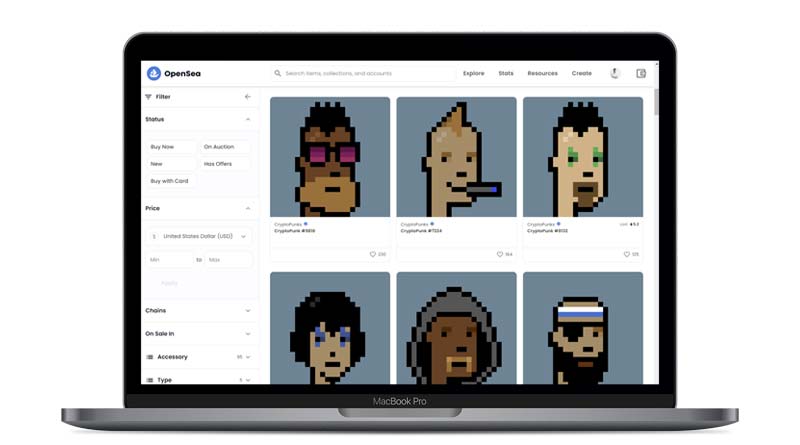
Screenshot: OpenSea / CryptoPunks
Create an NFT: Upload, Minting, Sale
You have your wallet and have chosen a marketplace – now you can publish your art (technical term: minting).
- Understand NFT types
- Single piece or collection?
- Upload on the marketplace
- Minting (classic vs. lazy mint)
- Listing & sale price
NFT Types: Collectibles, Art, Gaming, Music & more
NFTs are not only art. There is an entire world beyond that – and these are the categories with examples where money is moving today:
- Collectibles – collectibles (CryptoPunks, BAYC)
- Art – 1/1 pieces, Generative Art
- Gaming – in-game items, skins (Axie Infinity)
- Musik – tracks, albums with royalty shares
- Access / Entry – memberships, event tickets
- Domains – ENS (.eth), Unstoppable Domains
- Real World Assets – tokenized real estate, physical assets
Insider Bridge to Real Estate: Tokenized real estate is the next big step – ownership shares in houses or vacation homes are represented as NFTs. Exciting for investors: fractional ownership becomes tradable. Learn more about Blockchain applications and Ethereum.
NFT Collections: “Art Packages”
Unlike physical art, there are entire collections consisting of hundreds or thousands of individual items – usually generatively created. Successful examples: the CryptoPunks and the Bored Ape Yacht Club.
Such collections are not a must – you can also publish individual artworks (1/1), which is actually more typical for classical artists.
Learn more here:

Buy and sell NFT: explained step by step - instructions

Partnership limited by shares (KGaA) - formation, management, liability & Co

GmbH & Co OHG - formation, management, liability & Co

GmbH & Co KG - Foundation, Management, Liability & Co

Registered Businessman / Registered Businesswoman (e. K.) - Foundation, Financing, Liability & Co.

Stock Corporation (AG) - Founding, Liability, Legal Form, Management, Taxes









Living in Bogenhausen (Munich): Buy & rent a house or apartment - Viewing, price per square metre & Co.
Societas Europaea (SE) - Formation, Law, Taxes, Advantages & Co.

Capital investment in Germany: Where to invest? Cities, real estate, returns and development

xAI and Grok Overview: Elon Musk's AI Company Explained Simply