
Book a Private Jet: Process, Aircraft Types, Costs and Charter Services Explained
Anyone looking to book a private jet usually has three questions in mind: how does the request process work, which aircraft actually fits the route – and what does the flight really cost. Through PrivatJet One, our sister project for business aviation, we broker charter flights across a network of operators. This guide walks through the full process: from the first request through the right jet class, block hours and empty legs, all the way to the limousine transfer straight to the aircraft.
How does booking a private jet work, step by step?
The process looks nothing like booking a scheduled flight – there is no fixed timetable, just an individual setup tailored to the route:
Submit a request
Provide route, date, number of passengers, luggage and any special requirements (pets, wheelchair access, a cold chain for medical equipment) – free and non-binding, via PrivatJet One.
Compare offers
Several charter operators from the PrivatJet One network submit offers with different aircraft, which are then compared by price, availability and cabin configuration.
Contract and booking confirmation
Once you choose an offer, a charter contract follows, covering flight time, price, payment terms and the operator’s details (Air Operator Certificate).
Preparation
Passport details and customs paperwork for international flights, catering preferences, luggage dimensions and – if needed – the limousine transfer are finalised.
Departure day
Arrival at the Fixed Base Operator (FBO) is usually 15–20 minutes before departure, with boarding directly at the aircraft – no classic security line to wait in.
That’s it.
PrivatJet One compares charter offers by jet class, route and price, making the otherwise opaque pricing of the business aviation market transparent.

Which aircraft types and jet classes are available?
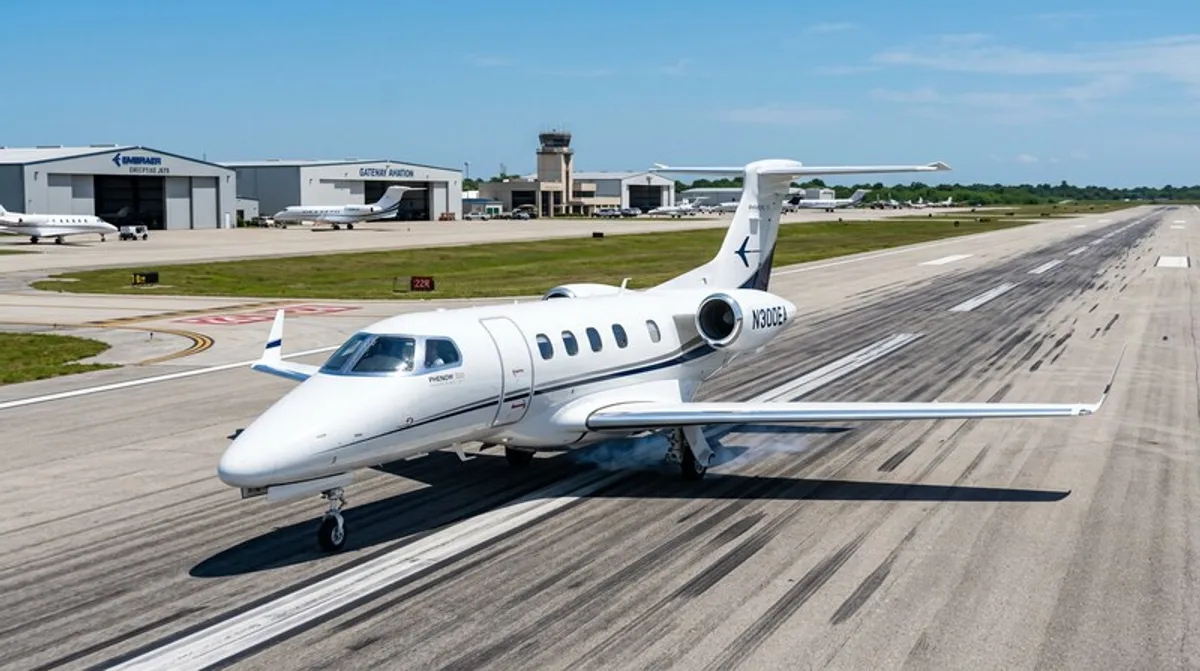
Not every aircraft suits every route. Short distances and smaller airports call for different models than intercontinental flights:
| Class | Example models | Passengers | Range (approx.) |
|---|---|---|---|
| Turboprop | Pilatus PC-12 | 6–9 | up to 2,600 km |
| Very Light Jet | Embraer Phenom 300E | 2–4 | up to 3,600 km |
| Light Jet | Cessna CJ3+, Learjet 75 | 4–6 | up to 3,800 km |
| Midsize / Super Midsize | Citation XLS+, Citation Longitude, Challenger 350 | 6–9 | up to 6,300 km |
| Heavy Jet | Bombardier Global 6000 | 8–14 | up to 11,000 km |
| Ultra Long Range | Gulfstream G650ER, Falcon 8X, Gulfstream G700, Global 7500/8000 | 12–19 | up to 14,800 km (nonstop intercontinental) |
A detailed breakdown of extra costs such as landing fees or de-icing can be found in our private jet rental experience report. Anyone wanting to compare individual models in detail can dig deeper on PrivatJet One.
What sets the classes apart?
Besides passenger count and range, three factors mainly decide which class fits a trip: cabin height (in turboprops and light jets you often have to stoop, from midsize upward you can stand upright), cruising speed (typically Mach 0.74 to 0.90), and equipment – ultra long range jets usually offer a sleeping cabin and sometimes a separate shower, which makes a real difference on a ten-hour nonstop flight.
How is the price made up: block hours and empty legs
Billing is based on block time – the time from closing the cabin door to opening it at the destination, not just the minutes actually in the air. Depending on the jet class, the hourly rate typically runs between about €2,000 and €10,000. On top of that come:
- Landing fees and handling: €800 to €2,500 per airport, sometimes considerably more at busy airports (for example during major trade fairs or sporting events).
- Positioning flight: If the aircraft is not already at the departure airport, the empty leg to get there is billed too – often at half the hourly rate.
- Crew overnight stay: On round trips with a stopover, hotel and meal costs for the crew are added.
Empty legs: cheap, but inflexible
An empty leg happens when a jet has to fly back to its home base without passengers after a charter, or needs to be repositioned for its next assignment. These legs can be booked at discounts of 50 to 75 percent compared to a regular charter price. The catch: the date, route and aircraft type are already fixed and can shift at short notice or fall through entirely – an attractive way to save money for flexible frequent flyers, but not ideal if you need to be at a fixed real estate appointment the next morning.

What charter services exist – private, business, medical and more

Charter flights aren’t just for leisure trips. Depending on the occasion, different aircraft and additional services come into play – a weekend trip for three needs a different setup than a medical repatriation with a doctor and nursing staff on board, or a delegation trip for ten people with its own security detail. Anyone looking for the right setup for their occasion will find in the table below which jet class is typical and what extra equipment or personnel can be booked alongside it:
| Service | Typical occasion | Common jet class |
|---|---|---|
| Private / leisure charter | Holidays, family trips, events | Light to Heavy Jet |
| Business charter | Multiple meetings in one day, roadshows, M&A negotiations | Light to Super Midsize |
| Medical charter | Medical repatriation, organ transport, intensive-care transfer | Retrofitted Midsize/Heavy Jet with doctor and equipment on board |
| Group / delegation charter | Sports teams, conferences, family offices | Heavy to Ultra Long Range |
| Cargo charter | Urgent freight, spare parts, artworks | Depends on volume and weight |
For the medical segment, PrivatJet One offers more detail directly on privatejets.one, and the same applies to corporate travel, including how billing and tax treatment typically work.
How does the ground transfer work – limousine, driver and FBO

The comfort of chartering doesn’t end at the aircraft door. A good part of it happens on the ground:
- FBO instead of terminal: Charter flights depart from and land at a Fixed Base Operator – a small, dedicated terminal away from scheduled traffic, with no long security or check-in lines.
- Limousine service: A driver picks you up at home or at the office and drives directly onto the apron, right up to the aircraft – no changing between terminal and gate.
- Handover at the destination: At the destination airport, another vehicle is usually already waiting, while the FBO ground staff take care of the luggage.
- The last mile: For hard-to-reach destinations such as islands or ski resorts, a helicopter transfer sometimes covers the final leg.
Limousine service, FBO handling and, where needed, a helicopter connection can all be booked directly along with the request, so the result is one continuous door-to-door transfer instead of separately organised legs.
Who is this service for?
Real estate investors with nationwide appointments
Anyone who regularly views properties in several cities or buys real estate directly often saves an entire travel day with a charter flight – especially for appointments away from the major airport hubs. Investors reviewing properties as a capital investment across several regions at once can bundle multiple viewings into a single day, something scheduled flights can rarely match.
Business travellers
Short-notice meetings, several stops in one day, or destinations without good scheduled connections can be planned far more flexibly with a charter flight than with regular airline routes.
Group and delegation trips
For family offices, teams or larger groups, a Light Jet often already pays off from around four to six people – frequently costing about the same per head as a business-class ticket, without connections or waiting times.
Frequently asked questions about booking a private jet
Is the request with PrivatJet One free and non-binding?
Yes. The request via PrivatJet One is free of charge, you receive non-binding offers and only decide afterwards whether to book.
How quickly will I get an offer?
Depending on the route and availability, initial offers are usually ready within a few hours, and sometimes on the same day for short-notice requests.
Do I have to book a whole jet even if only two of us are travelling?
Yes, charter flights are billed per aircraft, not per seat. For smaller groups, a Very Light Jet is usually the better fit than a larger class.
What does an empty leg cost compared to a regular charter?
Empty legs typically cost 50 to 75 percent less, since the aircraft has to fly the route anyway. The trade-off is that the date and route are already fixed and can no longer be changed.
Is the limousine transfer included in the price?
The transfer to and from the aircraft can be added directly to the request and is billed separately – it isn’t automatically part of every offer, but it is standard with most operators in the network.
Anyone wanting to see live fleet availability can find the current overview on privatejets.one – or submit the request directly and easily right there.

Hire a private jet? My experience - and what a charter flight really costs

Buying a heritage property in 2026: Tax benefits, costs & risks

Hausgeld: What is it, how much is it & what is included?

Inheritance Tax Real Estate 2026: Exemptions, Tax Rates & Strategies
Buy Real Estate 2026: Is It Still Worth It? Market Analysis & Forecast

Real Estate Statistics: House, Apartment, Investment & Real Estate Prices in Germany











USA: Buy Property! Neighborhoods to Invest – Coral Gables, Manhattan, Culver City, Co.
Where do the Richest People Live? Millionaires, Billionaires and USA Mega-Mansions

Capital investment in Germany: Where to invest? Cities, real estate, returns and development

Real Estate Stocks: 30+ Prices - Invest in Real Estate with Little Money!