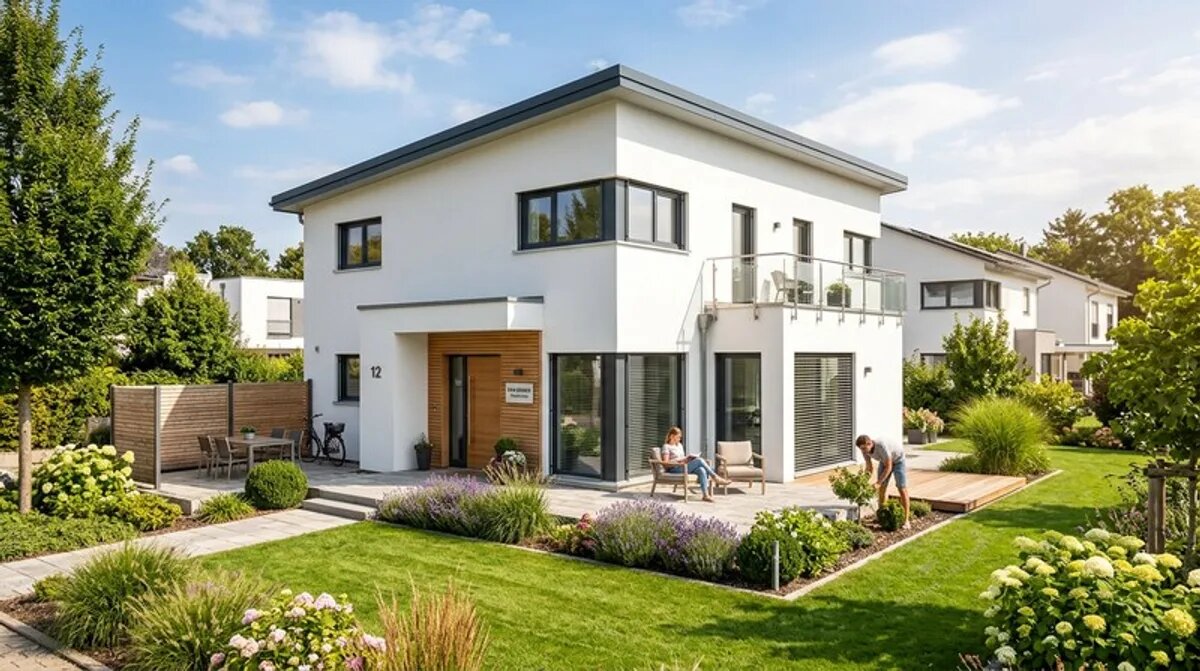
Inheritance Tax Real Estate 2026: Exemptions, Tax Rates & Strategies
How much inheritance tax do I have to pay on a property? – This depends on two factors: the degree of kinship and the value of the inherited property. Spouses and children pay significantly less than siblings or friends. The first step is always: check the tax exemption.
Exemptions for inheritance tax 2026
| Relationship | Exemption | Tax class |
|---|---|---|
| Spouse / registered life partner | 500,000 € | I |
| Children (per child) | 400,000 € | I |
| Grandchildren (if parent deceased) | 400,000 € | I |
| Grandchildren (parent still alive) | 200,000 € | I |
| Parents / grandparents (when inheriting) | 100,000 € | I |
| Siblings, nieces, nephews | 20,000 € | II |
| Non-relatives (friends, life partners without marriage certificate) | 20,000 € | III |
Important: The tax-free allowances apply per person and can be used again every 10 years (gift during lifetime!).

Inheritance tax rates 2026 by value and tax class
| Taxable inheritance | Tax class I (children, spouse) | Tax class II (siblings) | Tax class III (non-relatives) |
|---|---|---|---|
| up to 75,000 € | 7 % | 15 % | 30 % |
| 75,001 – 300,000 € | 11 % | 20 % | 30 % |
| 300,001 – 600,000 € | 15 % | 25 % | 30 % |
| 600,001 – 6 million € | 19 % | 30 % | 30 % |
| over 6 million € | 23–30 % | 35 % | 50 % |
Calculation example: Single-family house in Munich (800,000 €)
A child inherits a house worth 800,000 €:
- Tax-free allowance: 400,000 €
- Taxable inheritance: 400,000 €
- Tax rate (tax class I, 300,001–600,000 €): 15 %
- Inheritance tax: 60,000 €
Would a non-relatives person inherit the same house:
- Exemption: 20,000 €
- Taxable acquisition: 780,000 €
- Tax rate (tax class III): 30 %
- Inheritance tax: 234,000 €

Family Home: When is the real estate tax-free?
The self-occupied family home can be completely exempt from inheritance tax – but only if all three conditions are met:
- The deceased lived in the property until death
- The heir is spouse or child
- The heir moves in and occupies the property for at least 10 years
Warning: For children, additionally applies: The living area must not exceed 200 m². For larger properties, the portion exceeding 200 m² is taxed proportionally.
5 Strategies for Minimizing Inheritance Tax on Real Estate
- Gifts during lifetime: Exemptions can be used again every 10 years. With early planning: Child receives 400,000 € tax-free every 10 years – over 20–30 years, this way the entire real estate value can be transferred.
- Right of use reserved: Parents transfer the real estate to their child, but retain the right of use (right to live in the property + rental income). The value of the right of use significantly reduces the taxable acquisition.
- Register right of residence: Similar to the right of use, but only the right to live in the property without rental income. Reduces the gift value, hence less tax.
- Limited liability company or GmbH & Co. KG: Real estate in corporate structures can use tax exemptions of 85–100% under certain conditions (business assets).
- Partial sale before inheritance: If there are multiple heirs, part of the real estate can be sold and the proceeds distributed – reduces the overall tax burden.
Common questions about inheritance tax on real estate
Muss ich eine geerbte Immobilie sofort verkaufen, um die Erbschaftssteuer zu zahlen?
Nein. Das Finanzamt kann auf Antrag die Erbschaftssteuer bis zu 10 Jahre stunden, wenn die Steuer nur durch den Verkauf der Immobilie beglichen werden könnte und der Erbe die Immobilie selbst bewohnt.
Welchen Wert setzt das Finanzamt für eine Immobilie an?
Das Finanzamt berechnet den Grundbesitzwert nach dem Bewertungsgesetz (BewG). Seit 2023 werden dabei Bodenrichtwerte und Liegenschaftszinssätze stärker berücksichtigt – was die steuerlichen Werte deutlich nach oben getrieben hat und in vielen Fällen höher liegt als der tatsächliche Verkehrswert.
Kann ich ein geerbtes Haus steuerfrei verkaufen?
Ja, wenn der Erblasser die Immobilie seit mehr als 10 Jahren besessen hat (Spekulationsfrist), oder wenn der Erblasser – oder Sie als Erbe – die Immobilie in den letzten 3 Jahren selbst bewohnt haben. Die Erbschaftssteuer ist dabei unabhängig von der Einkommensteuer beim Verkauf zu betrachten.
Wie hoch ist die Erbschaftssteuer bei einem Haus im Wert von 1 Million Euro?
Erbt ein Kind (Steuerklasse I, Freibetrag 400.000 €): steuerpflichtiger Erwerb 600.000 €, Steuersatz 15 bis 19%, Steuer ca. 90.000–114.000 €. Erbt ein Geschwisterkind (Steuerklasse II, Freibetrag 20.000 €): steuerpflichtiger Erwerb 980.000 €, Steuersatz 30%, Steuer ca. 294.000 €.

Book a Private Jet: Process, Aircraft Types, Costs and Charter Services Explained

As Few New Dwellings as 2012: Germany's Construction Crisis at Rock Bottom

Investing 1 Million Euros: Real Estate, ETFs & the Best Strategy

Rental Prices 2026: Why Tenants in Munich, Berlin and Frankfurt Keep Paying More
Real Estate Investment 2026: Why 84 Percent of Investors Are Betting on Residential Property

Tenancy Law Reform 2026: What the New Rent Act II Means for Landlords





Sell a villa in Düsseldorf: Prices, real estate agent, checklist + buyer waiting list
Sell a villa in Düsseldorf: Prices, real estate agent, checklist + buyer waiting list
Sell a villa in Berlin: List, Rating, Prices, Real Estate Agent, Mistakes, Experiences
Villa for sale Hamburg: List, Rating, Prices, Real Estate Agent, Experiences