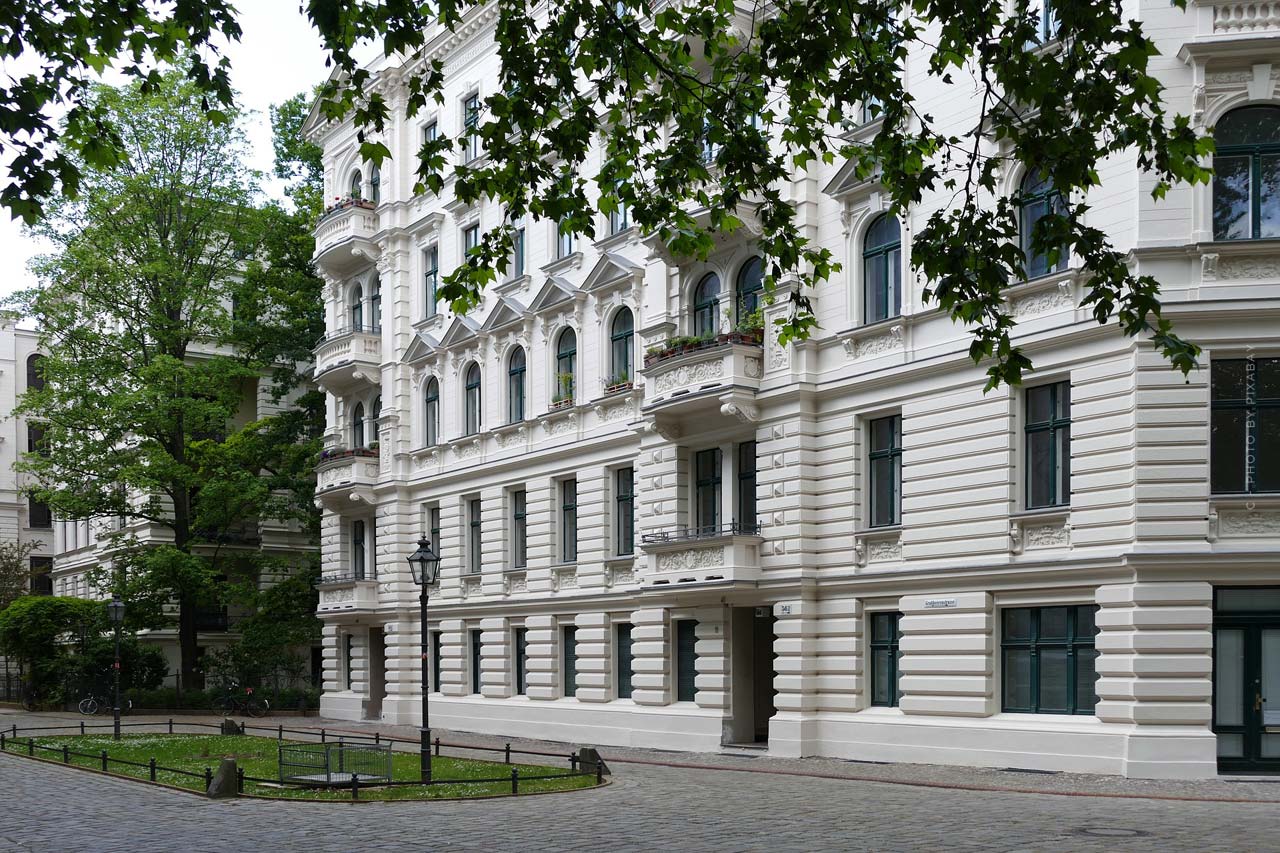

Hausgeld: What is it, how much is it & what is included?
Monthly fees decide when buying a condominium about cash flow, return, and long-term value retention — and are nevertheless regularly underestimated. Anyone who wants to buy their first property or calculates an object as real estate as an investment must necessarily include the monthly fees in the net return calculation. This guide shows what is really included in the monthly fees, which ranges are realistic, what is deductible for tax purposes — and where the typical pitfalls lie, which cost investors thousands of euros per year.
What is the monthly fee — and why is it not a “miscellaneous item”?
The house fee is the monthly contribution that each property owner pays to the homeowners’ association (WEG). It covers all costs related to the common property — everything from the staircase and facade to the elevator. Unlike with a single-family home, the ETW owner does not pay these costs directly to suppliers or tradespeople, but as a monthly prepayment to the WEG management.
House fee as a second payment alongside the bank
Economically, the house fee is a second payment alongside bank financing. Someone planning a €1,500 loan payment will quickly pay an additional €280–360 per month for an 80 m² apartment — and for life, even after the loan is fully repaid.
- Mandatory contribution: legally binding according to the economic plan, decided in the owners’ meeting
- Prepayment: paid monthly, settled annually (supplement or credit balance)
- Composite amount: chargeable operating costs + non-chargeable management and reserve costs
- Cash flow relevant: significantly reduces the net rental yield, often by 0.5–1.2 percentage points
- Indicator: too low a maintenance fee is usually a warning sign — no bargain
Legal basis: WEG, WEMoG and economic plan
The amount is not arbitrarily determined, but set by the economic plan according to § 28 WEG and decided upon by majority vote at the owners’ meeting. With the WEG reform (WEMoG), the decision-making authority for structural changes has been simplified — a simple majority is now sufficient, which speeds up renovations, but also increases the risk of special levies. Anyone who refuses to pay risks late fees and, in extreme cases, the revocation of property ownership under § 17 WEG.
What the WEG reform specifically changes for investors
- Certified manager: owners are entitled to a certified manager — quality improvement, but also higher management costs
- Structural changes: a simple majority suffices (§ 20 WEG) — majority can enforce modernisations, costs are borne by those who benefit
- Online meeting: allowed since the reform — easier participation for investors with multiple properties
- Right to sue: now with the WEG, not anymore with individual owners — faster processes


What is included in the service charge?
The composition varies depending on the property — crucial factors are year of construction, equipment, and existing communal facilities. A property without an elevator has a completely different cost structure than a new build with underground garage and concierge.
| Position | Description | Share (approx.) |
|---|---|---|
| Property Management | Compensation for professional WEG management | 15–20 % |
| Building insurance | Fire, water pipes, storm/hail, liability | 10–15 % |
| Reserve fund | Mandatory reserve for future repairs (§ 19 WEG) | 20–30 % |
| Building caretaker / cleaning | Stairwell cleaning, garden maintenance, snow removal | 10–15 % |
| General electricity | Stairwell, basement garage, outdoor area | 5–8 % |
| Heating (base share) | Central heating, maintenance, chimney sweep | 10–20 % |
| Waste disposal | Shared waste containers | 3–5 % |
| Elevator maintenance | Maintenance, TÜV inspection, emergency call system | 5–8 % |
What is not included in the housing fee
Misunderstanding: Several costs are not included in the housing fee, but are paid separately — and must be planned for separately in every cash flow calculation.
- Own electricity/gas: Direct contract with the energy provider
- Internet, phone, TV: except in case of shared cable contract
- Repairs in common property: everything within your own walls (flooring, interior doors, sanitary fixtures)
- Land tax: paid directly to the tax office
- Home contents insurance: for your own furnishings, it is private
- Financing costs: interest and repayment to your own bank — not part of the WEG
How high is the housing fee? Realistic ranges by property type
The often-cited rule of thumb “2.50–4.00 €/m²” is okay as an average, but too rough for investors. Anyone wanting to calculate realistically must differentiate by property type — luxury properties can cost twice as much.
Ranges by property type
| Object type | Service charge per m²/month | Example 80 m² | Drivers |
|---|---|---|---|
| Existing buildings before 1990, without elevator | 2.00–3.00 € | 160–240 € | basic furnishings, possible high renovation backlog |
| Renovated existing buildings, with elevator | 3.00–4.00 € | 240–320 € | elevator, underground garage, well-maintained facade |
| New build standard | 3.50–4.50 € | 280–360 € | ventilation, photovoltaics, higher insurance values |
| Premium / new build luxury | 5.00–7.00 € | 400–560 € | concierge, spa, high-quality outdoor areas |
| Luxury resort / penthouse | 7.00–9.00 €+ | 560–720 €+ | 24/7 service, pool, wellness, security |
In luxury properties, the service charge regularly eats up 1–1.5 percentage points of gross yield. Those who calculate with standard values systematically beautify the investment calculation.
Location effect: A-city vs. medium-sized city in direct comparison
Location also significantly drives the service charge. In A-cities, management and caretaker costs regularly exceed those in medium-sized cities by 20–35% — even with identical property quality.
| Location | Management €/unit/month | Caretaker €/m²/year | Total Service Charge for 80 m² |
|---|---|---|---|
| Munich / Frankfurt / Hamburg | 28–35 € | 4.80–6.50 € | 290–360 € |
| Berlin / Düsseldorf / Stuttgart | 24–30 € | 4.00–5.50 € | 260–320 € |
| B-cities (Leipzig, Hannover, Bremen) | 20–26 € | 3.20–4.50 € | 220–280 € |
| Medium-sized city / District town | 16–22 € | 2.50–3.80 € | 180–240 € |
Service Charge Increase Over Time
What many investors overlook: service charges continuously increase — typically 2–4% per year, even up to 5–8% during periods of high inflation. Drivers include especially energy, building insurance, and management fees. For a serious 10-year cash flow plan, this increase must be modeled in.
- Insurance: +5–10 % p. a. (natural disasters, higher reconstruction costs)
- Energy (general electricity, heating): highly variable, significantly increasing in the long term
- Property management fee: +3–5 % p. a. common since the WEG reform
- Building manager/cleaning: +3–4 % p. a. (wage development)

Monthly charges and return: The cash flow effect
For investors, the monthly charges are not an abstract item, but a direct return killer — as long as they are not transferable to the tenants. The truth: Approximately 30–40 % of the monthly charges remain with the owner, the rest can be passed on to the tenant. Anyone who wants to calculate the purchase price factor and seriously input it into the
Example calculation: 80-m² apartment as an investment
The following overview shows three typical scenarios — from the renovated existing property to the luxury property — and makes the return loss due to the non-transferable monthly charges visible.
| Item | Renovated stock | New build | Luxury |
|---|---|---|---|
| Purchase price | 320.000 € | 520.000 € | 950.000 € |
| Rent (€/m²) | 12 € | 16 € | 28 € |
| Annual rent | 11.520 € | 15.360 € | 26.880 € |
| Gross return | 3,60 % | 2,95 % | 2,83 % |
| Total maintenance fee/year | 3.360 € | 3.840 € | 6.720 € |
| of which not chargeable (~35 %) | 1.176 € | 1.344 € | 2.352 € |
| Return loss due to maintenance fee | −0,37 %p | −0,26 %p | −0,25 %p |
Special charge killer: Return killer special charge – Stress scenario
What the standard calculation does not show: every 7–10 years, a special charge threatens in every WEG. Whoever has not planned for roof renovation, facade or new heating system loses an additional half return point in reality. The stress scenario for the renovated stock:
- Special charge for roof renovation: 12.000 € one-time after 8 years
- Converted to remaining term: corresponds to additional 1,500 €/year of equity commitment
- Effective return reduction: further −0.47 %p on the net return
- Consequence: from 3.60 % gross, realistically often 2.2–2.5 % net after tax
What the gross return hides
As described in the guide on

Maintenance reserve — the most sensitive part of the service charge
The reserve is legally required (§ 19 Abs. 2 No. 4 WEG) and is saved on a separate WEG account. The key point: it belongs to the WEG, not to the individual owner. When selling, you receive nothing in return — the buyer takes over proportionally.
How much reserve is sensible?
The necessary reserve amount depends directly

Book a Private Jet: Process, Aircraft Types, Costs and Charter Services Explained

As Few New Dwellings as 2012: Germany’s Construction Crisis at Rock Bottom

Investing 1 Million Euros: Real Estate, ETFs & the Best Strategy
Rental Prices 2026: Why Tenants in Munich, Berlin and Frankfurt Keep Paying More

Real Estate Investment 2026: Why 84 Percent of Investors Are Betting on Residential Property

Tenancy Law Reform 2026: What the New Rent Act II Means for Landlords






Sell a villa in Düsseldorf: Prices, real estate agent, checklist + buyer waiting list
Sell a villa in Düsseldorf: Prices, real estate agent, checklist + buyer waiting list
Sell a villa in Berlin: List, Rating, Prices, Real Estate Agent, Mistakes, Experiences

Villa for sale Hamburg: List, Rating, Prices, Real Estate Agent, Experiences