
Berlin | Reinickendorf | Apartment Building | 3,600,000 € with approx. 4.6% Yield
An apartment building in Berlin-Reinickendorf for €3,600,000 with approx. 4.6% gross yield — this is an offer that deserves close scrutiny in the current Berlin market environment. The question is not whether Reinickendorf is a safe location (it is), but whether the purchase price, purchase price multiplier, and rent level lead to a sustainable cash flow. We show the key figures, compare the location with other Berlin districts, and place the property in the context of a professional investment property — including the typical pitfalls of buying an apartment building in the capital.
Reinickendorf: Micro-Location and Buyer Profile
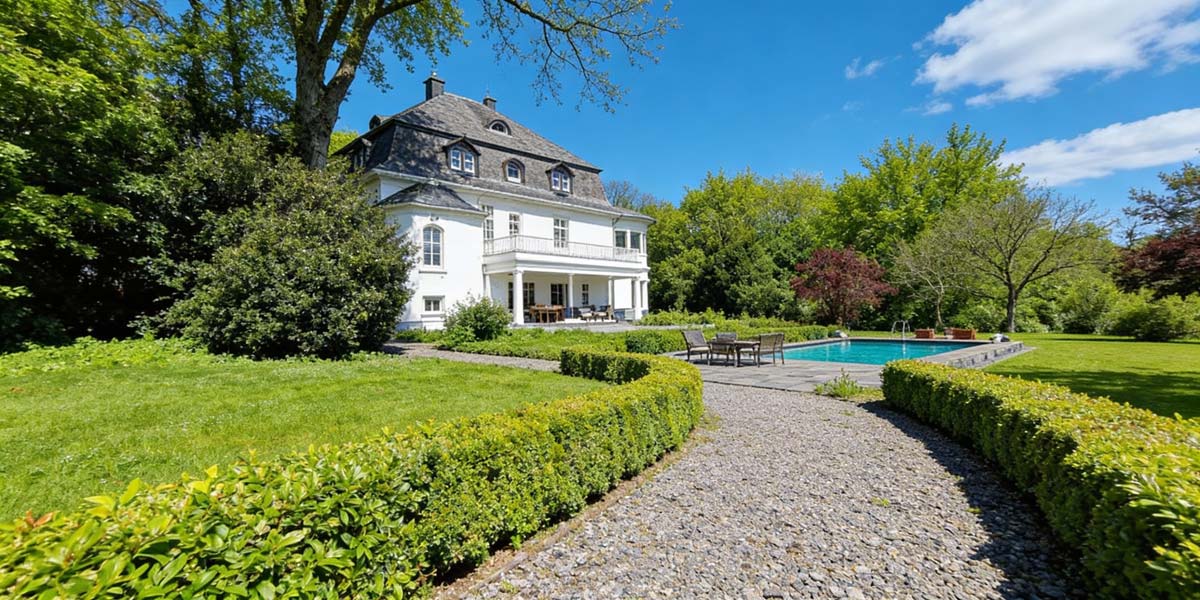
Reinickendorf in Berlin’s northwest is positioned demographically and structurally quite differently from the inner-city trend districts. The district is among Berlin’s greenest — Lake Tegel, the Tegel forest, and numerous parks shape its character. Buyers here are less often speculatively driven, but rather long-term-thinking asset holders and family offices.
What Makes Reinickendorf Special for MFH Investors
- Housing structure: high share of single-family and terraced houses, resulting in a scarce apartment building supply — structurally rent-stabilizing
- Tenant profile: families, commuters, middle class with long tenancies (often 8+ years) — low turnover
- Transport: S-Bahn ring connection + S25, U6 to Alt-Tegel, A111 to Hamburg — relevant after the BER airport connection
- Urban development: the former TXL airport site (“Berlin TXL — The Urban Tech Republic”) as a long-term value driver
- Buyer segment: private asset managers, no dominant fund pressure as in Mitte or Friedrichshain
Typical Property Types in the District
The district consists of very heterogeneous localities — Alt-Reinickendorf, Hermsdorf, Frohnau, Tegel, Wittenau, Märkisches Viertel. Building quality ranges from Wilhelminian-era apartment buildings in Tegel to 1950s row-block construction to the large housing estate Märkisches Viertel.
- Alt-Tegel/Hermsdorf: pre-war and villa-style apartment buildings, high per-square-meter prices
- Wittenau/Reinickendorf-Ost: 1950s–1970s stock, classic yield property
- Frohnau: villa colony, hardly any apartment buildings, high land values
- Märkisches Viertel: large housing estate, institutional holdings
- Borsigwalde/Tegel-Süd: mixed stock, good yield opportunities over medium time horizons

Price Level: Reinickendorf Compared to Berlin
Reinickendorf is priced below the Berlin average — this is not a sign of weakness, but rather widens the gap between purchase price and achievable rent. That’s exactly why multipliers of 20–22 are realistic here, while Prenzlauer Berg or Mitte demand 28–34.
| District | Avg. MFH multiplier | Avg. purchase price €/m² | Avg. gross yield |
|---|---|---|---|
| Mitte | 28–34 | 5,500–7,500 | 2.9–3.6% |
| Prenzlauer Berg | 27–32 | 5,800–7,800 | 3.1–3.7% |
| Charlottenburg | 24–28 | 4,800–6,500 | 3.5–4.2% |
| Reinickendorf | 18–22 | 3,200–4,500 | 4.5–5.5% |
| Spandau | 17–21 | 2,900–4,000 | 4.8–5.8% |
| Marzahn-Hellersdorf | 16–20 | 2,600–3,600 | 5.0–6.0% |
For this specific property at €3,600,000 and 4.6% gross yield, the resulting multiplier is approx. 21.7 — solid within the upper Reinickendorf market segment, but not overpriced.
Rule of thumb for Berlin: gross yield × purchase price multiplier ≈ 100. At 4.6% yield × 21.7 multiplier = 99.8 — the market is pricing consistently.
The Key Figures in Detail
A gross yield of 4.6% sounds attractive, but says nothing about actual cash flow. What matters is what’s left after operating costs, maintenance reserve, and financing.
Gross Yield vs. Net Yield
Calculating gross yield is only the starting point. Realistic planning must focus on calculating net yield — which for MFH in Berlin is typically 1.0–1.4 percentage points below the gross yield.
- Gross yield: 4.6% (annual net cold rent ÷ purchase price)
- Non-allocable costs: approx. 15–20% of the cold rent (management, caretaker, insurance)
- Maintenance reserve: €8–12/m² annually for existing buildings
- Realistic net yield: 3.3–3.6% before tax
- Rent-loss allowance: 2% of target rent as a reserve
Correctly Factoring In Purchase Ancillary Costs
Berlin levies 6.0% real estate transfer tax — nationwide, along with Brandenburg, North Rhine-Westphalia, Saarland, Schleswig-Holstein, and Thuringia, at the upper end. Anyone wanting to calculate purchase ancillary costs should budget approx. 7.5–8.0% of the purchase price.
| Item | Rate | Amount at €3.6 million |
|---|---|---|
| Real estate transfer tax Berlin | 6.0% | €216,000 |
| Notary fees | ~1.2% | ~€43,200 |
| Land registry entry | ~0.5% | ~€18,000 |
| Broker’s commission (if applicable) | 3.57% gross | ~€128,500 |
| Total | ~11.3% | ~€405,700 |
The real capital outlay for the acquisition is around €4.0 million — this is the figure that should form the basis for any sound yield calculation, not the bare purchase price.


Financing: Equity and Cash Flow Logic
For an MFH of this size, banks typically expect 25–35% equity plus ancillary costs — under current interest rate conditions, higher loan-to-value ratios are only achievable with worse terms. Calculating the equity requirement is the step that precedes every negotiation.
Example Financing Calculation
- Purchase price: €3,600,000
- Purchase ancillary costs: ~€290,000 (without broker) to ~€405,000 (with broker)
- Equity ~30%: approx. €1,080,000 on purchase price + ancillary costs
- Loan: approx. €2,520,000
- Annuity at 3.8% interest / 2% amortization on a mortgage: ~€146,200/year
- Annual net cold rent at 4.6%: ~€165,600
- Cash flow before tax (simplified): +€19,400/year
The cash flow buffer is tight — a two-month rent-loss phase can turn the year negative. As described in the guide buying your first property, the liquidity reserve should be at least 6 months’ rent.
Stress Test for the Bank Presentation
Banks don’t finance best-case calculations. Anyone wanting to be taken seriously in negotiations presents three scenarios — and communicates openly at what point the property no longer holds up.
| Scenario | Rent loss | Interest rate | Cash flow p.a. |
|---|---|---|---|
| Best case | 0% | 3.5% | +€28,500 |
| Base case | 2% | 3.8% | +€19,400 |
| Stress case | 5% | 4.3% | −€6,800 |
The stress test shows the real breaking point: if interest rates and vacancy rise simultaneously, cash flow tips into negative territory. This is exactly what depreciation benefits and hidden reserves in the rent buffer exist for — but both must be actively realized.
Checklist: Due Diligence Before Purchase
Before submitting an offer, every one of the following topics must be checked. Only then is the 4.6% figure reliable.
- Tenant list: with contract start date, cold rent, m², indexation — per unit
- Energy certificate: energy condition (heating type, insulation, windows)
- Maintenance backlog: quantified (roof, façade, risers, electrics)
- Rent-index comparison: Reinickendorf — rent reserve or rent cap exhausted?
- Land registry excerpt: current (sections II + III, rights of way, encumbrances)
- Register of building encumbrances: and Berlin contaminated-sites register
- Declaration of division: if WEG, or existing building file at the district office
- Operating cost statements: proof of non-allocable costs for the last 3 years
- Valuation: using the income approach as a plausibility anchor
- Cash flow model: cash flow calculator with three scenarios (best/base/stress)
Tax Aspects of Acquiring an MFH
For a holding period of less than 10 years, the speculation tax on real estate under §23 EStG applies upon later sale. Only after the speculation period of 10 years has elapsed is the capital gain tax-free. For a yield property of this size, the long-term holding perspective is the standard case anyway.
Depreciation as a Yield Lever
- Standard straight-line depreciation: 2.0% p.a. on building value (built after 1924) or 2.5% (before 1924)
- Purchase price allocation: land vs. building — for a Reinickendorf location typically 25–35% land share
- Maintenance expenses: immediately deductible (≠ acquisition-related expenses in the first 3 years!)
- Interest: fully deductible as income-related expenses
- Tax loss carryforward: with tight cash flow, often genuinely negative income from rental and leasing
Acquisition-Related Production Costs — The Costly Classic
§ 6 (1) No. 1a EStG is the tax pitfall when buying an existing building: if modernization and repair costs in the first three years after acquisition exceed 15% of the building’s acquisition cost (net), they are mandatorily reclassified as production costs — and thus deductible only over the 50-year depreciation period instead of immediately as income-related expenses.
Consequence: anyone buying an MFH in need of renovation should either stretch small measures beyond the three-year threshold or deliberately plan a full renovation as production costs — the mixed variant is the most expensive option from a tax perspective.
Berlin as an Investment Location — Strategic Classification
The Berlin housing market shows structural scarcity: net migration inflow, low construction activity in the free-market segment, regulatory pressure on rent increases. Reinickendorf benefits from this without bearing the price pressure of the inner-city districts — resulting in a risk-return profile that is particularly attractive for asset holders with a 15+ year horizon.
Anyone wanting to understand the market more broadly will find the current assessment in the guide buying real estate market situation. For a comparative yield perspective across asset classes, the yield comparison is helpful.
Non-Obvious Insider Lever: the TXL Site
The former Tegel airport site is being developed into the “Urban Tech Republic” and a residential quarter (“Schumacher Quartier”) with several thousand housing units. For asset holders in the immediate surroundings (Borsigwalde, Tegel-Süd, Wittenau), this means: a two-stage effect from job influx and neighborhood upgrading — for MFH purchases that are still priced today at standard Reinickendorf multipliers.
- Jobs: several thousand highly qualified research and tech jobs planned
- Housing construction: Schumacher Quartier with approx. 5,000 housing units — relieves pressure but also creates a pull effect
- Public transport: planned subway extensions and new bus routes to the site
- Spillover effect: existing rents within a 2 km radius with above-average indexation potential
- Time horizon: full effect only from quarter completion — early buyers benefit most
Facts About the Property
The following overview compactly summarizes the key data of the investment — as a quick reference for the investor decision and bank presentation.
- City: Berlin
- District: Reinickendorf
- Property type: apartment building
- Approx. purchase price: €3,600,000
- Approx. gross yield: 4.6%
- Purchase price multiplier: ~21
You might also like
Influencer Marketing: Creativity Meets Strategy – Join CM Creator

Real Estate Depreciation (AfA): Calculation, Rates & Example
Property GmbH 2026: Does a Limited Company Pay Off for Real Estate Investors?

Real Estate AI GDPR-compliant: Privacy Policy, standard land values & rental law for investors

Self-Occupancy Termination: Requirements, Deadlines & Tenant Rights
Land Register: Structure, Sections & Key Entries Explained
Discover moreNotaryNotary Costs When Buying a House: Table, Calculation… SellSell a villa in Düsseldorf: Prices, real estate…
 InvestmentInvestment Real Estate: What You Need to Pay…BerlinBerlin | Mitte | Apartment building | 15,000,000…BerlinBerlin | Lichterfelde | Apartment building | 4,450,000…BerlinBerlin | Friedrichshain | Apartment building | 2,680,000…BerlinBerlin | Friedrichshain | Apartment building | 3,100,000…BerlinBerlin | Kreuzberg | Apartment building | 3,700,000…BerlinBerlin | Prenzlauer Berg | Apartment building |…BerlinBerlin | Kreuzberg | Apartment building | 5,000,000…Readers also enjoyed
Berlin | Reinickendorf | Apartment building | 4,650,000 € with approx. 4.5% return
I Ordered Cannabis Online! #GameChanger - My Experience with CannaZen

Company fruit! Vitamins! Power! Small recommendation & a healthy idea for your office

Real Estate Software to Create Yourself: ChatGPT Example Link Structure Investment