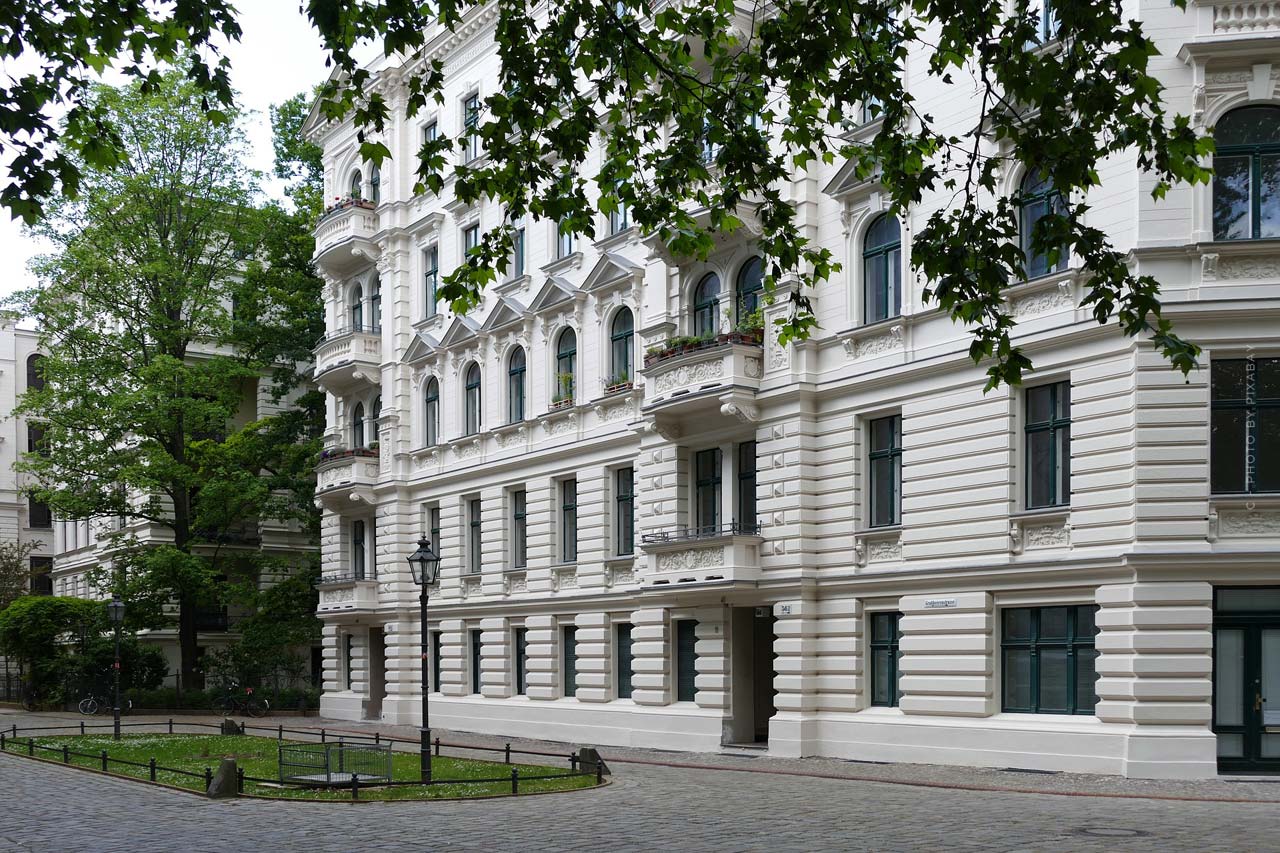

Berlin | Neukölln | Apartment Building | 6,500,000 € with approx. 3.74% Yield
An apartment building in Berlin-Neukölln for €6.5 million with a 3.74% gross yield — at first glance, a classic Berlin multi-family investment. But anyone who seriously calculates it as an investment property knows: 3.74% is above average for Berlin if the rents are sustainable — and below average if the building sits in a preservation area (Milieuschutz) with cold rents below market level. This article analyzes the Neukölln micro-location, contextualizes the purchase price multiplier, works through a complete cash flow scenario, and shows what you need to check before submitting an offer.
Neukölln in the Berlin Investment Market
Neukölln is not one market, but two. Anyone investing indiscriminately in “Neukölln” overlooks the fundamental divide between the urban north around the Reuter, Schiller, and Rollberg neighborhoods and the suburban south with Britz, Buckow, and Rudow. Price differences of 30 to 40 percent apply — with very different tenant structures, marketing periods, and exit options.
North Neukölln: Kreuzberg-Level Pricing Without the Kreuzberg Address
The northern part borders directly on Kreuzberg and has largely caught up with its price level. Existing buildings in good locations trade at purchase price multipliers between 25 and 32, and in prime locations along Weserstraße or Maybachufer, even higher. Characteristic features: a high share of young, well-earning tenants, high turnover, and consequently good opportunities for rent adjustments upon re-letting — provided no preservation statute applies.
South Neukölln: Stronger Yields, but Location-Dependent
In Britz, Buckow, and Gropiusstadt, multipliers range from 18 to 23. This is significantly more attractive for pure cash flow investors — but carries structural risks in tenant profile, social structure, and modernization scope. The Hufeisensiedlung as a UNESCO World Heritage Site is a special case with additional heritage protection requirements.
Micro-Location Check: Which Neighborhoods Attract Which Buyers
Reuterkiez and Weserstraße are the hotspots for international asset holders; Schillerkiez and Rixdorf are considered a still under-valued insider tip with price appreciation momentum. In the south, family-office capital with a long time horizon dominates.
Typical Seller Structure in Neukölln
Anyone buying apartment buildings in Neukölln rarely buys from professional asset holders — they tend to hold. The seller structure is atypical and explains why so many deals happen off-market:
- Communities of heirs: By far the most common seller type — often several heirs, limited expertise, pressure to sell due to internal disputes, frequently sold below market value.
- Old Berlin property owners (second generation): Selling due to age or because the next generation has no interest in management. Tend toward conservative rent levels, often resulting in rent increase potential.
- Restructured family offices: Portfolio cleanup — selling smaller assets to reallocate into larger volumes.
- Distress sales after deferred maintenance: Owners unable to cope with GEG (building energy law) requirements and interest burden — offering substance risk but also genuine price discounts.

Price Level and Yields in Comparison
The table below shows the typical ranges for apartment buildings in the Neukölln micro-locations — compared with the Berlin city average. The figures relate to let existing properties built before 1960.
| Micro-location | €/m² Purchase | Cold rent €/m² | Purchase price multiplier | Gross yield |
|---|---|---|---|---|
| Reuterkiez / Weserstr. | 5,500–7,500 | 13–16 | 28–34 | 2.9–3.5% |
| Schillerkiez / Körnerpark | 4,800–6,500 | 12–14 | 26–30 | 3.3–3.8% |
| Rixdorf / Richardplatz | 4,500–6,000 | 11–13 | 24–28 | 3.5–4.1% |
| Britz / Buckow | 3,200–4,500 | 9–11 | 20–24 | 4.1–5.0% |
| Berlin City Average MFH | 4,500–6,000 | 11–13 | 24–28 | 3.5–4.1% |
Classifying This Specific Property
At a purchase price of €6.5 million and a 3.74% gross yield, the implied annual net cold rent is around €243,000, giving a purchase price multiplier of roughly 26.7 — consistent with Schillerkiez/Rixdorf level. For details on the calculation, see calculating gross yield and calculating net yield.
When a Multiplier of 26.7 Is Actually Fair
A multiplier just under 27 is only fair in Neukölln if rents are below market level or modernization potential exists. If index rents are already fully exhausted at the maximum rent index level, the price is ambitious.
A purchase price multiplier of 26 to 27 in Neukölln is only fair if rent-increase potential can still be captured. If rents are already at the maximum of the local rent index and the building is subject to a preservation statute, 3.74% is the yield plateau for the coming years — not the entry point.
Leverage Effect Through Modernization: Before/After
The table below shows how the purchase price multiplier shifts through clean modernization and rent adjustment in a property not burdened by preservation statutes — as a plausibility check on value creation:
| Status | Cold rent €/m² | Multiplier today | Multiplier in 5 yrs | Gross yield |
|---|---|---|---|---|
| Existing, unrenovated | 10.50 | 26.7 | 27.5 | 3.7% |
| Index rent exhausted | 11.80 | 23.8 | 24.5 | 4.2% |
| Modernization + re-letting | 13.50 | 20.8 | 21.4 | 4.8% |
| Full premium renovation | 15.50 | 18.1 | 18.6 | 5.5% |


Preservation Statute (Milieuschutz): The Underestimated Yield Killer
Large parts of North Neukölln lie within social preservation areas under § 172 of the German Building Code (BauGB). This has hard consequences for investors that are often completely missing from gross yield assessments. As described in the guide on property valuation, checking the preservation statute is mandatory due diligence — before any purchase price commitment.
Modernization and Cost Allocation
- Modernization surcharge capped: Limited nationwide to 8% of modernization costs per year; in preservation areas additionally subject to approval and often only partially allocable.
- Rent cap in Berlin: Rent increases in Berlin are capped at 15% over three years — even without a preservation statute.
- Restricted standard upgrades: Luxury renovations (concierge, retrofitted elevator, high-end bathrooms, second bathroom) require approval in preservation areas and are mostly rejected.
- Mandatory energy modernization: GEG requirements must still be met — without full cost-allocation possibility. That’s the yield squeeze.
Exit, Right of First Refusal, and Termination Moratorium
- Conversion ban: Subdividing into condominium ownership under WEG law requires approval and is often effectively blocked — largely eliminating the “subdivide and sell individually” exit strategy.
- District’s right of first refusal: The Neukölln district has historically made active use of this — the closing risk is real and can delay the acquisition by up to two months after submission of the purchase agreement.
- Avoidance agreement: The buyer can avert the right of first refusal by contractually committing to social conditions (rent caps, no luxury renovation, no WEG application) — typical term 20 years.
- Termination moratorium § 577a BGB: After conversion, Berlin applies a 10-year moratorium on terminations for own use or economic exploitation — relevant for the end-buyer exit.
- Restricted vacancy: Speculative vacancy to drive up rents is prohibited under the misuse-of-housing ban and subject to fines.
Practical Consequence for the Calculation
A preservation-statute property should be valued with a multiplier discount of 1.5 to 3.0 compared to a comparable unrestricted property. Anyone paying 26.7 for a preservation-statute building with fully exhausted rents is effectively buying at a multiplier of 28–29 relative to the open market.

Yield Analysis: From Gross 3.74% to a Realistic Net Figure
The communicated gross yield of 3.74% is the annual net cold rent divided by the purchase price — without ancillary costs, without operating costs, without rent-loss allowance. For a sound investment decision, you need to calculate further.
Purchase Ancillary Costs: What Actually Comes Out of Pocket
In Berlin, the real estate transfer tax currently stands at 6.0%. Plus notary and land registry fees (around 1.5–2%) plus any broker’s commission, purchase ancillary costs come to 7.5 to 13.5%. At €6.5 million, that’s an additional €490,000 to €880,000. See details under calculating purchase ancillary costs, calculating notary fees, and real estate transfer tax by federal state comparison.
Operating Costs in Detail
The table below breaks down the typical operating cost items for a Berlin pre-war apartment building — as a bridge between gross and net yield:
| Item | €/m² p.a. | % of cold rent | p.a. in example |
|---|---|---|---|
| Management costs | 3.50–5.00 | 3–4% | 9,700 |
| Non-allocable building costs | 2.00–3.50 | 1.5–3% | 6,100 |
| Maintenance reserve | 12.00–18.00 | 10–14% | 36,500 |
| Rent-loss allowance | 2.50–4.00 | 2–3% | 6,100 |
| CapEx reserve (energy-related) | 8.00–15.00 | 6–12% | 24,300 |
| Total operating costs | 28.00–45.50 | 22–36% | 82,700 |
See details under maintenance reserve. For pre-1978 buildings, a CapEx reserve of a realistic €400–800/m² in renovation needs over the next 10–15 years should be assumed.
Mandatory GEG Renovations for Pre-1960 Buildings
- Heating replacement obligation: Mandatory replacement for heating systems older than 30 years; from defined thresholds, a 65% renewable-energy requirement applies.
- Top-floor ceiling insulation obligation: If not already insulated, a minimum insulation value under GEG applies.
- Hydraulic balancing: Mandatory for buildings with six or more residential units.
- Insulation of hot water and heating pipes: In unheated areas (basement).
- Energy performance certificate obligation: Mandatory upon sale and re-letting; a demand-based certificate is sometimes mandatory for smaller buildings.
Full Cash Flow Scenario (Example Calculation)
Conservative calculation at a €6.5 million purchase price, 60% debt financing, 4.0% interest rate, 2.0% amortization, 9% purchase ancillary costs: