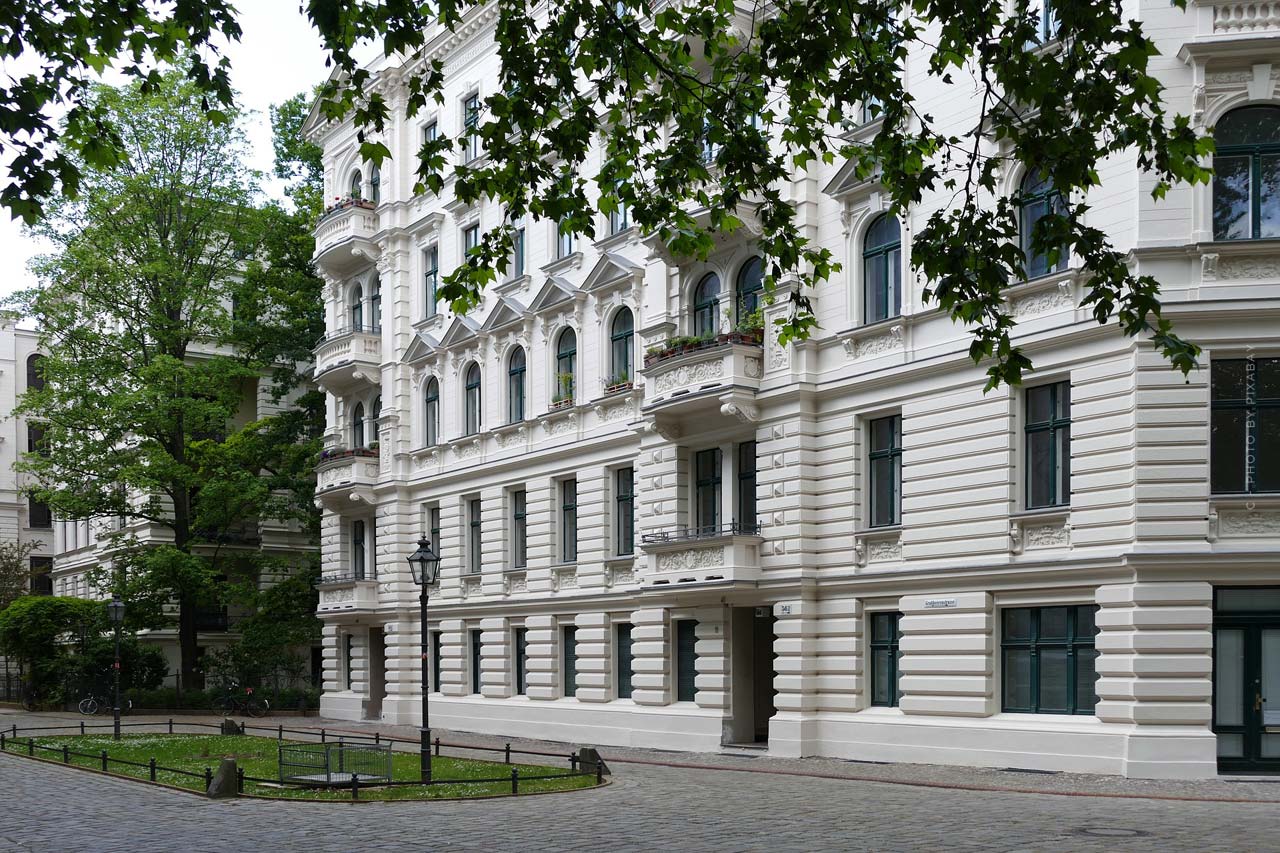

Apartment building for sale Taxes: Speculation tax for owner-occupation, Heritage & Co.
Sell an apartment building – Control – Do you want to sell your apartment building? This not only involves the usual costs for control, notary and land registry office, but also some control payments. Find out here which controls you have to consider when selling your apartment building. Additionally: How you can save on controls and what matters when selling an inherited apartment building. Questions? Write to me or call, completely non-committal: Contact us.
Control when selling an apartment building
Read more here:

Which taxes apply when selling an apartment building?
Selling an apartment building can be associated with significant tax payments. At a glance:
| Tax type | Due | Amount | Avoidable? |
|---|---|---|---|
| Speculation tax | When selling within 10 years | Personal income tax rate (up to 45%) | Yes, after 10 years |
| Trade tax | Commercial real estate trading | 15–17% + municipal surcharge | Yes, with the right structure |
| Value added tax | Only if VAT option is chosen | 19% | Yes, standard case tax-free |
| Corporate tax | When selling through a GmbH | 15% + solidarity surcharge | – |
Speculation tax on an apartment building
Also for multi-family homes, the 10-year speculation period (§ 23 EStG) applies. The period begins with the notarized purchase contract. Decisive:
- After 10 years: Capital gain from sale fully tax-free (private individual)
- Under 10 years: The prize is taxed at the personal income tax rate
- Self-Occupancy: For MFH, the 3-year self-occupancy rule applies only to the unit occupied by the owner, not to the entire building.
- Exemption: 600 € per year (§ 23 Abs. 3 EStG) – usually not relevant for MFH sales
Calculation of the capital gain
Formel: Selling price − purchase costs − additional costs − depreciation (depreciation Real Estate Depreciation: Depreciation & Rates) + taxable depreciation amounts
Important: Depreciation already deducted (AfA) is added back to the taxable profit upon sale (AfA recalculation). This significantly increases the effective tax burden.



Commercial Tax: When Does It Apply?
Private individuals who hold real estate as an investment generally pay no commercial tax. The situation becomes risky with the so-called Three-Property Threshold:
- Anyone who buys and sells more than three properties within five years is considered a commercial real estate dealer
- Consequence: All profits – even retroactively – become subject to commercial tax
- Commercial tax: approximately 15 % corporate tax + local surcharge (effectively 30–40 %)
- The 10-year speculation exemption is lost in commercial trading!
Solution: Hold each property for longer than five years or structure ownership through separate GmbHs/holding structures.
When selling larger multi-family homes owned by a company, there are two sale structures:
| Asset Deal | Share Deal | |
|---|---|---|
| What is being sold? | The plot/building itself | Shares in the GmbH/KG that holds the MFH |
| Purchase tax buyer | Full 3.5–6.5 % applicable | For <90 % acquisition: waived (structuring model) |
| Tax seller | Corporate tax on profit (15 % + solidarity surcharge) | Partial income procedure (60 % taxable) |
| Buyer preference | Possible to increase depreciation | Saving on purchase tax |
| Risk | Higher transaction costs | Liability for old debts |
Saving taxes: Strategies for MFH sellers
- Wait 10 years: For privately held MFH the simplest way to achieve tax exemption
- Sell in a bad income year: For example, after retirement or in a loss year
- Offset losses: Losses from other property sales in the same year reduce the profit
- Transfer to children before sale: Gift to children in a lower tax class (observe holding periods!)
- Limited liability company structure: MFHs sold within the GmbH structure are subject to only 1.5 % effective tax when retained (§ 8b KStG) — complex structure, tax advisor necessary
- 1031-Exchange Analogue (DE: Reinvestment): No direct equivalent, but tax advisors can delay the tax burden through clever reinvestment planning
MFH Inheritance: Taxes when selling an inherited apartment building
If an apartment building is inherited and then sold, special rules apply:
- The speculation period starts from the deceased’s purchase date – not from the inheritance
- If the deceased bought the MFH more than 10 years ago: Sale after inheritance is tax-free
- If the deceased lived in the MFH themselves (only one unit): The 3-year rule applies to this unit
- Inheritance tax and speculation tax can apply simultaneously – independent of each other
- Exemptions for inheritance tax: 400,000 € (children), 500,000 € (spouse)

Sell villa in Meerbusch: Sought-after villa location near Düsseldorf

Heritage Self-Help Groups: Inherited Money, What to Do? Step-by-Step Guide

Selling an apartment building in Munich: What is important? Steps, taxes, estate agent

Real estate asset deal: What is it? + tax example

Real estate holding: box privilege and only 1.54% tax on sale

Selling an apartment building in Düsseldorf: what you need to know











Real Estate Location Quickly Explained: Investing in A-Location, B-Location and C-Location @ Inglewood, LA – New Video

Investment Real Estate: What You Need to Pay Attention to When Buying Your First Property

Florida as a tax haven: Benefits for businesses, real estate owners and investors – USA
Delaware as a tax haven: Advantages for businesses, real estate owners and investors – USA