Sell water source: Process, Rating, anonymous sale of Plot & Source
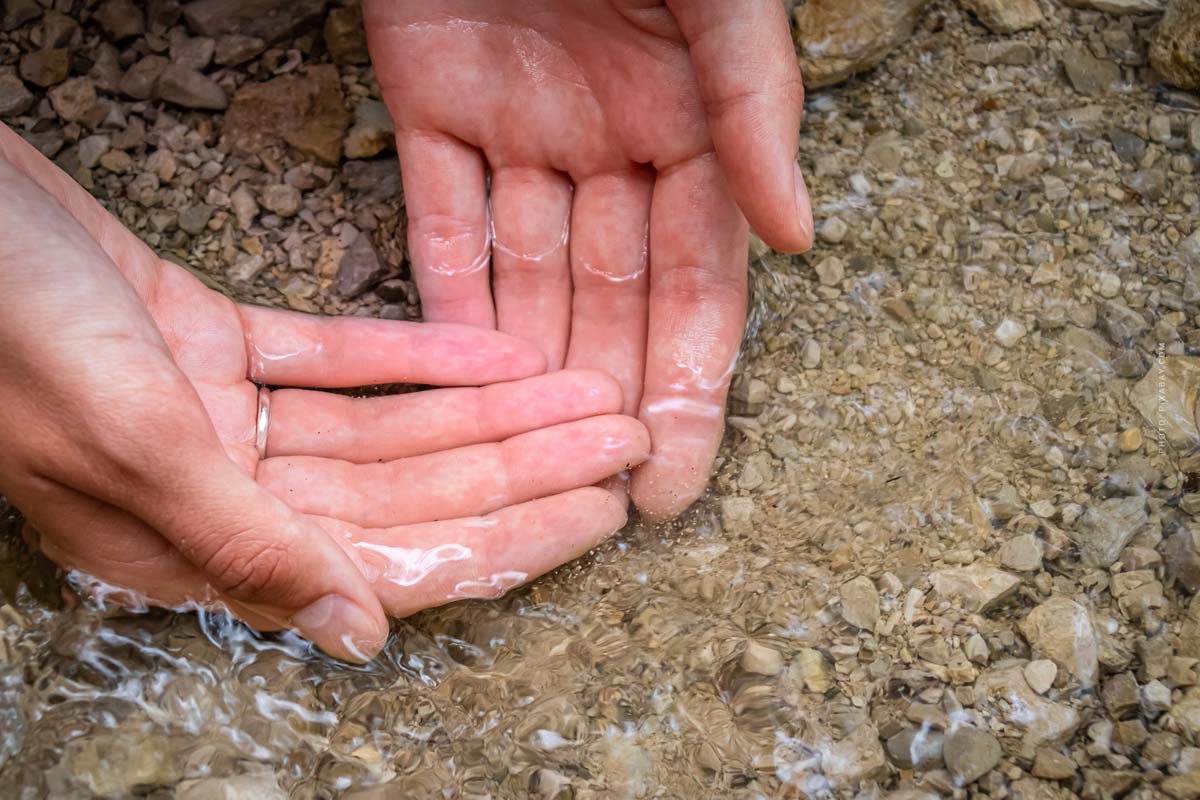
Sell a water source — from the hydrogeological report through the water rights permit to the discreet off-market sale to investment funds, mineral water companies or state funds: Selling a water source is one of the most specialized deals in the real estate and commodity market. Water is the raw material of the future. Limited supply, high demand — and a buyer group you won’t find on any real estate portal. This guide will lead you through the three phases of preparation, marketing, and execution — with concrete valuation examples, buyer profiles, tax logic, and the question of why 90 % of the value does not lie in the source itself, but in the water rights concession.
- Target audience: First-time sellers, heirs, water cooperatives, municipalities, forestry companies
- Purchase: Drinking water starting at 1 billion liters/year (developed), 5 billion liters/year (undeveloped), healing and mineral springs separately
- Sale method: 99 % off-market — discreet, anonymous, direct
- Regions: Europe & USA, waiting list available
Water Source Classification: What Exactly Are You Selling?
Before anything can be said about ratings and buyers, the source must be legally and qualitatively categorized. The sales price per liter of production capacity differs between the classes by a factor of 5 to 20.
An Overview of the Four Source Classes
| Class | Legal Basis | Typical Use | Price Indication per Liter Annual Production |
|---|---|---|---|
| State-recognized healing spring | Recognition by the state authority, often related to a spa town | Healing water, spa operations, premium mineral water | 0.15 – 0.40 € |
| Natural mineral water | Min/TafelWV, official recognition | Brand water, premium bottling | 0.08 – 0.20 € |
| Spring water | Drinking water regulation, simple legal framework | Private brands, discount, export | 0.02 – 0.06 € |
| Table water / Drinking water without spring reference | Drinking water regulation | Municipal supply, industrial water | 0.01 – 0.03 € |
The legal classification of the source is the greatest single value lever. A state recognition of a healing spring can multiply the source’s value tenfold — the recognition itself is not tradable, but is tied to the source and thus part of the asset deal.
Water Rights Permit and Authorization — the actual asset
The subject of sale is legally divided into three parts: plot, source (as part of the plot), and the water rights usage right according to §§ 8 ff. WHG. The latter determines the value. A “permit” (§ 10 WHG) is the strong, long-term form — usually limited to 20 to 30 years, secured in rem, and transferable. An “authorization” (§ 8 WHG) is weaker and can be revoked at any time.
- Maximum allowable abstraction: has the approved amount been fully utilized or is there potential for an increase?
- Remaining term: a remaining term of 5 years significantly reduces the price, while 25 years is premium
- Transferability: not every permit is person-independent — essential to check
- Protected Area Designation: Water protection zones I/II/III increase security, but restrict land use

Rating: How the value of a water source is really calculated
The widespread misconception: “Annual revenue = purchase price”. Wrong. Investors evaluate sources through Discounted-Cash-Flow or EBITDA multiples — because promotion, processing, bottling, and logistics cost money. What matters is the sustainable cash flow that can be generated.
The realistic valuation approach: EBITDA multiple
Calculation example for an established spring water source with its own bottling, approved extraction of 1.2 billion liters per year:
| Position | Value per Year |
|---|---|
| Output volume (Utilization 75 %) | 900 million liters |
| Average price at factory (B2B, own brand) | 0.18 € / liter |
| Gross revenue | 162 million € |
| Production costs (subsidy, bottle, label, internal logistics) | – 118 million € |
| Sales, administration, energy | – 22 million € |
| EBITDA | 22 million € |
| Multiple (industry standard 8–12×) | 10× |
| Enterprise Value | 220 million € |
When evaluating pure source rights without bottling, it is assessed on a royalty basis: 0.8 to 2.0 cents per bottled liter over the remaining term of the permit, discounted at 6–9%. An untapped source with a potential of 5 billion liters per year and 25 years of remaining permit can quickly reach double-digit million values.
Weighting of Evaluation Factors
- Water rights permit (35 %): Remaining term, quantity, transferability
- Water quality & mineralization (20 %): Analytics, stability over decades, healing spring status
- Deposition & climate resistance (15 %): historical data 30+ years, behavior during dry periods
- Infrastructure (15 %): transport connections, port, rail, power supply, filling facility
- Location & sales market (10 %): distance to urban areas, export options
- Plot & development (5 %): workshop, warehouse, expansion areas
The famous location also plays a role here, although weighted differently than in residential real estate — the decisive factors are the distance to logistics hubs and the distance to competing sources.
Hydrogeological report: the central document
Unlike in the classic real estate sale, a valuation report is not sufficient. Buyers require:
- Hydrogeological report from an accredited expert office (catchment area, renewal rate, climate projections)
- Settlement history of at least 10, ideally 30+ years
- Full analysis according to the Drinking Water Ordinance or Minimum/Table Water Ordinance including trace substances and PFAS
- Soil report and brownfield research in the catchment area
- Confirmation of the water rights permit by the competent authority


Buyers of water sources: Who buys, with what motivation, in what size range?
The buyer circle is small, well-capitalized, and international. Anyone selling without a real estate agent network reaches at most 5 % of the realistic buyer circle.
The five buyer types at a glance
| Buyer Type | Motivation | Typical Ticket Size | Negotiation Style |
|---|---|---|---|
| Mineral Water Conglomerates (Nestlé Waters, Danone, Coca-Cola, BlueTriton) | Strategic Expansion, Brand Pipeline | 50 – 500 Mio. € | Hard, with Earn-out Structures, Long Due Diligence |
| Regional Water Companies | Capacity Expansion, Product Diversity | 5 – 50 Mio. € | Pragmatic, Fast Closure Possible |
| Infrastructure & Water Funds (e.g. Macquarie, KKR-Infra) | Stable Cashflows, Inflation Protection | 30 – 300 Mio. € | Finance-Driven, Multiple-Oriented |
| Family Offices & Private Wealth | Real Assets, Generational Investment | 10 – 100 Mio. € | Discreet, Often 100 % Equity, Fast |
| Sovereign Wealth Funds (Gulf Region, Asia) | Water Security, Geopolitical Reserve | 100 Mio. – 2 Mrd. € | Politically Sensitive, Compliance-Intensive |
Off Market: The Only Serious Sales Channel
Water sources are not advertised. The sale takes place in a structured process through specialized off-market real estate agents:
- Anonym teaser (1–2 pages, without identification of the source, only key data)
- Signing of NDA by interested investors
- Information Memorandum (40–80 pages, full profile with appraisal)
- Indicative offers (non-binding offers, range)
- Management presentation & site visit with top 3–5 bidders
- Due diligence via data room (legal, technical, hydrogeological, tax)
- Binding offers with contract draft
- Exclusivity agreement with the highest bidder
- Signing & closing at the notary
Advantages Off Market: pre-approved financing confirmation, personal network, discretion and anonymity, no reputation damage if the property doesn’t sell, faster process until purchase contract and notary.
Leverage Points That Sellers Must Know
- Earn-out: A portion of the purchase price is tied to the amount of production or revenue achieved in the following years
- Quantity Guarantees: The seller is liable for a minimum production — can be useful, but can also become expensive
- Reversion: The seller retains 10–25 %, benefiting from value appreciation
- Locked Box vs. Closing Accounts: Cut-off date balance or closing balance — a million-dollar question for large deals
- Approval Conditions: Price adjustment if the water rights approval is extended
In the high price segment, even 5 % fluctuation is a big risk. Without expertise, sellers often lose 10 to 20 % of the achievable price in negotiations — for a 200-million-asset, that’s 20 to 40 million euros.

Process: The Three Phases in Detail
Phase 1 — Preparation (3 to 9 months)
- Inventory of all rights: approval, permission, land register, easements
- Update hydrogeology and injection data
- Comprehensive water quality analysis in accordance with applicable regulations
- Prepare financial key figures, EBITDA bridge, normalization
- Structural decision: asset deal or share deal
- Tax optimization — holding structure, review of lock-up periods
- Set up data room, prepare information memorandum
Phase 2 — Marketing (3 to 6 months)
- Long list of 30–80 potential buyers from the off-market network
- Anonym contact, NDA, send IM
- Collect indicative offers, form short list
- Management presentations and site visits
- Due diligence in the virtual data room
Phase 3 — Execution (2 to 4 months)

Investing 1 Million Euros: Real Estate, ETFs & the Best Strategy
Sell a villa in Düsseldorf: Prices, real estate agent, checklist + buyer waiting list

Sell villa in Meerbusch: Sought-after villa location near Düsseldorf
Sell a villa in Düsseldorf: Prices, real estate agent, checklist + buyer waiting list
Sell a villa in Berlin: List, Rating, Prices, Real Estate Agent, Mistakes, Experiences
Villa for sale Hamburg: List, Rating, Prices, Real Estate Agent, Experiences





Townhouse Berlin: Modern townhouses to buy & rent
![Buy a townhouse in Berlin-Mitte: Luxury on 5 floors [also suitable for embassy / company headquarters]](https://lukinski.com/wp-content/uploads/2025/08/townhouse-berlin-mitte-stadt-kaufen-5-etagen-luxus-regierungsviertel-art-kunst-marmor-interior.jpg)
Buy a townhouse in Berlin-Mitte: Luxury on 5 floors [also suitable for embassy / company headquarters]
Plot of land by the water in Berlin: KP 90 Mio. - Luxury residential development in Germany's capital city

Berlin | Friedrichshain | Apartment building | 2,680,000 € with approx. 3.75% return