Juist: Real Estate, Most Expensive Areas & What an Apartment on the Island Costs
Juist is the narrowest and least car-friendly island in Germany — and one of the most expensive real estate addresses along the North Sea. Vacation homes cost 400,000 to 1.5 million euros, beachfront houses up to 5 million. The car-free concept attracts a wealthy, peace-seeking buyer segment looking for exclusivity without mass tourism.
Square meter prices of up to 16,400 € are quoted along the promenade — placing Juist among the top 10 most expensive locations in Germany. What distinguishes the island from Sylt or Norderney: no private cars, no new construction, the National Park Wadden Sea acts as a natural brake for any offer.
Juist at a Glance: An Island of Peace and High Prices
Juist lies between Norderney and Borkum, is 17 kilometers long, and at its narrowest point is only 500 meters wide. The island is accessible exclusively by ferry (about 1 hour 40 minutes from Norddeich) or private plane — cars remain on the mainland. Transport is carried out by horse-drawn carriages, cargo bikes, and electric vehicles. For investors, this means: stable buyer base, minimal mass tourism risk, but also increased logistics costs for renovations.
Key Facts about Juist
- Area: 16.43 km²
- Length: 17 kilometers, Width: 500–900 meters
- Residents: approximately 1,700 (permanently registered)
- State: Lower Saxony, Aurich District
- Status: car-free island for over 100 years, UNESCO World Natural Heritage Site Wadden Sea
- Accessibility: ferry from Norddeich (about 1:40 hours) or island seaplane from Norden-Norddeich
Juist doesn’t filter its buyer base through prices alone — but through the island itself. Those who are not willing to leave their car at home buy elsewhere.

Most Expensive Streets on Juist: Beach Promenade and Prime Locations
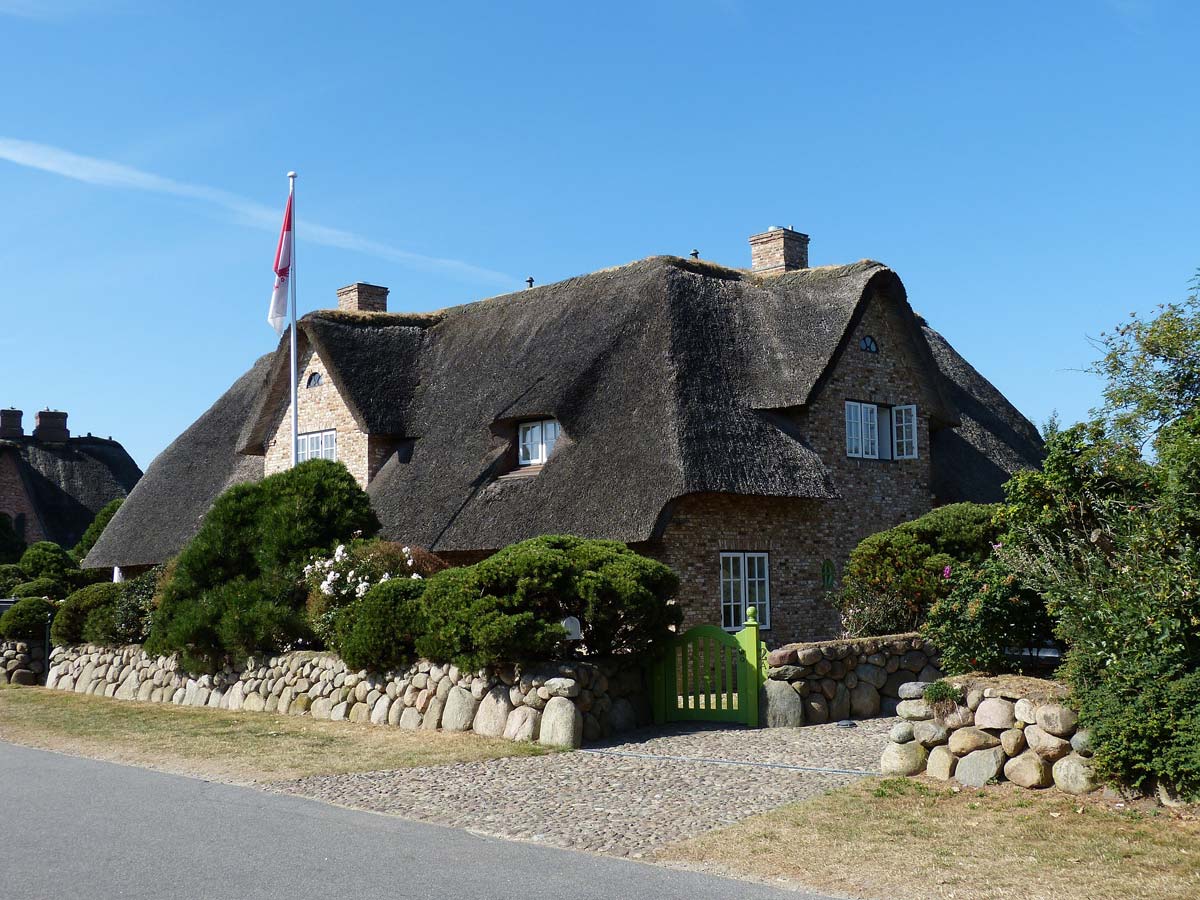
The Beach Promenade is the undisputed top address — right at the water’s edge, historic bathhouse architecture villas, free view of the North Sea. In addition, there are further premium locations with stable demand:
- Beach Promenade / Beach Street: First row, free sea view — up to 16,400 €/m²
- Wilhelm Street: Central location, close to town — 10,000–13,000 €/m²
- Goethe Street / Friesen Street: Classic villa location, quiet — 8,000–11,000 €/m²
- Loogster Pad / Westend: Larger plots, quieter western part — 7,000–9,500 €/m²
Real Estate Prices on Juist: How Much Does a Vacation Home Cost?
The prices on Juist belong to the highest along the German North Sea coast. A vacation property by the sea is not a bargain here — but a structurally scarce asset.
| Property type | Price range | €/m² |
|---|---|---|
| Beachfront villa (first row) | 1.5 – 5.0 million € | 12,000 – 16,400 € |
| Vacation home (average location) | 600,000 – 1.5 million € | 7,000 – 10,000 € |
| Condominium (2–3 rooms) | 250,000 – 900,000 € | 5,500 – 8,500 € |
| Penthouse with sea view | 900,000 – 2.2 million € | 9,000 – 13,000 € |
| Plot (buildable, rarity) | on request | 2,000 – 4,000 € |
Juist vs. Sylt vs. Norderney: Direct comparison
| Island | Peak price €/m² | Character | Car-free |
|---|---|---|---|
| Sylt (Kampen) | up to 35,000 € | Glamour, celebrity, high visibility | No |
| Juist (Beach promenade) | up to 16,400 € | Peaceful, discreet, exclusive | Yes |
| Norderney | up to 14,000 € | Tourism-oriented, well connected | No |
| Langeoog | up to 12,000 € | Family-oriented, quiet | Yes |
| Borkum | up to 9,500 € | Largest East Frisian island | No |
| Spiekeroog | up to 11,000 € | Small, very quiet | Yes |
The prices on Juist have almost doubled in the last decade. Main drivers: car-free atmosphere, no new construction due to national park protection, limited supply and an exclusive buyer group from Hamburg, Frankfurt, Dusseldorf and Munich.


What makes Juist a special Investment?
- Car-free for over 100 years: Transport by horse-drawn carriage, cargo bike and electric vehicle — no traffic noise, no exhaust fumes.
- Wadden Sea National Park: New building permits are extremely rare. The supply remains structurally limited — regardless of the interest rate environment.
- Own pricing logic: Juist does not follow the general German real estate cycle. Even during correction phases, prices remain at a high level.
- Family-owned properties: Many properties remain in family ownership across generations. The market is small, and competition for available properties is accordingly high.
- Discreet buyer circle: Unlike Sylt, Juist does not attract status seekers, but rather wealth owners seeking peace and quiet.
Return: Is Juist a good investment?
Renting out holiday homes on Juist is profitable — but seasonality and island logistics costs reduce the net return. Calculation example for a holiday home in a medium location:
- Purchase price: 1,200,000 € (120 m², approx. 10,000 €/m²)
- Daily rent high season: 380 €
- Daily rent low season: 180 €
- Occupancy high season (May–Sep, 150 days): 85 % = 128 nights → 48,640 €
- Occupancy low season (Oct–Apr, 215 days): 35 % = 75 nights → 13,500 €
- Gross rental income per year: approx. 62,000 € → Gross yield: approx. 5.2 %
- Minus management (20 %), cleaning, maintenance, insurance, ground rent: approx. 22,000 €
- Net yield: approx. 3.3 % — plus historical value increase of 5–8 % per year
Island surcharge: Running costs at a glance
- Ground rent: 4–7 €/m² monthly (significantly above mainland level)
- Material transport by ferry: Renovations cost 25–40 % more than on the mainland
- Availability of tradespeople: Limited island businesses, hourly rates 90–130 €/h
- Building insurance: Storm and flood surcharges, 30–50 % above inland rates
- Management: 15–25 % of rental income for local property managers
Who buys on Juist?
- Wealthy families from Hamburg, Bremen, Düsseldorf and Frankfurt — desire for a discreet summer residence
- Entrepreneurs and freelancers — allocate portions of wealth into rare, stable tangible assets
- Return-oriented investors — high-priced holiday rentals (800–2,500 €/night for premium villas)
- Heirs’ generation — hold family properties and gradually modernize them
Buying Juist: Legal, Taxes, Checklist
Legal and constructional specifics
- Monument protection: Many historic bath architecture villas are protected. Modifications require approval, material requirements are strict.
- National park regulations: Extensions and outdoor design must be coordinated with nature conservation authorities.
- Storm safety: Requirements for roof structure and façade are significantly higher than on the mainland.
- Second home tax: The municipality of Juist levies a second home tax on properties not used for personal residence.
Tax aspects
- Land transfer tax Lower Saxony: 5.0 % of the purchase price — at a purchase price of 1.2 million € this corresponds to 60,000 €. The current land transfer tax rates of all federal states for comparison.
- Speculation tax: When selling within 10 years, income tax applies to the capital gain from the sale.
- Depreciation: Linear depreciation of 2 % (new construction) or 2.5 % (old building) on the building portion — tax deductible when renting out.
- Hobby risk: If the use is mainly for personal use, the tax office may not recognize losses from renting out.
Checklist before purchasing on Juist
- Location checked (first row, second row, local connection)?
- Monument protection status clarified with the district of Aurich?
- Building condition assessed by an independent expert on site?
- Rental potential realistically estimated with a local property manager?
- Ongoing additional costs (maintenance fee, insurance, maintenance) calculated?
- Logistics costs for possible renovation considered (+25–40 %)?
- Second home tax included in the calculation?
- Financing discussed (island properties are sometimes evaluated more restrictively by banks)?
Frequently Asked Questions about Real Estate on Juist
How high are real estate prices on Juist?
The prices belong to the highest along the German North Sea coast: promenade front 16,400 €/m², average locations 7,000–10,000 €/m², condominiums from 250,000 €, beachfront villas 1.5–5.0 million €.
Is Juist a good investment?
Yes, with realistic expectations: gross rental yield from holiday lettings 4–6 % p.a., net rental yield after costs 2.5–3.5 % p.a., historical price appreciation 5–8 % p.a. The strongest value lever remains the structural scarcity combined with the car-free status.
Why are real estate prices on Juist so high?
Three factors: Scarcity (national park prevents new construction), Exclusivity (car-free + limited ferry accessibility filters buyers) and Stable Demand (wealthy buyers with long holding periods). The supply will decrease in the long term, while demand remains stable.
Is there new construction on Juist?
Practically not. The Wadden Sea National Park, heritage protection regulations and municipal restrictions make new building permits an absolute exception. Those who buy, buy existing properties — often requiring modernization.
What taxes apply when buying on Juist?
Land transfer tax of Lower Saxony: 5.0 %. In addition, notary fees (approx. 1.5 %) and land registry entry (approx. 0.5 %). Total purchase ancillary costs: approx. 7–8 % of the purchase price.

Investing 1 Million Euros: Real Estate, ETFs & the Best Strategy

Sell villa in Meerbusch: Sought-after villa location near Düsseldorf
Sell a villa in Düsseldorf: Prices, real estate agent, checklist + buyer waiting list
Sell a villa in Düsseldorf: Prices, real estate agent, checklist + buyer waiting list

Apartment building Buy yes / no?! The fastest Rating in the world (also works for apartments)

Buying profile: Cologne, Düsseldorf (NRW), Berlin & Munich – Apartment & Apartment building





Hire a private jet? My experience – and what a charter flight really costs

Townhouse Berlin: Modern townhouses to buy & rent
![Buy a townhouse in Berlin-Mitte: Luxury on 5 floors [also suitable for embassy / company headquarters]](/img/640/2025/08/townhouse-berlin-mitte-stadt-kaufen-5-etagen-luxus-regierungsviertel-art-kunst-marmor-interior.jpg.webp)
Buy a townhouse in Berlin-Mitte: Luxury on 5 floors [also suitable for embassy / company headquarters]

Berlin | Friedrichshain | Apartment building | 3,100,000 € with approx. 5.00% return