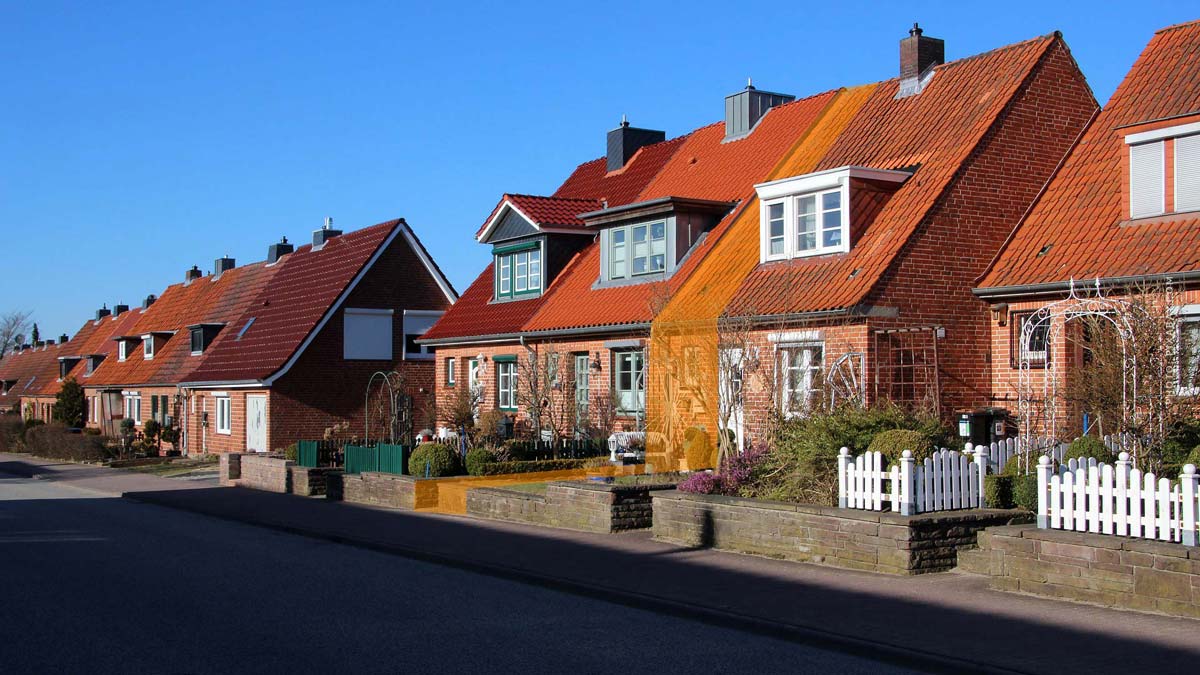
Apartment building Buy yes / no?! The fastest Rating in the world (also works for apartments)
You hear from an acquaintance that an Apartment building for sale is up for sale? Then you want to know quickly: Is the purchase worth it or not? With a few simple numbers, you can check this yourself in just a few minutes (Quickly evaluate an apartment building) – without an appraiser or real estate agent. What do you need? Address, purchase price, annual net cold rent (JNKM), renovation status, rental status, rental growth potential – let’s go! More videos? 👉 Subscribe to me on YouTube x Lukinski Immobilien.
Valuing an apartment building in under 5 minutes
Let’s start with a case that could happen to you today:
Imagine a friend sitting next to you in the café and saying: “Someone wants to sell an apartment building in this street, I knew the old lady, her son is taking care of it now. I’ll ask around for you.” The next day you get the numbers via WhatsApp: 240,000 euros in annual rent, the purchase price should be 8.5 million, A-location. Sounds exciting – but is this really a good deal?
It’s important to note: you only need two numbers in the first step – the purchase price (PP) and the annual net cold rent (ANCR). With these, you can immediately calculate the price factor and the gross rental yield. Both are the most important key figures to determine whether an investment can even be sensible.
Free calculators for your quick evaluation
Whether it’s return or purchase price factor – use my free real estate calculators on Immobilien Guru or directly the
Stream it for free here – the fastest real estate rating in the world! More videos? 👉 Follow me on YouTube x Lukinski Immobilien.
Calculate purchase price factor and gross return
Example:
- Purchase price: 8,500,000 €
- JNKM: 240,000 €
Start now:
Purchase price factor = purchase price / JNKM = 8,500,000 / 240,000 = 35.4
An purchase price factor of 35 means: It takes over 35 years until you have earned back the purchase price through rental income – without costs, without interest, without risk.
Calculate gross rental yield
Return = Annual rental income / Purchase price = 240,000 / 8,500,000 = 2.8 %
At first glance, it sounds okay – but this is the gross return. After costs, significantly less remains. More on this shortly.
Purchase price factor by location – understanding the range
A factor of 35 is not always bad – and a factor of 18 is not always good. Here are the typical ranges:
| Location | Typical Factor | Gross Yield | Strategy |
|---|---|---|---|
| A-location (Munich, Berlin-Mitte, Hamburg) | 28–38 | 2.6–3.6 % | Appreciation |
| A-location outskirts / B-cities | 22–28 | 3.6–4.5 % | Mix |
| 17–22 | 4.5–5.9 % | Cashflow + slight appreciation | |
| 12–17 | 5.9–8.3 % | Pure Cashflow |



The magic threshold: why calculations start only from ~5.5 % gross yield
If you’re working with debt capital – and that’s almost everyone – you need to account for the ongoing costs. Here’s the honest breakdown:
What really eats into your return?
- Interest: currently about 3.5 % p.a. on the loan amount
- Maintenance: 1.0 % (new build) up to 4.0 % (unsanitized old building) – rule of thumb average: 2.0 %
- Management: 250–350 € per residential unit p.a. (about 0.3–0.5 % of the purchase price)
- Rent default allowance: 2 % of the JNKM (vacancy, rent nomads)
- Amortization: 1–3 % – this is not a loss, but asset building
Rule of thumb: Only from a gross return over 5.5 % does the object cover itself. At 2.8 % you pay every month – even with full rental income.
Gross vs. Net – the crucial difference
Example on a 4 million € purchase price with 240,000 € JNKM (= 6 % gross):
- Gross rental income: 240,000 €
- – Maintenance 2 %: −80,000 €
- – Management: −10.000 €
- – Vacant rate 2 %: −4.800 €
- = Gross rental income: approx. 145.000 €
- Gross rental return: 145.000 / 4.000.000 = 3,6 %
From 6 % gross, you quickly end up with 3,6 % net. This number belongs in every pitch.
How much should you pay at most?
Turn the formula around. You want at least 6 % gross return?
Maximum purchase price = JNKM / desired return = 240.000 / 0,06 = 4.000.000 €
At 6 %, the object should cost at most 4 million €. At 8 %, even only 3 million €.
Example: You want 8 %
Purchase price = 240.000 / 0,08 = 3.000.000 €
Anything above that is not financially attractive – or you have to negotiate the purchase price down.
Purchase ancillary costs – the forgotten factor
Attention: The pure purchase price is never the final price. For an apartment building, purchase ancillary costs of 8–12 % are added on top:
- Land transfer tax: 3,5 % (Bavaria) up to 6,5 % (North Rhine-Westphalia, Brandenburg)
- Notary + Land Registry: approx. 1.5–2.0 %
- Real estate agent commission: 0–7.14 % (negotiable, often split)
With a purchase price of 4 Mio. €, you realistically need to plan for a capital investment of 4.3–4.5 Mio. €. These additional costs further reduce your return by approximately 0.3–0.5 percentage points.

Cashflow Reality Check – what remains at the end of the month?
Quick calculation for a MFH for 4 Mio. € with 80 % financing:
- Equity (20 % + additional costs): approx. 1.2 Mio. €
- Loan: 3.2 Mio. € → Interest 3.5 % + repayment 2 % = 5.5 % annuity
- Annual annuity: 176,000 €
- Annual net rental income: approx. 145,000 €
- Operational cash flow: −31,000 € p.a. (before tax, before depreciation)
- After depreciation (2 %) and tax advantage: usually ±0 or slightly positive
Insight: Even with a 6 % gross return, the deal is often only “black zero” in the first few years. Wealth building occurs through repayment + appreciation, not through cash flow.
A factor of 30 can be a top deal – if the rents are 30% below market level. This is very common in older stock with long-term tenants.
Example: 240,000 € JNKM today, market rent would be 320,000 €. After a tenant change and modernization, the return increases from 2.8% to 3.8% – and so does the market value. This is the King’s discipline: buy, improve, rent out, hold.
Therefore, always ask:
- How old are the rental agreements? (Index rent? Seasonal rent?)
- How far below the rent index are the rents?
- Is there modernization potential (§ 559 BGB rent increase after modernization)?
- What is the local comparable rent?
Checklist: Which numbers do you ask the seller?
Before you make an offer – you need to know these points:
- ✅ Purchase price + presentation of negotiation room
- ✅ JNKM – breakdown per unit (target and actual rent)
- ✅ Living and usable area in m² (total + per unit)
- ✅ Year of construction + last major renovation
- ✅ Energy certificate (efficiency class, final energy demand)
- ✅ Heating system (type, year of construction, GEG compliance)
- ✅ Roof + facade (condition, last renovation)
- ✅ Tenant structure (rental period, age, social situation)
- ✅ Vacancy currently + last 3 years
- ✅ Reserve fund for maintenance (if available)
- ✅ Land register extract (encumbrances, easements, right of way)
- ✅ Standard land value + land size
- ✅ Ground rent? (a critical factor for many buyers)
Are 8.5 million a good deal? Income-generating property vs. investment property
On immobilien-erfahrung.de, I have elaborated extensively on this topic: Difference between Return and Investment Real Estate.
The difference lies in the focus: With a return property, what matters is what comes into your account monthly – positive cash flow through rental income, usually in
Do you want cash right away? Option 1 brings you ongoing income. Do you want more cash in the long term? Option 2 requires patience, capital, and market knowledge – in return, a big profit is possible later (and possibly tax-free after 10 years).
Even better:
If you buy in a prime location at a low price and renovate: Cashflow + Longterm Cash = Top class. Buy, renovate, increase rent, benefit from appreciation.
FAQ – the most common questions about the MFH quick valuation
At what purchase price factor does an apartment building become worthwhile?
As a rough rule of thumb: A factor below 20 is classic cashflow territory, 20–25 is a mixed calculation, above 25 you need to invest subst
Sell a villa in Berlin: List, Rating, Prices, Real Estate Agent, Mistakes, Experiences
Villa for sale Hamburg: List, Rating, Prices, Real Estate Agent, Experiences
Sell a villa in Cologne: List, Rating, Prices, Real Estate Agent, Mistakes, Experiences
Sell a villa in Munich: List, Rating, Prices, Real estate agent, Experiences

Buying profile: Cologne, Düsseldorf (NRW), Berlin & Munich - Apartment & Apartment building
Buying a villa in Munich: Living & Investment - Procedure, Costs, Off Market & Co.







3 Advantages of a Property as a Capital Investment: Inflation Protection, Debt Capital & Passive Income

Real Estate Location Quickly Explained: Investing in A-Location, B-Location and C-Location @ Inglewood, LA - New Video

Influencer Marketing: Creativity Meets Strategy – Join CM Creator
Townhouse Berlin: Modern townhouses to buy & rent