
Real Estate Defects According to the Year of Construction: Building Materials, Masonry, Insulation & Co. – Assessment
Old real estate and its drawbacks – Do you want to invest in real estate as a financial investment? Whether they were built in 1920, 1930 or 1960, old properties have specific disadvantages compared to new constructions. Have you found an apartment that suits you dating from 1938? Or a residential building built in 1982 that you want to buy? In this case, you will learn here everything you need to know about the building structure, masonry, thermal and acoustic insulation, and the repairs and defects you can expect. In addition, at the end, the following question: should you invest in old real estate?
Old properties: apartments & houses from decades ago
More than 2.650.000 real estate properties were built in Germany before the year 1919. And some time later, in the middle of the century, there were even nearly 7.500.000 houses! Of course, construction techniques back then were different. But over the decades, the construction industry quickly learned and not only used more efficient building materials, but also focused on acoustic and thermal insulation, as well as fire protection.
Here is a brief overview:
- Built before 1919: 2.655.042
- 1919 – 1949 Built: 2.374.762
- 1950 – 1979 Built: 7.357.255
- 1980 – 1989 Built: 2.090.142
- 1990 – 1999 Built: 2.490.829
- 2000 – 2011 Built: 1.954.588
Each decade has brought its share of advantages and disadvantages. Would you like to invest in a co-owned apartment dating from 1940? Or buy a residential building constructed in 1967 as an investment? Before looking at the various drawbacks, here are first the advantages and disadvantages of an existing property of such an age:
Existing real estate: summarized advantages and disadvantages
If you want to invest in a rental property, an existing property that is several decades old has obvious advantages: The purchase price is advantageous and the rental yield is high. The additional purchase costs and the equity required for investment are also limited. At the same time, maintenance costs are relatively high.
Existing real estate properties that are older located in zones B and C are perfectly suitable as income-generating real estate!
Here is once again a summary of the advantages and disadvantages.
Advantage when buying an older real estate property:
- Generally more favorable purchase price
- Costs can be calculated if you know the defects.
- A lower purchase price often ensures a better return
- Location in a developed infrastructure
Disadvantage when buying an older real estate property:
- High maintenance and repair costs
- Possibility of hidden defects
What distinguishes real estate from different construction years? And what are the flaws you should expect? Let’s start with the chronological order, beginning with properties over 120 years old.

Properties built in 1900
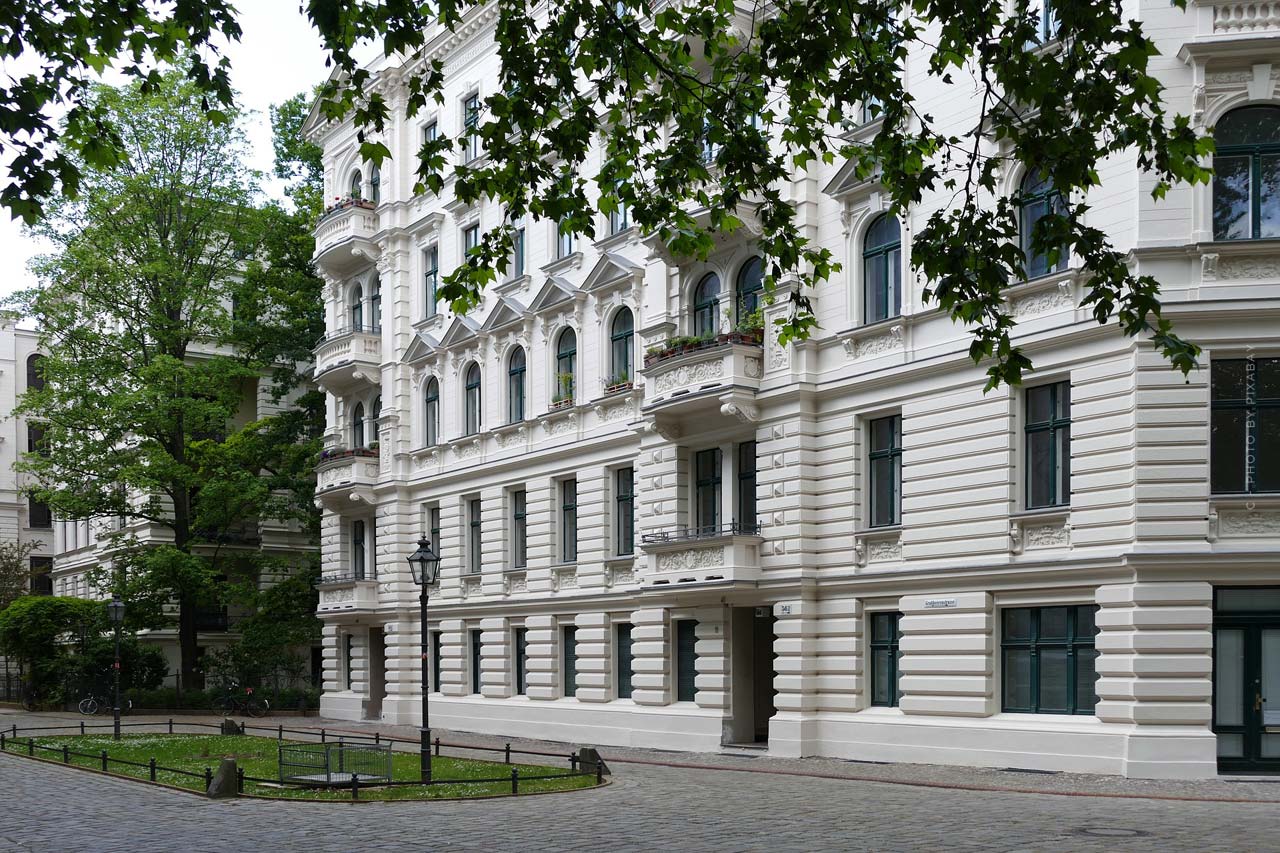
Cracks in the masonry are typical of older properties built before 1900. Due to outdated construction techniques of the time, thermal insulation is either non-existent or insufficient. Windows are generally single-glazed and thus let in the cold in winter, while moisture accumulates in the attics and basements. Bathrooms also have some issues: lead pipes, which have been banned since 1971, are often still present and usually need to be replaced urgently after purchase.
Typical of buildings over 120 years old: energy efficiency wasn’t a topic back then!
Defects of properties built before 1900
Here’s a brief overview:
- Cracks in the plaster and masonry
- Lack of thermal insulation on the façade, roof, and windows
- Moist basements
- Outdated techniques and electronics
- Outdated clay and lead pipes in the bathroom


Properties built between 1900 and 1939
Similar defects can also be found in properties built between 1900 and 1939. The lack of underlayers allows cold and moisture to enter the house, the wooden beam ceilings are infested with mold, and the walls, often built in a way that is far too thin, tend to mold. The ceiling is not the only part made of wood – the staircase is as well – a huge fire hazard!
Characteristic: back then, fire protection was not considered during construction!
Checklist: Property defects from around 1900 – 1939
All defects briefly summarized at a glance:
- Lack of underlayers
- Condensation issues
- Presence of sponges and mold
- Limited fire protection
- Outdated clay and lead pipes
- Cracks in masonry

Properties built between 1939 and 1945
Real estate built between 1939 and 1945 is characterized by their poor structure. During the war, raw materials, time and energy were invested in the war. Therefore, buildings were constructed quickly and at low cost, which explains why the structure and statics of some real estate have suffered as a result. Inappropriate building materials were also used, such as rubble and summer wood.
Checklist: Defects of real estate around 1939 – 1945
Among the typical defects, there are
- Poor building structure
- Infestation of pests due to inappropriate building materials
- Structural issues
- Cracks in masonry
- Outdated gas pipes
- Limited fire protection

Properties built between 1945 and 1959
It is mainly poor or absent thermal insulation that is often found in real estate from 1945 to 1959. Construction materials now considered questionable were also frequently used. These include asbestos, tar, formaldehyde-based paints, and lead-based paints. Still relevant today: the lack of fire protection. After the war, houses had to be built quickly and efficiently. As a result, access possibilities for firefighters are generally lacking, and fire doors are rare. Sound insulation was also not considered at the time, which is why old apartments from this period are often very noisy.
Checklist: Defects of real estate around 1945 – 1959
The characteristics of real estate from that era are
- Use of questionable building materials
- Lack of fire protection
- Lack of soundproofing
- Insufficient thermal insulation
- Non-tight gas pipes
- Cracks in the masonry
Real estate built between 1960 and 1969
In the second half of the 20th century, construction improved. Wood was no longer used for stairs and ceilings. Instead, stone and concrete were used, and windows were insulated with aluminum. Drains prevented moisture from causing mold in the basement and attic, and under-roof screens were installed. The focus was on thermal insulation, but harmful substances continued to be used.
Checklist: Property defects around 1960 – 1969
Here is a brief overview:
- Suspect building materials
- Harmful insulation
- Concrete damage
- Uninsulated roof structure
Properties built between 1970 and 1979
In the 1970s, construction techniques improve significantly once again. The newly adopted guidelines regarding sound insulation through insulation lead to more efficient construction. Lead pipes are no longer used, but instead copper water pipes are installed, and buildings are mainly constructed from concrete. Despite the improvement in building structures, cold still penetrates living rooms in winter and causes mold.
Checklist: Property defects around 1970 – 1979
Among the typical defects, there are
- Parkett glue containing tar
- Needs renovation
- Concrete as a building material

Properties built between 1980 and 1999
Real estate properties built over the past 30 to 40 years are generally distinguished by their modern construction techniques. However, they can also have some drawbacks. Maintenance costs are high, roof connections are broken, and central heating systems installed before 1985 are often problematic.
Checklist: Defects in real estate from 1980 – 1999
Here are the typical defects from 1980 – 1999 once again:
- Roof connections and finishes for flat roofs
- Central heating
- High maintenance costs

Conclusion: Should you invest in older real estate?
It has to be admitted: Compared to modern new constructions, real estate built a few years ago have their own charm. And depending on the year of construction, they present their own advantages and disadvantages. With a little capital, it is also possible to renovate the technical installations, the roof, and the masonry.
You will find even more details on the respective drawbacks depending on the year of construction on my new project for real estate buyers (Immobilien-Erfahrung.de):

Broker SEO: Tips! Search engine optimization for brokers – Google, Bing & Co.
Buying real estate with a social commitment: Low rent based on costs, post-assignment & housing authorization certificate explained

Buy Roof Tent: Comparison, price, list, tips – Camping up to 4, 5 people in the mobile home.

Sole proprietorship: Founding, liability, legal form, management & taxes

Socket outlets – Surface-mounted socket outlets, Gira & in English

When is it worth buying, when is it worth renting?







Florida as a tax haven: Benefits for businesses, real estate owners and investors – USA
Delaware as a tax haven: Advantages for businesses, real estate owners and investors – USA

Corporation: C-Corp, S-Corp, Formation, Taxes, Pros & Cons (USA)
Real Estate Holding Company (USA): Formation, advantages, disadvantages & taxes