
Berlin | Reinickendorf | Apartment building | €3,400,000 with approx. 4.09% yield
An apartment building in Berlin-Reinickendorf for €3,400,000 with approx. 4.09% gross yield — that’s a statement in the current Berlin market. While Mitte, Prenzlauer Berg and Charlottenburg have long been trading at factors beyond 30, Reinickendorf sits at a purchase price factor of around 24.4. Before placing a bid, it’s worth looking at the gross yield, the real cash flow after financing, and how this district will develop long-term within the Berlin market environment. This article classifies the property — micro-location, key figures, risks, insider perspective.
Reinickendorf: micro-location and market character
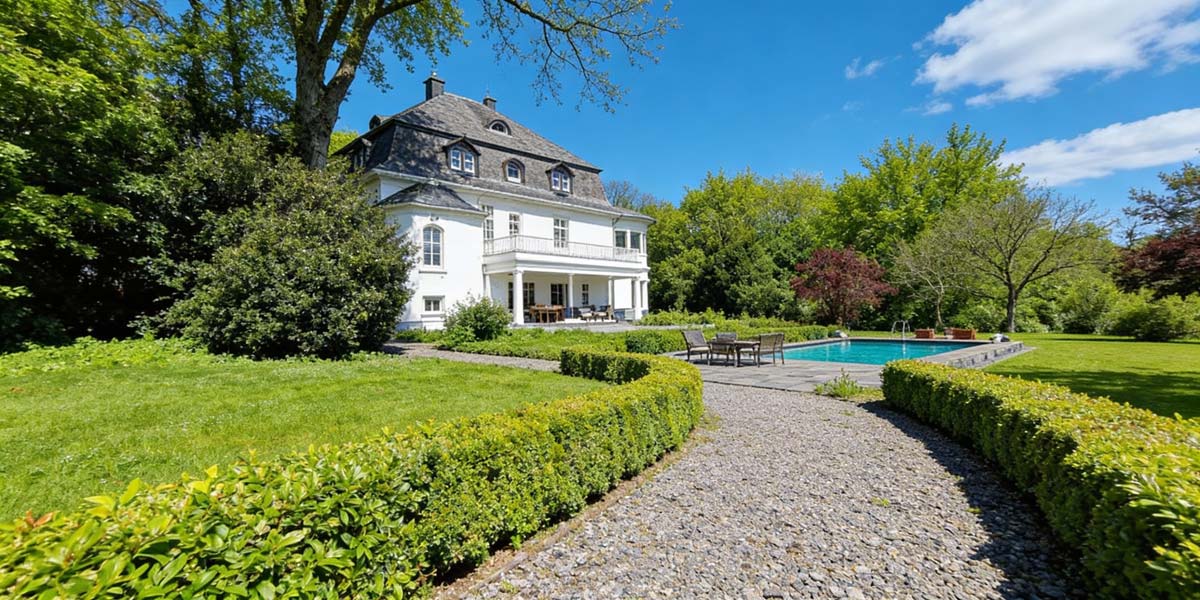
Reinickendorf in Berlin’s north-west is one of the largest by area and, at the same time, one of the most heterogeneous districts of the capital. Anyone who thinks of Reinickendorf only as “the Tegel district” underestimates its investment potential. Locations range from Wilhelminian-era old-building quarters around the Schäfersee, through 1920s housing estates (UNESCO World Heritage “White City”, outskirts of the Horseshoe Estate), to villa areas in Hermsdorf, Frohnau and Konradshöhe.
What makes Reinickendorf special
- High owner-occupier share: unlike inner-city districts, the owner-occupier share is in places above 25% — this stabilises tenant structures and reduces turnover.
- The Tegel effect: the conversion of the former TXL airport into the “Urban Tech Republic” acts as a long-term value driver for adjacent residential areas.
- Transport links: U6, U8, S25, several S-Bahn ring lines, A111 to Hamburg — one of the best connections in northern Berlin.
- Green space: Lake Tegel, Tegel Forest, Hermsdorf stream valley — together one of the greenest districts in Berlin.
- Buyer profile: families, mid-sized owner-occupiers, regional long-term holders — less speculative investor money than in Mitte or Friedrichshain.
Price level in district comparison
The rent level in Reinickendorf is below the inner-city districts, but clearly above the outer districts of Spandau-South or Marzahn. The following overview shows typical ranges — the exact location within the district (Frohnau vs. Auguste-Viktoria-Allee) makes a massive difference.
| Location | Purchase price €/m² (apartment building) | Cold rent €/m² | Factor (apartment building) |
|---|---|---|---|
| Berlin Mitte | 5,500–8,000 | 14.00–18.00 | 30–36 |
| Charlottenburg | 5,000–7,000 | 13.00–16.00 | 28–33 |
| Reinickendorf (Frohnau/Hermsdorf) | 4,000–5,500 | 11.00–13.50 | 25–28 |
| Reinickendorf (Tegel/Wittenau) | 3,200–4,500 | 9.50–11.50 | 22–26 |
| Reinickendorf (Auguste-Viktoria-Allee) | 2,800–3,800 | 8.50–10.50 | 20–24 |
| Berlin average | 4,500–6,000 | 12.50–15.00 | 26–30 |
Rule of thumb for Berlin: a factor below 25 for an apartment building is only realistic in B- and C-locations. Reinickendorf offers these factors — in return, investors accept slower rent growth paths.
Micro-locations with upside potential
Within Reinickendorf, investors should assess the neighbourhoods individually. Not every street benefits equally from the Tegel effect — and not every premium address still has room for rent growth.
- Borsigwalde: historic industrial quarter with upward dynamics and listed building stock
- Tegel-South: benefits directly from the elimination of aircraft emissions — noise map assessment renewed
- Hermsdorf-Mitte: solid middle-class location with continuously rising demand
- Wittenau North: classic residential estate, benefits from the U8 extension debate
The property under the numbers: €3.4m at 4.09%
At a purchase price of €3,400,000 and a gross yield of 4.09%, this results in a purchase price factor of approx. 24.4 — i.e. a gross annual rent of around €139,060. This corresponds to a monthly target income of approx. €11,590. Comparing the purchase price factor in Berlin against the national average shows: Reinickendorf is below the Berlin mean — which speaks in favour of the location.
Gross vs. net — the crucial difference
The 4.09% mentioned is a gross yield. The net yield after operating costs, non-recoverable shares, management and reserves is typically 25–35% lower. Realistic order of magnitude for this property:
| Item | Amount p.a. | Note |
|---|---|---|
| Gross annual rent (target) | €139,060 | 4.09% on €3.4m |
| Rent default risk (2%) | −€2,780 | realistic in Berlin |
| Management (€250/unit) | −€4,500 | assumption 18 units |
| Maintenance reserve | −€12,000 | approx. €8–12/m²/year |
| Non-recoverable operating costs | −€6,000 | maintenance, tax advice |
| Net rental income | ≈ €113,780 | net yield approx. 3.35% |
Don’t underestimate incidental purchase costs in Berlin
Berlin charges 6.0% real estate transfer tax — one of the highest rates in Germany. Together with notary, land registry and possibly estate agent commission, the incidental purchase costs amount to around 9–11% of the purchase price.
- Real estate transfer tax Berlin: 6.0% = €204,000
- Notary & land registry: approx. 1.5–2.0% = €51,000–68,000 (see notary costs)
- Estate agent commission: freely negotiable for apartment buildings, often 3.57% gross = approx. €121,380 (estate agent commission)
- Total: approx. €376,000–393,000 — total investment thus ≈ €3.79m
Anyone calculating the real factor based on the total investment arrives at around 27.3 — the gross yield on total investment thus drops to about 3.67%. This is the figure that counts in bank valuation.
Financing and cash-flow reality
For an apartment building of this size, the financing bank typically expects 20–30% equity plus the incidental purchase costs. As described in the guide to property financing, the repayment rate is the central cash-flow lever for investment properties — not the interest rate alone.
Example cash-flow calculation
- Equity (25% + incidental costs): €850,000 + €393,000 = approx. €1,243,000
- Loan: €2,550,000
- Annuity (4.0% interest, 2.0% repayment): approx. €153,000 p.a.
- Net rental income: approx. €113,780 p.a.
- Cash flow before tax: −€39,220 p.a. (repayment takes effect)
- Cash flow after depreciation & tax benefit: closer to zero or slightly positive
With this property, you don’t earn through ongoing cash flow but through repayment (wealth building via the tenant) and value appreciation. A classic “Berlin yield property” — suits investors with a 10+ year horizon.
The tax lever via depreciation
The straight-line building depreciation of 2% or 3% for new builds significantly reduces the tax base. With a building value share of approx. 75% of €3.4m, this results in annual depreciation of around €51,000. This noticeably lowers the taxable rental surplus.
- Building value share: typically 70–80% for apartment buildings in Berlin
- Straight-line depreciation: 2% p.a. for existing buildings, 3% p.a. for new builds (§7 para. 4 EStG)
- Special depreciation: additionally possible under §7b EStG for energy renovation
- Effect: real tax burden drops to around 30–40% of net rental income

Insider perspective: the Tegel effect
The underestimated value driver for Reinickendorf is the conversion of the former Tegel airport into the “Urban Tech Republic” and “Schumacher Quartier”. More than 5,000 apartments, a campus of the Berlin University of Applied Sciences for Technology, and a research and industrial park for urban technologies will be created here in the coming years.
Direct consequences for adjacent neighbourhoods
- Auguste-Viktoria-Allee & Cité Pasteur: historically B-locations, benefit most from the new employment cluster
- Wittenau & Borsigwalde: rent increases above the Berlin average expected
- Tegel-South: noise reduction from airport closure enhances the value of the housing stock
- Frohnau & Hermsdorf: remain price-stable premium locations, less dynamic
What this means for the holding period
Major projects of this scale only unfold their full market effect after 7–12 years. Anyone buying today should plan for at least this horizon — otherwise the value appreciation will not be realised. This aligns strategically with the ten-year speculation period and makes Reinickendorf a buy-and-hold location par excellence.
Checklist: due diligence before bidding
Before placing a bid on a Berlin apartment building — whether in Reinickendorf or Mitte — these points should be checked off:
- ✓ Tenant list with rental start date, contract type (fixed-term/open-ended) and modernisation levies
- ✓ Comparison with the local rent index: how far is the actual rent below the permissible maximum?
- ✓ Milieu protection area yes/no (in Reinickendorf only relevant in some parts)
- ✓ Energy certificate and renovation backlog — GEG obligations in the coming years?
- ✓ Roof, façade, heating — recent renovations documented?
- ✓ Realistic maintenance reserve (min. €8–12/m²/year)
- ✓ Land register: rights of way, contaminated sites, usufruct?
- ✓ Valuation using the income capitalisation method
- ✓ Speculation period strategy for a later exit
- ✓ Bank term sheet before the notary appointment
Exit strategy and taxes
A professional investor thinks about the sale already at the time of purchase. For rented apartment buildings, the ten-year speculation tax period under §23 EStG applies — after it expires, the capital gain is tax-free in private assets. If sold within the period, the gain is taxed at the personal income tax rate.
Tax scenarios compared
- Private assets, holding period > 10 years: capital gain tax-free
- Private assets, < 10 years: personal tax rate on the gain
- Commercial property trading: for more than 3 sales within 5 years — caution!
- GmbH structure: 15% corporation tax + solidarity surcharge, but no 10-year period
Anyone who contributes the property to a real estate GmbH and later sells shares in the company may, under certain circumstances, avoid real estate transfer tax for the buyer — the threshold for a detrimental share acquisition is 90%. These structures only pay off from portfolio sizes of approx. €5–10m and require early tax advice.
Facts about the property
The key data for this off-market apartment building in Berlin-Reinickendorf at a glance:
- City: Berlin
- District: Reinickendorf
- Property type: apartment building, fully let
- Approx. purchase price: €3,400,000
- Approx. gross yield: 4.09%
- Approx. purchase price factor: 24.4
- Marketing: off-market, anonymised
FAQ: investing in Reinickendorf
Is Reinickendorf worthwhile compared to Berlin Mitte?
Reinickendorf offers factors of 22–28, while Mitte sits at 30–36. Anyone focused on ongoing cash-flow performance is better off in the north; anyone speculating on maximum value appreciation in an A-location pays the premium in Mitte. For long-term holders with a 10+ year horizon, Reinickendorf is often mathematically more attractive.
- Key points:
- Cash-flow advantage: 4–6 years shorter payback period in Reinickendorf
- Value appreciation historically lower, but catching up due to the Tegel effect
- Tenant stability higher than in inner-city districts
- No tourism lever, but stable family demand instead
How much equity and incidental purchase costs are actually needed?
At a purchase price of €3.4m, incidental purchase costs of around €376,000–393,000 arise (6% real estate transfer tax, notary, land registry, possibly estate agent). Banks additionally expect 20–30% equity on the pure purchase price. In total, that amounts to approx. €1.05–1.40m in own funds.
- Key points:
- Real estate transfer
You might also like
Influencer Marketing: Creativity Meets Strategy – Join CM Creator

Real Estate AI GDPR-compliant: Privacy Policy, standard land values & rental law for investors

Self-Occupancy Termination: Requirements, Deadlines & Tenant Rights
Real estate agent commission 2026: Who pays how much & how can it be saved?

Sell a villa in Düsseldorf: Prices, real estate agent, checklist + buyer waiting list

Investment Real Estate: What You Need to Pay Attention to When Buying Your First Property
Discover moreBerlinBerlin | Friedrichshain | Apartment building | 2,680,000 € with approx. 3.75% returnBerlinBerlin | Friedrichshain | Apartment building | 3,100,000 € with approx. 5.00% returnBerlinBerlin | Kreuzberg | Apartment building | 3,700,000 € with approx. 2.7% returnBerlinBerlin | Mitte | Apartment building | 15,000,000 € with approx. 2.9% returnBerlinBerlin | Lichterfelde | Apartment building | 4,450,000 € with approx. 1.88% returnBerlinBerlin | Prenzlauer Berg | Apartment building | 5,000,000 € with approx. 2.9% returnBerlinBerlin | Kreuzberg | Apartment building | 5,000,000 € with approx. 3.81% returnBerlinBerlin | Reinickendorf | Apartment building | 4,650,000 € with approx. 4.5% return II Ordered Cannabis Online! #GameChanger - My Experience with CannaZen
 CompanyCompany fruit! Vitamins! Power! Small recommendation & a healthy idea for your officeReaders also enjoyed
Real Estate Software to Create Yourself: ChatGPT Example Link Structure Investment

Building a House, Finca & Villa in Mallorca: Architect Reveals All - Video Recommendation

Medical Cannabis Prescription: Tips, Experiences & Recommendations
Germany in Decline: 0.3% Growth, Calls for Caliphate, Islam 78.6% of Immigrants